Recommended Free Tools
Not exactly. Mosquitoes do not appear to see a detailed thermal picture of a person with infrared-sensitive eyes. A 2024 Nature study did find that female Aedes aegypti mosquitoes detect thermal infrared—the heat radiation emitted by a warm body—and combine it with carbon dioxide and human odor to find a host.
Not exactly. Mosquitoes do not appear to see a detailed thermal picture of a person with infrared-sensitive eyes. However, a 2024 Nature study found that female Aedes aegypti mosquitoes can detect thermal infrared—the heat radiation emitted by a warm body—and use it alongside carbon dioxide and human odor to find a host.
That means switching off the lights does not make you invisible. A mosquito may still follow the carbon dioxide in your breath, chemicals from your skin, and heat-related cues. The infrared signal is one part of a layered, highly effective host-seeking system—not a standalone human detector.
What the study actually found
The researchers studied female Aedes aegypti, commonly called the yellow-fever mosquito. Females are the mosquitoes that seek blood meals, and this species can transmit diseases including dengue, Zika, yellow fever, and chikungunya.
#1 Best Overall

- Enhanced LED Attraction: This Bug Zapper is equipped with dual-color LED lights emitting both 365nm and 395nm wavelengths. The dual-color LED system increases insect attraction by 30%, making it especially effective in low-light or nocturnal environments.
- High-Efficiency Instant Electric Shock Tech: Experience enhanced efficiency with our upgraded electric grid, capable of delivering a powerful electric shock in just 0.01 seconds. This quick action swiftly immobilizes and eliminates a variety of insects, including mosquitoes, flies, moths, fruit flies, and culex, ensuring these pesky flyers have no chance to escape.
- Long-Lasting & Cost-Saving: No need for frequent bulb replacements. The durable UV-LED tubes feature a 25,000~50,000 hours lifespan—10 times longer than traditional glass tubes—providing a long-lasting solution that saves maintenance time and costs. (Bulbs are replaceable.)
- Wide Coverage for Outdoor & Indoor: Including a 1.7m/5.6ft cord, it can protect up to 1/2 acre for outdoor or 2,100 sq. ft. area for indoor, which makes the insect killer ideal for outdoor and indoor use. Great for gardens, backyards, patios, balconies, garages, and homes.
- User-Friendly & Safe: This outdoor mosquito killer has a safely protective grid. It is equipped with a dead insect collection tray at the bottom and a cleaning brush for user convenience.
In a controlled laboratory arena, the researchers could separately adjust several cues that mosquitoes use when searching for a host:
- carbon dioxide, similar to the concentration in exhaled breath;
- human odor;
- the temperature of a target;
- thermal infrared radiation from a warm target; and
- visible-light conditions and other environmental variables.
The thermal-infrared source was set near 34°C, close to the radiant surface temperature of human skin. It produced long-wave thermal infrared associated with a warm body. This was not simply a conventional infrared LED shining visible-looking light at the insects.
Infrared by itself did not trigger the strongest host-seeking response. When the thermal-infrared cue was combined with human odor and carbon dioxide, the number of mosquitoes attracted to the target and beginning probing behavior approximately doubled compared with the other host-cue combination without infrared.
That result is important: mosquitoes integrate information. A plume of carbon dioxide can suggest that a breathing animal is nearby. Odor can help identify the type of host. Heat and thermal radiation can help the mosquito locate the target as it gets closer.
Can mosquitoes detect a warm person more than 2.5 feet away?
Under the study’s laboratory conditions, the mosquitoes used the thermal-infrared cue while flying from more than 2.5 feet away—approximately 70 centimeters.
This is a measured experimental result, not a universal detection limit. The effective range will depend on the mosquito species, air temperature, humidity, wind, background surfaces, clothing, and the size and temperature of the target. It would be misleading to say that every mosquito can reliably detect every person from 70 centimeters away.
Rank #2

- Catch Flying Insects 24/7: This plug-in flying insect trap uses blue & UV light to attract and catch house flies, fruit flies, gnats, and flying pests. Its continuous attraction helps catch insects day and night for everyday indoor flying pest control.
- No-Mess Adhesive Cartridge: Disposable glue cartridge works like bug sticky traps by holding trapped insects hidden on the wall-facing adhesive pad, while the no-mess tab makes cartridge removal simple when it is time to toss and replace.
- Spray-Free, Zap-Free, Odor-Free Design: This quiet fly trap helps quickly and continuously control small flying insects indoors without spraying, zapping or added odors, making it a discreet everyday option in kitchens, living rooms, bathrooms, enclosed patios, and other indoor spaces.
- Family-Friendly Fly Trap: Safe for use around children and pets when used as directed.* Works best placed near the source - fruit bowls, trash bins and indoor plants, where flying insects and fungus gnats gather.
- Year-Round Indoor Fly Control: Blinking blue light reminds you to check the cartridge every six weeks. Includes 1 device & 1 cartridge for everyday fly control in your kitchen and home. Stock up on refills or choose a Value Pack to keep a fly catcher in every room.
The distance also does not mean that infrared is the first or only signal involved. In a natural setting, a mosquito may encounter carbon dioxide and odor before it reaches the point where heat-related information becomes especially useful.
Where are the mosquito’s infrared sensors?
The study implicated heat-activated TRPA1 proteins in neurons at the tips of the mosquito’s antennae. Genetic and imaging experiments indicated that TRPA1 was necessary for the infrared-sensing response described in the research.
At lower infrared intensities, two proteins known as opsins also helped the antennae detect the signal. Opsins are traditionally associated with light detection, but sensory proteins can have different roles in different tissues and contexts.
This is why the phrase “infrared sensors” is broadly understandable, while “mosquitoes see humans with infrared eyes” is too strong. Mosquitoes do have compound eyes and use visual cues such as contrast and movement. The thermal-infrared mechanism reported in this study, however, is associated with antennae-tip neurons. It is not equivalent to a miniature thermal-imaging camera producing a detailed image of a person.
Why infrared worked better with breath and odor
A mosquito looking for a blood meal does not normally receive one perfect signal. It encounters a changing mixture of clues as it approaches an animal.
- Carbon dioxide provides a directional warning. Exhaled breath can alert a mosquito that a breathing animal is nearby.
- Skin odor supplies chemical information. Compounds released by human skin help mosquitoes distinguish and locate potential hosts.
- Vision helps with orientation. Contrast, movement, and dark shapes can help a mosquito approach a possible target, especially when there is some ambient light.
- Heat adds positional information. A warm body can stand out from a cooler background through conduction, convection, and thermal radiation.
- Close-range cues help with landing and feeding. Humidity, contact cues, and taste can influence whether the mosquito lands and begins probing.
The newer study helps explain why earlier experiments did not always find a strong behavioral response to infrared alone. Presenting infrared together with the other cues more closely resembles the way a mosquito naturally searches for a host.
What’s actually slowing this PC down?
Pick the symptom - the matching free tool is one click away.
Rank #3
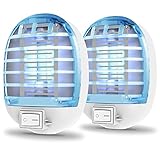
- Bug Zapper Indoor: Upgraded protective cover has ultra high light transmittance. It attracts bugs with emitting high-intensity light and can be placed indoors, such as balcony, bedroom, parlor, kitchen, bathroom, garage, etc
- Safely Bug Zappers: The narrow housing interval (less than 0.22 in) of mosquito zapper can effectively prevent fingers from high-voltage power grid by accident
- No Harm to Human & Pets: Made of high-quality material. Get rid of mosquitoes fast without sticky, messy poisons or sprays. Use natural physical method gets rid of flies. Great for places where pesticides can't be sprayed like kitchens and hospitals. Completely harmless to human and pets.Gnat traps for house indoor
- Easy to Clean: To clean dead mosquitoes, ensure the unit is unplugged from an electrical outlet and then use a screwdriver to touch the metal plate for static electricity release. Use the tissue or small brush to get the dead bugs out
- Easy to Use: Plug it in and wait. For better results, please put your fly traps in areas where flying insects are frequent activity(Est NO:99436-CHN-1)
Why the surrounding temperature matters
Thermal infrared is most useful when there is a temperature contrast between the target and its surroundings. The reported preference weakened when the background approached human skin temperature, because the warm target became less distinctive.
So infrared is not an always-on homing system that works equally well in every climate. A person may produce thermal radiation, but the mosquito still needs to distinguish that radiation from the background. Cooler surroundings can make the contrast more useful; a very warm environment can reduce it.
What “in the dark” really means
Turning off visible lights removes or reduces some visual information, but it does not remove the other signals produced by a human body.
In darkness, mosquitoes may still have access to:
- carbon dioxide from breathing;
- skin odor;
- thermal radiation from warm skin;
- air movement and humidity; and
- limited visual information, depending on how much ambient light remains.
“Dark” also does not necessarily mean absolute darkness. Human eyes may perceive a room as dark while an insect with a different visual system can still respond to low levels of light. But even in conditions where visible vision contributes little, the chemical and heat-related cues remain.
The Tool Desk
Outbyte PC Repair FREERepair Windows errors before they cause bigger problemsFix Now →Outbyte Driver Updater FREEScan for outdated or missing drivers - takes under a minuteDriver Scan →The defensible conclusion is therefore: visible darkness does not make a person chemically or thermally invisible to a mosquito. It does not mean the insect sees a sharp thermal image in the same way a thermal camera does.
Does this discovery change how you should prevent mosquito bites?
Not in the way some headlines suggest. The study did not test infrared-blocking clothing, thermal cameras, infrared goggles, or infrared emitters as consumer bite-prevention products. It provides no evidence that buying one of those products will hide you from mosquitoes.
Rank #4

- Refills Only — No Device Included: 20 replacement glue cards included.
- Compatible with raid light trap, for stem bug trap and wondercide flying insect trap.
- Note: If you have any questions, please don't hesitate to contact us. We will provide you with a satisfying solution.
- Long-Lasting: It is possible to use the refill cartridges for up to 14 days.
- Easy to Use: Just peel off the plastic cover before inserting them into the blue light trap.
The practical objective remains the same: reduce mosquito–human contact and use proven layers of protection.
Use a mosquito net when sleeping without screens
When you are sleeping outdoors or staying somewhere without reliable screens, a mosquito net for travel creates physical separation between you and the insect. It does not block the infrared radiation emitted by your body; it works by preventing the mosquito from reaching your skin. CDC guidance notes that permethrin-treated nets provide more protection than untreated nets, while the World Health Organization identifies insecticide-treated nets as an important mosquito-vector-control intervention.
Do these 3 things before closing this tab:
1Fix the driver behind crashes, sound loss and screen glitches2Repair Windows errors before they cause bigger problems3Scan for outdated or missing drivers - takes under a minuteUse the net as directed. Make sure it is large enough for the sleeping area, tucked or suspended so mosquitoes cannot easily enter, and free of holes. If it is treated, follow the label and care instructions rather than assuming that any net has insecticidal protection.
Add an EPA-registered repellent
For exposed skin, consider an EPA-registered DEET or picaridin mosquito repellent. These products reduce the likelihood of mosquito landing and biting; they do not disable the insect’s thermal-infrared sensing system. Follow the product label for concentration, application, reapplication, age restrictions, and whether it can be applied to clothing.
Repellent is one layer, not a reason to skip long sleeves, screened rooms, or a net when those measures are appropriate. Never apply repellent to a child’s hands, eyes, mouth, cuts, or irritated skin, and follow the specific label rather than relying on a generic rule.
Consider household or spatial-control products as supplementary measures
Spatial emanators, vaporizers, and mosquito-control devices may reduce biting activity in some settings, but their performance depends on the product, ventilation, outdoor conditions, mosquito species, and correct use. They should supplement—not automatically replace—physical barriers and skin-applied repellents. Check product registration, safety directions, and local availability before buying or using one around people or animals.
Quick wins for a faster PC:
Fix the driver behind crashes, sound loss and screen glitchesFind Drivers →Repair Windows errors before they cause bigger problemsFix Now →Scan for outdated or missing drivers - takes under a minuteDriver Scan →Best Value

- Powerful 20W UV Light Attraction: The 20W UV light attracts mosquitoes, flies, and gnats, while the 4200V grid eliminates them instantly for bite-free evenings
- Wide Coverage Area Up to 2,100 sq ft: Super-bright UV bulb provides protection for patios, porches, living rooms, and more during late-season outdoor activities
- Durable IPX4 Waterproof Design: Built to withstand rain and outdoor conditions, this bug zapper keeps working through various weather. Pull out the tray and use the bonus brush for easy cleaning
- Flexible Placement Options: 6.5 ft cord plus hanging hook allow you to hang it from a tree, porch, or set it on a table. Operates quietly for undisturbed sleep
- Safe for Kids & Pets: No sprays, no chemicals, no worries. Protective housing keeps curious hands and paws safe while running quietly all night
What the research does—and does not—show
| Claim | How accurate is it? |
|---|---|
| “Mosquitoes can see humans in the dark.” | Popularized and misleading. They can use thermal radiation and other nonvisual cues in darkness, but the study does not show detailed thermal vision. |
| “All mosquitoes use infrared to find people.” | Unsupported by this study. The experiments focused on female Aedes aegypti. |
| “Infrared alone guides mosquitoes to humans.” | Incorrect for the reported experiments. The strongest response occurred when infrared was combined with carbon dioxide and human odor. |
| “Mosquitoes detect a human from exactly 70 cm away.” | Too broad. More than 2.5 feet was observed under controlled laboratory conditions. |
| “An infrared-blocking product will prevent bites.” | Not demonstrated. The study examined sensory biology, not a consumer defense. |
| “A net defeats mosquito infrared detection.” | Not its mechanism. A net reduces contact by creating a barrier; treated nets can add insecticidal protection. |
The bottom line for a dark bedroom or campsite
Female Aedes aegypti mosquitoes can use thermal infrared from a warm target as one part of a multisensory host-seeking system. Their antenna-associated TRPA1 and opsin proteins appear to help detect the signal, while carbon dioxide and human odor provide essential context.
So the headline contains a real scientific result but overstates it. Mosquitoes are not necessarily viewing a detailed infrared portrait of you. They are combining breath, odor, visual information, and heat-related cues—and darkness removes only some of those clues.
Frequently Asked Questions
Do mosquitoes have thermal vision like a camera?
No. The study does not show that mosquitoes produce a detailed thermal image like a thermal camera. It found that thermal infrared is detected through sensory structures associated with the antennae and used as one host-seeking cue.
Can every mosquito detect humans through infrared?
Not necessarily. The reported experiments involved female Aedes aegypti, so the results should not automatically be applied to every mosquito species or to males.
Will blocking infrared stop mosquito bites?
No. Infrared-blocking clothing, infrared goggles, thermal cameras, and infrared emitters were not shown in this study to prevent bites. A net works by physically separating you from mosquitoes, not by blocking infrared.
Does a mosquito net block the heat mosquitoes detect?
A mosquito net is especially useful when sleeping outdoors or where screened rooms are unavailable. A properly treated net can provide additional insecticidal protection, but it should be used according to its label and care instructions.
The Bottom Line
Bottom line: Mosquitoes do not have miniature thermal cameras, but female Aedes aegypti can use heat radiation from warm targets alongside carbon dioxide and human odor. Turning off the lights will not make you invisible. Use physical barriers such as a correctly used mosquito net, plus an EPA-registered repellent when appropriate.
Quick Recap
Product prices and availability are accurate as of the date/time indicated and are subject to change. Any price and availability information displayed on Amazon at the time of purchase will apply.
Free tools Windows power users keep installed
One-click scans. No signup required.




