Windows Errors? Fix Them Before They Spread
Repair common Windows errors and clear accumulated junk for a smoother, more stable PC - no reinstall needed.Free scan · no reinstallCrashes, No Sound, or Screen Glitches?
Random freezes, missing sound and display glitches usually trace back to one bad driver. Find and replace yours safely.Free scan · under a minuteThere is no reliable universal scoop-per-tank amount for hatchery fish. Choose feed and delivery method for the species and life stage, estimate a starting ration from biomass when appropriate, then adjust it against feeding response, temperature, dissolved oxygen and the needs of the culture system. Larvae at first feeding need a different approach from juveniles or broodstock.
Start with the species, life stage and culture system
Before selecting a feed or schedule, identify the fish species and whether the stock is larval, fry, fingerling, juvenile, grow-out fish or broodstock. Also account for whether they are raised in ponds, flow-through tanks or a recirculating aquaculture system (RAS). Diets must suit the fish’s nutritional needs and digestive development, as well as its mouth gape and ability to consume the feed. The FAO’s sturgeon hatchery guidelines describe feeding as one of the main factors, alongside water quality and facility design, affecting rearing success.
A pond’s supplementary-feeding practice should not automatically be applied to a tank or RAS. Likewise, a feeding protocol for one species is not a general rule for all hatchery fish.
When do fish fry start eating?
Fry begin external feeding when development and yolk reserves make the transition appropriate; temperature affects how quickly development proceeds. There is no single number of days after hatching that applies to every species, so use a species-specific protocol and observe the fish.
Quick wins for a faster PC:
Fix the driver behind crashes, sound loss and screen glitchesFind Drivers →Clear out junk files and repair common Windows errorsFree Scan →Scan for outdated or missing drivers - takes under a minuteDriver Scan →#1 Best Overall

- Fish Food, Minnow Food, Floating Fish Pellet
A Russian sturgeon example—not a general schedule
NC State Extension’s Russian sturgeon larval-rearing guide gives first-feeding examples of about 7.5 days post-hatch at 21°C, 8 days at 19°C, 9.5 days at 17°C and 12 days at 15°C. Those figures describe Russian sturgeon under the guide’s protocol; they should not be used to time first feeding in other fish.
Choose a feed the fish can take and digest
Depending on species and stage, a hatchery may use live feed, enriched live feed, formulated microdiet or a transition involving more than one of these. Particle or prey size, nutritional suitability and how the feed is delivered all matter: a feed the fish cannot capture or accept will not meet its needs.
Rank #2
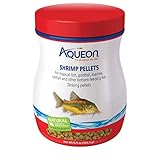
- Ideal for bottom dwelling fish
- Nutritious food ingredients that fish are naturally attracted to
- Formulated so that fish utilize more of what they eat and create less waste
- Supports a healthy immune system, brings out their true colors and provides the essentials for proper growth and vitality
- Will not cloud water when fed as directed
Larvae: manage the transition to formulated feed
Some larval protocols begin with live prey and introduce a formulated microdiet gradually. In its Russian sturgeon protocol, NC State Extension recommends introducing sinking microdiet during co-feeding and reducing live feed as acceptance improves. This is an example, not a prescription for other species or systems.
Artemia may be enriched before it is fed to larvae, but enrichment products differ in ingredients, nutritional profiles and instructions. Follow the procedure for the chosen product and the relevant hatchery protocol rather than assuming a common dose or method. Virginia Cooperative Extension and Virginia Sea Grant discuss these differences in Artemia Culture for Intensive Finfish and Crustacean Larviculture.
Rank #3

- Contains one (1) API BOTTOM FEEDER PELLETS WITH SQUID Fish Food 7.9-Ounce Container
- Includes optimal protein sources to support healthy fish and ideal growth
- Contains squid pellet, mussel, and seaweed for improved nutrition and great taste
- Formulated for easy digestion, leading to less toxic ammonia and cleaner, clearer water
- Feed as much as fish can consume in 30 minutes as bottom feeders have slower feeding habits
Larger fish: match the formulated feed to stock size and stage
For juveniles and larger fish, use a formulated or supplementary feed suited to the species, life stage and fish size. The correct feed form and ration still depend on the culture conditions and what the fish are actually consuming; a juvenile ration is not automatically suitable for broodstock or newly feeding larvae.
How much feed should I give my fish?
For stages and systems where biomass-based feeding applies, estimate the total weight of the stock and use the farm’s relevant feeding table or species-specific rate as a starting point. The daily feeding rate is commonly expressed as feed per day as a percentage of total fish biomass. It is not a universal percentage: adjust for fish size, natural food availability, stocking, feed quality, temperature and operating experience.
Rank #4

- 🐟 MUST HAVE: When looking for the very best for your fish
- 🐟FLOATING: Perfect for any pond, lake, or large aquarium fish
- 🐟COMPLETE: Packed with protein and all the essential minerals and vitamins
- 🐟 WHAT YOU GET: Clear package of 2 pounds of clean premium floating fish food
- 🐟 WE MAKE IT RIGHT: Not only can you rest assured that all of our products are covered by Amazon’s Return Policy, on the Farm, we will always stand by our products
The FAO’s supplementary-feed guidance illustrates the calculation with a 2.5% daily rate and 80 kg of fish biomass: 80 kg × 0.025 = 2.0 kg of feed per day. This is a worked example showing how to calculate a quantity from an assumed rate, not a recommended rate for an unspecified hatchery.
- Estimate biomass: use current stock numbers and representative fish weights, accounting for mortalities or transfers.
- Find the applicable rate: use a feeding table or protocol for the species, size, life stage and system—not a rate borrowed from an unrelated operation.
- Calculate the starting quantity: multiply estimated biomass by the rate expressed as a decimal. For example, a 2.5% rate is 0.025.
- Review and adjust: compare the amount offered with feeding response, growth, temperature and water conditions, then document changes.
Watch feeding response and water quality together
Observe whether fish are actively taking the feed and whether uneaten feed remains. Review those observations alongside fish size or biomass, temperature and dissolved oxygen. An apparent appetite change is a reason to check stock and conditions before increasing the ration.
Recommended Free Tools
Best Value

- Bottom feeder fish food that contains up to 40%, nutrient-rich Black Soldier Fly Larvae, the first ingredient
- High in multiple proteins like whole salmon – rich in Omega 3 and 6 for healthy skin, scales and fins
- Fortified with essential vitamins, amino acids and minerals for a balanced daily diet
- Sinking granule format (1.4-1.6mm) – ideal for bottom feeders; feed as much as fish can eat in two minutes, two or three times daily
- Sustainably processed in small batches for quality control and maximum freshness
In RAS, feed quantity and composition affect water-quality load, and uneaten feed adds to the management burden. Keep ration decisions within the facility’s species- and system-specific water-management limits. UF/IFAS explains dissolved oxygen’s role in fish production and describes an electronic oxygen meter or a chemical test kit as monitoring options in its dissolved-oxygen guide.
Set feeding times for the species and system
Feeding frequency and timing depend on the fish, life stage and facility protocol; the sources do not establish one schedule for every hatchery. Larval feeding and RAS schedules should follow the applicable species- and system-specific procedure.
For pond operations specifically, Virginia Cooperative Extension’s good aquaculture practices overview advises feeding in the morning after dissolved oxygen starts rising. If feeding twice daily in that context, it recommends placing the second feeding at least three hours before sunset. This is pond-oriented guidance, not a blanket schedule for tanks or RAS.
Store feed correctly and keep useful records
Store feed in a cool, dry place and rotate stock using first-in, first-out, as recommended in the Victorian Fisheries Authority’s RAS environmental-management guidelines. Keep the feed manufacturer’s handling instructions available, particularly where live-feed enrichment or other protocol-specific preparation is involved.
Maintain records that make ration changes explainable and repeatable. FAO recommends accurate records and adjusting feeding to actual stock and conditions. A practical log can include:
Quick Recap
- Species, stage, stock estimate and representative fish size or biomass.
- Feed type, form and amount offered, with dates and times.
- Temperature and dissolved-oxygen observations, plus other water checks required by the facility.
- Feeding response, uneaten feed, growth observations and any ration adjustment.
Product prices and availability are accurate as of the date/time indicated and are subject to change. Any price and availability information displayed on Amazon at the time of purchase will apply.




