Fish regulate swim-bladder gas in two main ways. Physostomous fish retain a pneumatic duct linking the bladder to the gut, so gas can often enter or leave through the digestive tract. Physoclistous fish lack a functional open duct; they secrete gas from the blood through a gas gland and remove it through specialized resorptive tissue. In both groups, water pressure changes bladder volume immediately, while biological gas transfer takes longer.
What the swim bladder does
A swim bladder is a gas-filled cavity that lowers a fish’s overall density. Increasing its gas volume generally increases buoyant force; removing gas decreases it. The organ is flexible, so surrounding water pressure also changes its size directly: pressure compresses the gas during descent, while falling pressure lets it expand during ascent.
This gives a fish a way to approach neutral buoyancy at a particular depth, reducing the effort needed to remain there. It does not provide an instant depth-control system, because moving gas into or out of the bladder is limited by blood flow and gas-transport capacity.
The two systems fish use to add and remove gas
| Type of fish | How gas enters | How gas leaves | Main anatomical route |
|---|---|---|---|
| Physostomous | Many species gulp air at the surface; air can pass through a pneumatic duct into the bladder. | Some can release gas back through the duct and digestive tract. | Bladder connected to the gut by a pneumatic duct. |
| Physoclistous | A gas gland moves gas from the blood into the bladder. | Specialized resorptive tissue absorbs gas back into the blood; an oval region serves this role in some species. | No functional open gut connection; blood-mediated secretion and resorption. |
The exact importance of each route varies by species. Not every fish with a bladder uses the same filling or emptying method.
Quick wins for a faster PC:
Scan for outdated or missing drivers - takes under a minuteDriver Scan →Repair Windows errors before they cause bigger problemsFix Now →#1 Best Overall
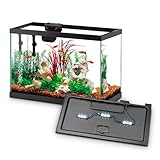
- PERFECT FOR BEGINNERS AND SEASONED AQUATIC HOBBYISTS: User-friendly setup designed for quick aquarium assembly and maintenance.
- COMPLETE STARTER KIT: Includes a 10-gallon glass rectangle aquarium, low profile hood with cool white LED lighting and feeding door, SmartClean filtration, EcoRenew cartridge, preset heater 50W, thermometer, fish net, premium fish food and a water conditioner.
- SIMPLE MAINTENANCE: SmartClean internal power filter provides quick and easy water changes to help improve water quality.
- IDEAL TEMPERATURE: Preset heater keeps your aquarium temperature at a constant 78 degrees, appropriate for most tropical fish.
- DURABLE GLASS CONSTRUCTION: Ensures clarity and durability, providing a safe environment for your fish. Made from high-quality materials for long-lasting use.
Physostomous regulation: the duct-to-gut route
In physostomous fish, the pneumatic duct remains between the swim bladder and gut. Many species reach the surface and gulp air, which can travel through this duct into the bladder. Depending on the species, the same route can permit gas release. This arrangement is especially useful for relatively rapid access to atmospheric air, but it requires the fish to reach the surface or otherwise use the digestive connection.
Physoclistous regulation: secretion from blood
Physoclistous fish regulate gas internally. Cells in the gas gland acidify nearby blood. This triggers the Root effect in fish hemoglobin, causing hemoglobin to release oxygen and raising local gas partial pressures. Gas then diffuses from the blood into the swim bladder.
The gas gland is supported by the rete mirabile, a close arrangement of incoming and outgoing capillaries. Countercurrent exchange concentrates gases and helps maintain the pressure gradient needed to move gas into the bladder, including at substantial depth. A review of fish swim-bladder gas exchange reports partial pressures reaching several hundred atmospheres in some deep-sea dwellers; that is an extreme reported value, not a typical pressure for all fish (Scheid, Pelster and Kobayashi, 1990).
How gas is removed
To reduce buoyancy, gas must leave the bladder. Specialized resorptive tissue takes gas into the blood. In some species this tissue is concentrated in an area called the oval, with its own blood supply. The absorbed gases are then carried away through the circulation. Physoclists therefore do not simply “let air out” through the mouth; their primary emptying route is internal resorption.
Windows Errors? Fix Them Before They Spread
Repair common Windows errors and clear accumulated junk for a smoother, more stable PC - no reinstall needed.Free scan · no reinstallCrashes, No Sound, or Screen Glitches?
Random freezes, missing sound and display glitches usually trace back to one bad driver. Find and replace yours safely.Free scan · under a minuteRank #2

- Compact: Dimension: 7.9"x5.9"x5.9"; 1 Gallon tank; ideal for small spaces, aquarium beginners caring for a single betta, a few shrimp, snails, or a tiny goldfish. Also works as a temporary hospital tank, quarantine tank, or desktop decor (After deducting the filter part, the actual usable volume is approximately 0.8 gal and it will further decrease after adding substrate)
- Customizable Lighting: features a 3-color LED hood with 10 adjustable brightness levels to showcase your fish and tank décor
- Self-Cleaning Filtration: Hidden filter keeps tank clean for easier maintenance. Note: Clean filter sponge and pump regularly to avoid clogging; regular water changes are required — this small tank does not support zero-maintenance use
- Thoughtful Design: its top feeding hole allows for easy feeding without removing the lid; four silicone feet for stability and quiet operation
- Complete Starter Kit: 1x 1 gallon Fish Tank, 1x Filter Sponge, 1x Adjustable Water Pump, 1x LED Hood (Note: The light requires a power transformer (not included) for use. Compatible transformers include 5V 0.5A, 5V 1A, 5V 1.5A, and 5V 2A)
What happens when a fish changes depth
Water pressure rises by approximately one atmosphere for every 10 metres of water. In the idealized example discussed by Pelster (2021), pressure at 10 metres is about two atmospheres absolute, and a gas cavity would be compressed to roughly half its surface volume under the corresponding gas-law comparison (Pelster, 2021). These are physical approximations; actual bladder behavior depends on the fish, its tissues and its rate of movement.
During descent
Increasing pressure compresses the bladder, reducing its volume and buoyant effect. A fish may therefore become negatively buoyant while descending. A physoclist can begin secreting gas through the gas gland, but secretion is not instantaneous. A physostome may need access to the surface to gulp more air, so it also cannot necessarily restore volume while it remains deep.
During ascent
Lower pressure allows the existing gas to expand, increasing bladder volume and buoyancy. The fish may need to remove gas through its duct or resorptive tissue. Resorption also takes time, so a rapid ascent can leave the bladder temporarily overexpanded.
Why swimming still matters
A 2021 review concludes that bladder secretion and resorption cannot fully compensate for rapid vertical movement. Fish can use hydrodynamic lift generated by their fins and body while changing depth, rather than relying on the bladder alone. Neutral buoyancy is therefore most realistic when a fish is holding a relatively steady depth, not during a fast ascent or descent (Pelster, 2021).
Rank #3
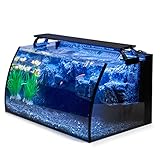
- 【hygger Aquarium Kit Includes】a 7W 110GPH internal power filter pump, a colored led aquarium light, a 8 gallon glass tank with a decorative 3D rockery mountain background. The 3D background makes the whole aquarium looks cool like a dream word underwater, is a great rest, play spot, shelters for little fish. Also you can plant some green grass on the rockery mountain.
- 【Mutil-modes LED Light】The aquarium led light is DC12V/18W, with extendable brackets, length can be adjusted from 0 to 19 inch. It has a external digital controller, you can use it to set the lighting time to 3, 6 or 12 hours, to adjust the light brightness from 100% to 10%, 5 levels of brightness in total, to shift the light modes: White LEDS, Blue+white+red LEDS, Red+ blue LEDS.
- 【Durable Power Filter】The aquarium power filter is 7W 110GPH, for 2-8 gallon tank use. It's a super quiet and durable filter, and can be use for low water, the upper part is the 2 stage filtration system, the bottom part is water pumping systerm to pump the water upward. Please NOTE this filter may be too strong for small fish that is not long than 2 inch, may suck small fish, if you keep small in the tank, please don't run the filter or don't run it all the time
- 【New View Curved Tank】Tank size: 19" L x 11.8" W x 9.6" H. This glass fish tank has a unique convex arc curve shape, can widen your view on the aquarium, and can hold more capacity of water. The total tank volume is 8 gallon, it can hold 6 gallon of water, because the tank has a undetachable 3D background decor. When it holds full water, the whole tank weighs about 68 pounds.
- 【Multi-protection Packing】We used 3 layers of packing to pack the aquarium kit and with light lifting label, the innermost layers is a super sturdy poly foam with excellent cushion. We have done the shipping test by sending 3 of the packs to 3 different distance places and find the glass tanks are still in good condition when received. So don't worry the tank will not be broken during the shipping, if you find tank broken when open the package, please take a photo and send it to the seller.
Can fish control their buoyancy without swimming?
At a stable depth, a properly adjusted bladder can offset much of a fish’s weight, allowing it to hover with little active thrust. Even then, the fish may make small fin or body movements to correct for currents, posture and changes in pressure. During rapid movement, swimming-generated lift provides the faster response while gas regulation catches up.
Do all fish have the same swim-bladder functions?
No. Most bony fishes have a swim bladder, but the organ is not universal among fish, and its uses differ among species. Besides buoyancy, some swim bladders contribute to respiration, particularly in certain surface-dwelling or shallow-water fishes. Others help produce or amplify sounds. These additional roles should not be generalized to every species (Springer Nature, “Fishes”; Pelster, 2021).
How fish “let air out” of a swim bladder
The answer depends on the anatomical type:
- Physostomous fish: gas may travel out through the pneumatic duct and into the gut, with the exact release behavior varying by species.
- Physoclistous fish: gas is absorbed through the oval or other resorptive tissue into the bloodstream, rather than expelled through an open gut connection.
Because these processes are not instantaneous, a fish brought rapidly toward the surface can experience bladder expansion before enough gas has been removed.
Quick Recap
Key points to remember
- The bladder changes whole-body density by storing gas.
- Physostomes use a gut-connected pneumatic duct; many fill the bladder by gulping surface air.
- Physoclists use a gas gland, Root-effect hemoglobin chemistry and the rete mirabile to secrete gas from blood.
- An oval or comparable resorptive tissue removes gas in many physoclists.
- Pressure changes bladder volume immediately, but secretion and resorption are slower.
- Some species also use the bladder for respiration or sound production.
Product prices and availability are accurate as of the date/time indicated and are subject to change. Any price and availability information displayed on Amazon at the time of purchase will apply.
Free tools Windows power users keep installed
One-click scans. No signup required.




