No. Salmon are not permanent deep-sea fish. They are anadromous: they hatch in freshwater, migrate through estuaries to coastal and open-ocean habitat to feed and mature, then return to freshwater—usually their natal river—to spawn.
Where salmon live at each stage
A salmon’s habitat changes dramatically during its life. Eggs and young fish require cool, clean, flowing freshwater. Juveniles then adapt to seawater and spend a major growth phase in marine habitat before migrating back upstream.
- Freshwater rivers and streams: spawning, egg incubation, and juvenile growth.
- Estuaries and coastal waters: the transition zone where smolts adjust to saltwater.
- Open ocean: feeding, growth, and maturation.
- Freshwater again: the adult return migration and spawning.
Do salmon live in the deep sea?
“Ocean fish” does not automatically mean “deep-ocean fish.” Salmon use coastal and open-ocean waters, but the cited NOAA descriptions do not establish one universal depth range for all salmon. Depth, route, timing, and habitat use vary among species and individual stocks.
For example, Atlantic salmon from Maine may travel through the Gulf of Maine, across the Scotian Shelf and Labrador Sea, and toward coastal waters around Greenland. That is a long marine migration, but it is not evidence that every salmon lives in the deep sea.
#1 Best Overall

- Ocean Run Salmon, Bass, Steelhead, Coho, Silver Salmon, Humpy, Pink Salmon, King Salmon, Chinook, Sockeye
- 42-inch and 40-lb leader optimized to troll for king salmon
- 4.7 Inches/12cm UV Coated
- Double Snell Hook, chemical polish, super sharp
- Gill squid skirt to increase attraction
Marine habitat must supply abundant prey, suitable cold temperatures, and good water quality. Conditions can change as salmon move between coastal feeding areas and broader ocean routes.
The salmon life cycle, step by step
1. Spawning and eggs
Mature adults return to freshwater. A female excavates a gravel nest called a redd, releases eggs, and covers them with gravel after fertilization. Atlantic salmon females lay an average of about 7,500 eggs, according to NOAA Fisheries (2026). That figure is Atlantic-specific, not a value for every salmon species.
2. Alevins in the gravel
Hatched salmon are called alevins. They remain protected among the gravel while absorbing nutrients from their attached yolk sac.
Rank #2

- 【Maximize Your Catches with Bright Lures】 upgraded 16PCs fishing lure kit features over 5 different sizes (2.2" - 2.6") and weights (0.11- 0.18 oz) , specifically designed to catch a variety of fish. Anglers can choose the ideal lure for various fish species & water conditions, enhancing your fishing success.
- 【Realistic Mimic Spin Action】 With a precision-engineered rotatable blade and hard-metal clevis, these bass lures offer instant spinning and constant flash to imitate natural swimming action, even in the slowest waters. Easily attract fish in both freshwater and saltwater environments.
- 【Wide Range of Fishing Species】 Ideal for catching a variety of predator fish like Bass, Trout, Walleye, Salmon, Musky, Pike, Big Blue Gill, Perch, Crappie, Pan fish. Those swimming fishing lures baits are perfect for both freshwater and saltwater fishing.
- 【Top-Quality Lures with Easy-Carry Case】Boost your catch rate with our Maufriu trout fishing lures, featuring ultra-sharp treble hooks, realistic rooster tails, and premium brass bodies for effective action at any retrieval speed The compact, waterproof tackle case keeps your gear organized and restock, perfect for anglers who value convenience & efficiency on the go.
- 【Ideal Gift for Fishing Enthusiasts】This versatile spinner bait kits is perfect for any angler, from beginners to experts. It’s a great choice for Christmas, Thanksgiving, Father’s Day, birthdays, and more—encouraging unforgettable fishing adventures for all ages.
3. Fry emerge and feed
Once the yolk sac is used, young salmon emerge as fry and begin catching food. They remain in freshwater, where temperature, flow, cover, and food availability influence survival.
4. Parr grow in rivers
As juveniles develop characteristic markings, they are often called parr. Atlantic salmon parr in Maine commonly spend two to three years in rivers. Pacific salmon freshwater residence can range from a few months to several years, depending on the species and stock.
5. Smoltification prepares them for saltwater
Before leaving the river, juveniles undergo smoltification—a set of physiological and behavioral changes that enables them to regulate salt and water in a marine environment. The resulting smolts migrate downstream through an estuary and into the sea.
Rank #3
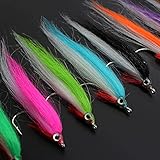
- Vibrant Color Selection: Available in 10 attractive colors including Brown, Green, Light green, Orange, Purple, Yellow, Red, Blue, Black, and Hot Pink
- Hook Specifications: Features 1/0 size high carbon hooks with a hook length of approximately 1.5 inches (4cm)
- Overall Fly Length: Each fly measures approximately 4.5 inches (11cm) in total length
- Lightweight Design: Each fly weighs approximately 0.04oz(1.1g), allowing for smooth casting and natural presentation in the water
- Complete Set Quantity: Includes 20 pieces total with 10 different colors, 2 pieces of each color per set
6. Ocean feeding and maturation
The ocean phase is primarily for feeding, growth, and sexual maturation. NOAA’s cited figures place Atlantic salmon’s typical sea period at one to three years, while Pacific salmon may spend about one to six years in the ocean. These are species- and stock-dependent ranges, not a single timetable.
7. Return to freshwater and spawn
Adults use environmental cues and learned migration behavior to return to their home watershed. “Natal” means the place where a fish was born; many salmon return to that natal freshwater habitat, although exact migration patterns differ among populations.
Do these 3 things before closing this tab:
1Clear out junk files and repair common Windows errors2Scan for outdated or missing drivers - takes under a minute3Repair Windows errors before they cause bigger problemsAtlantic and Pacific salmon are not identical
| Feature | Atlantic salmon | Pacific salmon |
|---|---|---|
| Marine region | North Atlantic routes, including waters toward Greenland | Pacific coastal and open-ocean routes that vary by species and stock |
| Freshwater period | Maine parr commonly spend 2–3 years in rivers | From a few months to several years, depending on stock |
| Ocean period | Commonly 1–3 years at sea | About 1–6 years in the cited NOAA life-cycle guide |
| After spawning | Some survive and spawn again, but repeat spawners are increasingly uncommon | Most die after spawning; steelhead is an important exception |
Why salmon need a connected river-to-ocean habitat
Salmon cannot complete their life cycle if any essential link is blocked. Dams and poorly designed culverts can prevent adults from reaching spawning grounds or juveniles from reaching the sea. Other pressures include degraded freshwater habitat and water quality, warming and changing ocean conditions, disease, predation, and changes in the abundance or distribution of prey.
Rank #4
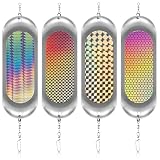
- Salmon Flasher Length: 6 inch, 360 degree rotating churning motion creates interesting irregular action and flash, attracting larger fish such as Chinook salmon and lake trout
- Cute and Fun: kokanee dodger wiggles from side to side as it swims, making the movements of spoons, flies and lures more lively
- Widely Use: deep water use with spoons, plugs and lures to attract salmon, halibut, lake trout and other species
- Accessories: fishing flashers comes with a sturdy welded ring, brass eyelet, Metal ball bearing swivel for smooth action
- Sufficient Quantity: you will receive 4 pcs salmon flash light, sufficient quantity to meet your daily replacement needs
Protecting salmon therefore requires more than safeguarding a single river. Effective conservation connects spawning gravel, juvenile habitat, estuaries, coastal waters, and offshore feeding areas while maintaining passage between them.
Independent reader supportYour contribution helps us test, update, and keep practical guides available for everyone.Common questions about salmon habitat
Are salmon freshwater or saltwater fish?
They use both. Salmon begin life in freshwater, spend their growth phase in the ocean, and return to freshwater to reproduce.
Where do salmon go in the ocean?
They move through estuaries into coastal and open-ocean feeding areas. The route depends on species, stock, season, and ocean conditions; there is no single route shared by all salmon.
PC Slower Than It Used to Be?
A free scan shows the junk files, broken settings and background clutter dragging Windows down - then fixes them in one click.Free scan · Windows 10 & 11Outdated Drivers Are Slowing You Down
One free scan finds every outdated or missing driver and matches the right update for your exact hardware.Free scan · exact hardware matchBest Value

- 2026 New Release Fishing Spinners Set:The Fishing Spinner is FONMANG 2026 new release fishing lures, featuring different sizes and weights, beautiful colors, unique spinners, and a portable tackle box.
- Multiple Weights for More Fish:1/8 oz (3.5g) for panfish, bluegill, and small trout; 1/6 oz (4.5g) for trout and bass; 1/4 oz (7g) for larger trout, bass, pike, salmon, and steelhead.
- Flash and Vibration Attraction:Providing spinnerbait ideal combination of flash and vibration to trigger strikes in both clear and murky waters.
- Premium Components Performance:Made using the best possible components, featuring a premium blade, top-of-the-line clevis for smooth running, and a reliable treble hook.
- Great for All Anglers & Gifts:Perfect for beginners and professionals, rooster tail fishing lures help catch more fish in rivers and lakes and make a great fishing gift.
Do salmon return to the river where they were born?
Adults generally return to their natal river or watershed to spawn. The strength of this homing behavior and the exact destination vary among populations.
How long do salmon live in the ocean?
Atlantic salmon commonly spend one to three years at sea, while Pacific salmon may spend roughly one to six years. Those ranges should not be applied to every species or stock.
Do all salmon die after spawning?
No. Most Pacific salmon die after spawning, whereas some Atlantic salmon survive to spawn again. Repeat spawning among Atlantic salmon is uncommon, and steelhead is a Pacific salmon relative that can also survive spawning.
Quick Recap
Product prices and availability are accurate as of the date/time indicated and are subject to change. Any price and availability information displayed on Amazon at the time of purchase will apply.
What’s actually slowing this PC down?
Pick the symptom - the matching free tool is one click away.