Do these 3 things before closing this tab:
1Repair Windows errors before they cause bigger problems2Scan for outdated or missing drivers - takes under a minute3Clear out junk files and repair common Windows errorsDesign a tropical fish tank around the adult size, social needs and water requirements of the fish—not around a decorative layout or a simple “fish per gallon” formula. Choose a stable tank and stand, install dependable heating and biological filtration, dechlorinate the water, complete a fishless cycle, and add compatible fish gradually only after ammonia and nitrite return to zero.
Start with the fish, not the shopping list
Write a livestock plan before buying equipment. For every proposed species, check its adult length, preferred temperature and pH, swimming level, schooling or territorial behavior, diet, and breeding potential. A peaceful community is not automatically suitable: fish that need groups, fish that defend a territory, and fish that require different water chemistry may all need separate designs.
Size the aquarium for adult fish and their activity. A rough RSPCA UK guide is 1.5–2 litres of water per 1 cm of tropical fish length, but it is only a starting point. Body shape, waste production, activity, shoaling requirements, filtration, footprint and compatibility can make a larger aquarium necessary. Never use the rule to justify keeping incompatible species together.
Choose a tank and location
Tank volume and footprint
More volume generally gives temperature and water chemistry more stability. RSPCA Knowledgebase guidance gives 50 litres as a minimum tank volume for tropical fish. RSPCA UK advises choosing a tank larger than about 45 × 30 × 30 cm (roughly 40 litres) and sizing it for the adult fish. Treat those figures as welfare floors, not an ideal target for every community.
#1 Best Overall
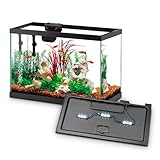
- PERFECT FOR BEGINNERS AND SEASONED AQUATIC HOBBYISTS: User-friendly setup designed for quick aquarium assembly and maintenance.
- COMPLETE STARTER KIT: Includes a 10-gallon glass rectangle aquarium, low profile hood with cool white LED lighting and feeding door, SmartClean filtration, EcoRenew cartridge, preset heater 50W, thermometer, fish net, premium fish food and a water conditioner.
- SIMPLE MAINTENANCE: SmartClean internal power filter provides quick and easy water changes to help improve water quality.
- IDEAL TEMPERATURE: Preset heater keeps your aquarium temperature at a constant 78 degrees, appropriate for most tropical fish.
- DURABLE GLASS CONSTRUCTION: Ensures clarity and durability, providing a safe environment for your fish. Made from high-quality materials for long-lasting use.
Compare the footprint as well as litres. Long tanks provide more horizontal swimming room; taller tanks provide height but can offer less usable surface area and are harder to maintain. Leave enough clearance above the aquarium to service the filter and heater.
Stand, floor and surroundings
- Use a purpose-built, level stand that supports the entire base; do not substitute a shelf or furniture that can flex under the load.
- Place the aquarium away from direct sun, radiators, heating vents and doors that are frequently bumped.
- Locate it near a safe electrical outlet and a water source, while keeping plugs and power strips higher than drip points.
- Allow room behind and above the tank for hoses, cables, feeding and maintenance.
Before adding substrate or livestock, fill the tank with water and check for leaks on a level surface. A filled aquarium is extremely heavy, so decide its final position first.
Equipment checklist
| Equipment | Design requirement | What to verify |
|---|---|---|
| Tank and stand | Volume and footprint suit adult fish and the room | Level, fully supported base; no leaks |
| Filter | Provides mechanical and biological filtration for the planned bioload | Adjustable or diffused flow for delicate fish; space for mature media |
| Submersible heater | Thermostatically controlled and rated for the tank and room | Choose wattage from the temperature rise required and the aquarium’s conditions; use a guard where fish may contact it |
| Thermometer | Independent temperature check | Read it daily during setup and after water changes |
| Lid or cover | Limits evaporation and prevents jumping | Leaves safe openings for equipment cables |
| Light | Supports the viewing schedule and selected plants | Use a timer; intensity and duration should match the plants to limit algae |
| Water conditioner | Removes chlorine and chloramine from tap water | Dose for the full volume of new water |
| Test kit | Measures ammonia, nitrite, nitrate and pH | Use it throughout cycling and after stocking |
| Gravel siphon and buckets | Enables controlled water changes and debris removal | Reserve equipment for aquarium use and avoid soap residues |
A submersible aquarium heater is the reliable way to maintain a constant tropical temperature; RSPCA Knowledgebase describes it as the only way to achieve and maintain an appropriate constant temperature for tropical fish. Use a thermometer rather than trusting the heater’s dial. Heater wattage cannot be specified safely without knowing the tank volume, room temperature, cover and required temperature rise.
Build the aquarium in a safe sequence
- Prepare the empty tank. Put it on the final, level stand and inspect seams. Rinse the aquarium and equipment with water only; never use household cleaners.
- Add the substrate. Rinse gravel or sand until the rinse water is mostly clear. Slope it slightly toward the front if that makes debris easier to see and siphon.
- Install hardscape. Use aquarium-safe rocks and wood. Set heavy items on the tank base or firmly into the substrate so they cannot topple. Avoid sharp edges and leave open routes for swimming.
- Add the filter, heater and thermometer. Follow the manufacturer’s water-level and placement instructions. Keep a heater submerged to its marked minimum and provide circulation around it. Fit the lid and light, then secure cables with drip loops.
- Add plants. Choose species compatible with the planned light and fish. Live plants create cover and can consume some nitrogen compounds, but they do not replace filtration, testing or water changes.
- Fill with treated water. Add room-temperature tap water and dose dechlorinator according to the product label. Chlorine and chloramine can injure fish and beneficial bacteria. Pour onto a dish or plastic bag to avoid disturbing the substrate.
- Check operation. Confirm the filter is moving water, the heater is heating, the thermometer is readable and there are no leaks. Let temperature stabilize before beginning the cycle.
Fishless-cycle the filter before stocking
Beneficial nitrifying bacteria need time to colonize filter media. RSPCA UK strongly advises fishless cycling for new aquariums. Run the filter continuously and provide an ammonia source intended for aquarium cycling, following its instructions rather than adding fish to “start” the process.
Recommended Free Tools
Rank #2

- FUN and REWARDING: Are you looking to buy an aquarium for your children? If you are, you are going to want to look at this fish tank. Owning an aquarium can be a really fun and rewarding experience and an ideal way to teach your child the responsibility of pet ownership
- Dazzling Colors: This energy-efficient LED lighting features 30 LEDs and offers multiple modes—white, warm, blue, and white-blue mix. Easily switch modes with a touch of a button. It includes a timer (2/4/8 hours) and memory function for personalized settings
- COMPLETE FILTRATION: Powerful internal power filter cleans and purifies aquarium water at a flow rate of 45 gallons per hour effectively removing organic pollutants including discolorations, odors, heavy metals, and toxic gases. Uses Koller Products S replacement filter cartridges (B086ZM4PYG)
- OPTIMUM VIEWING: Crystal-clear clarity so good that most think it's glass. Made of impact-resistant plastic providing leak-proof assurance, unlike glass tanks glued together with silicone, this one-piece tank puts to rest any worries or concerns about possible leaks
- TRENDY DESIGN: Unique shape allows viewing from multiple angles anywhere in the room
Test ammonia and nitrite every other day or every two to three days during startup. A cycle is progressing when ammonia is processed to nitrite and then nitrate. Do not add fish after a single low reading: wait until a measurable ammonia and nitrite rise has returned to zero. Cycling takes at least two weeks and has no fixed maximum duration; new tanks can take longer depending on temperature, pH, media and the ammonia source.
Before stocking, perform any water change needed to bring nitrate and other readings into your planned range, then retest. Keep the filter running throughout. If ammonia or nitrite appears after fish are added, stop adding livestock and use partial water changes while investigating the cause.
Set target conditions before fish arrive
| Parameter | General tropical-freshwater target | Qualification |
|---|---|---|
| Temperature | 24–26°C | RSPCA Knowledgebase, 2024; individual species may require a narrower range |
| Ammonia | Below 0.1 ppm | RSPCA Knowledgebase, 2024; any detectable rise after stocking warrants action |
| Nitrite | Below 0.2 ppm | RSPCA Knowledgebase, 2024; RSPCA UK says ammonia and nitrite should return to 0 mg/L before fish are added |
| Nitrate | Below 50 ppm | RSPCA Knowledgebase, 2024; lower is preferable for sensitive species |
| pH | 6.5–7.5 | RSPCA Knowledgebase, 2024; match the selected species and avoid abrupt changes |
These are general guidance ranges, not a license to force every fish into one chemistry. Stable water that suits the chosen species is safer than repeatedly altering pH to chase a number.
Design the interior around behavior
Cover and territories
Combine open swimming lanes with plants, wood, caves or other stable cover. Arrange sight breaks so a subordinate fish can leave the view of a territorial fish. Keep the filter intake screened and leave access to the substrate and equipment for cleaning.
Rank #3
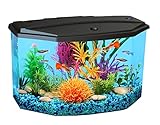
- POWERFUL FILTRATION - The built-in filter cleans and purifies aquarium water at a flow rate of 25 gallons per hour, helping maintain a cleaner, healthier environment for your fish. Compatible with SW PRODUCTS/Koller Products XS filter cartridges
- 4 ADJUSTABLE LED LIGHTING MODES - Enhance your viewing experience with four lighting options: daylight white, warm white, blue light, and blue-white light. Easily choose the lighting that best suits your aquarium and fish
- CONVENIENT TIMER - Set the LED light to run for 2, 4, or 8 hours, and it will automatically turn on at the same time the next day, creating a consistent lighting cycle without daily manual adjustments
- QUIET OPERATION - Operating at less than 35 dB, the aquarium provides quiet filtration for a peaceful environment at home or in the office
- DURABLE & COMPACT DESIGN - Made from impact-resistant plastic with a crystal-clear finish, this 3-gallon fish tank measures 14.75" L x 10.25" W x 9.50" H and fits easily on desks, cabinets, and office surfaces
Substrate and décor safety
- Use inert, aquarium-safe materials unless you deliberately need a substrate that changes water chemistry.
- Choose a grain size that will not be swallowed by bottom-feeders and that allows waste to be siphoned.
- Boil or otherwise prepare décor only when the material’s manufacturer or an experienced aquarist confirms that method is safe; some rocks and woods can crack or release unwanted substances.
- Do not overcrowd the layout: maintenance access is part of the design.
Add fish gradually and monitor the biological load
- Quarantine when practical. A separate, cycled quarantine aquarium reduces the chance of introducing disease to the display tank.
- Acclimate carefully. Match temperature, then follow the seller’s or species specialist’s acclimation guidance. Avoid adding transport water to the display aquarium.
- Add a small first group. Introduce only part of the final stocking plan, especially in a newly cycled tank.
- Observe and test. Check behavior, temperature, ammonia and nitrite over the following days. Wait for stable readings before adding another group.
- Recalculate after growth. The aquarium must continue to suit adult size, not just the size at purchase.
Schooling fish generally need an appropriate group, while territorial species may need separate territories or a different aquarium entirely. If compatibility is uncertain, choose fewer species and more space rather than adding fish and hoping behavior improves.
Weekly maintenance that preserves stability
- Perform a 10–25% partial water change each week, the range given by RSPCA Knowledgebase (2024), adjusting frequency for stocking, feeding and test results.
- Treat replacement water with dechlorinator and bring it close to the aquarium’s temperature before adding it.
- Siphon loose debris from the substrate without stripping every surface clean.
- Test ammonia, nitrite, nitrate and pH routinely; clear water does not prove that chemistry is safe.
- Rinse clogged filter media gently in removed aquarium water. Never rinse biological media under chlorinated tap water, which can damage the bacterial colony.
- Clean algae from viewing panels, inspect the heater and filter, and check that the lid and cables remain secure.
Diagnose common design and setup problems
Temperature fluctuates
Check the independent thermometer, heater submersion and room drafts. Confirm that the heater is correctly rated for the tank and required temperature rise. A cover and better circulation can reduce heat loss, but replace a faulty heater rather than repeatedly changing its setting.
Ammonia or nitrite is detectable
Do not add more fish. Verify the test method, perform a conditioned partial water change, remove uneaten food and dead material, and confirm that the filter is running. Re-test until readings return to the safe, established range.
Fish hide, chase or fight
Check group size, territory, décor and species compatibility. Add sight breaks only if they do not reduce swimming room or maintenance access. Be prepared to separate or rehome an incompatible fish; changing the layout cannot overcome every behavioral mismatch.
Free tools Windows power users keep installed
One-click scans. No signup required.
Persistent cloudy water or algae
Review the cycle, feeding, light duration, stocking and filter maintenance. Avoid cleaning all surfaces or replacing all media at once, because that can remove the bacteria the aquarium depends on. Test rather than judging safety by appearance.
Quick Recap
Product prices and availability are accurate as of the date/time indicated and are subject to change. Any price and availability information displayed on Amazon at the time of purchase will apply.




