Free tools Windows power users keep installed
One-click scans. No signup required.
For most healthy adult aquarium fish, start with one small feeding a day and offer only what the fish can eat within a few minutes. Remove anything left over and make the next portion smaller. Species, age, temperature, food type and tank competition can all change that starting point.
The simplest portion rule
Put in a small amount, watch the entire feeding and stop when the fish have eaten for roughly two to five minutes. NSW aquarium guidance describes “enough to be eaten within a few minutes,” while PetMD gives two to five minutes as a practical limit. The fish should find and consume the food without a layer settling across the substrate.
Remove uneaten flakes, pellets or thawed food promptly. Leftovers are not a harmless extra meal: they decompose, add waste and can contribute to deteriorating water quality. If food remains after the feeding window, reduce the next portion rather than trying to compensate by feeding more later.
How often should aquarium fish eat?
Healthy adult community fish
One modest feeding daily is sufficient for many adult pet fish. Some aquarists divide the same daily amount into two small feedings, but do not automatically increase the total quantity. As a general rule, avoid feeding more than twice daily unless a species-specific care plan calls for it.
#1 Best Overall

- TROPICAL FORMULATION: Highly digestible ingredients for use as staple food for your top- and mid-feeding tropical fish.
- COMPLETE DIET: Nutritionally balanced for optimal health.
- ACTIVE LIFE FORMULA: With added antioxidants for healthy cells, select proteins for growth and prebiotics for digestion.
- CLEAR-WATER FORMULA: Won’t cloud water when used as directed.
- LESS WASTE: Feed two to three times daily, only as much as your fish can consume within three minutes.
Fry and juveniles
Young fish have small stomachs and are growing, so they generally need smaller portions more frequently than adults. Use appropriately tiny particles and keep each meal short. A schedule of several small meals may be appropriate for a particular species, but the total amount and water quality still need monitoring.
Large-meal carnivores
Fish adapted to taking substantial prey may not follow a daily flake schedule. Some carnivorous aquarium fish can be fed once or twice weekly, depending on species, meal size and condition. Follow species-specific veterinary or husbandry guidance instead of applying the community-fish rule.
What changes the right amount?
Species and feeding ecology
A small, continuously grazing species, a surface feeder and a predator that takes large meals have different digestive and behavioral needs. Species instructions take priority over a generic pinch of flakes.
Rank #2

- TROPICAL FORMULATION: Highly digestible ingredients for use as staple food for your top- and mid-feeding tropical fish.
- COMPLETE DIET: Nutritionally balanced for optimal health.
- ACTIVE LIFE FORMULA: With added antioxidants for healthy cells, select proteins for growth and prebiotics for digestion.
- CLEAR-WATER FORMULA: Won’t cloud water when used as directed.
- LESS WASTE: Feed two to three times daily, only as much as your fish can consume within three minutes.
Size, age and the goal of feeding
Maintenance feeding is intended to keep an adult fish in good condition. Growth diets for juveniles use higher rates, while an overweight adult may need a carefully reduced plan. Observe body condition rather than treating a growth recommendation as a permanent adult allowance.
Outdated Drivers Are Slowing You Down
One free scan finds every outdated or missing driver and matches the right update for your exact hardware.Free scan · exact hardware matchWindows Errors? Fix Them Before They Spread
Repair common Windows errors and clear accumulated junk for a smoother, more stable PC - no reinstall needed.Free scan · no reinstallTemperature and activity
Metabolism and appetite change with temperature. When water is colder or outside the species’ preferred range, feeding frequency often needs to fall. Do not continue a warm-water schedule when fish are inactive or not eating normally.
Food form and particle size
Choose particles that fit the fish’s mouth and feeding zone. A pinch of flakes, a scoop of micro-pellets and a cube of frozen food do not contain the same mass, so volume alone is not a universal measure. Species- and life-stage-appropriate aquarium fish food pellets or flakes are the sensible staple starting point.
Rank #3

- Contains one (1) API TROPICAL FLAKES Fish Food 1.1-Ounce Container
- Contains key nutrients for a complete and balance diet for all tropical community fish
- Includes menhaden and squid for ideal amounts of amino acids and optimal growth
- Formulated to help fish more readily use nutrients which means less waste and clean, clear water
- Feed twice a day the amount of food your fish will consume in three minutes
Competition in a community tank
Fast or aggressive feeders can consume food before shy, bottom-dwelling or slow fish reach it. Feed different areas, use a feeding ring or target-feed an individual when necessary. The solution is better distribution, not simply adding more food to the whole tank.
Using body-weight percentages without overfeeding
Published maintenance benchmarks illustrate why there is no single universal number:
Recommended Free Tools
| Reference | Published maintenance figure | How to use it |
|---|---|---|
| University of Florida IFAS, publication FA096 | 0.5–1.0% of body weight per day | A context-specific benchmark, not a prescription for every species or food. |
| Merck Veterinary Manual, review shown as February 2020 | About 1–2% of body weight per day for maintenance diets | Interpret alongside species, diet, temperature and condition. |
| Merck Veterinary Manual aquarium-fish reference, accessed 2026 | About 3% of body weight daily for adult maintenance in that reference | A reference value for its stated context, not a universal home-aquarium target. |
These percentages vary because feed density, species, temperature, activity, life stage and the difference between maintenance and growth all matter. Weighing fish and food is rarely practical in a home tank. Use the few-minutes observation rule first, and use published percentages only as background when designing a species-specific plan.
Rank #4

- TROPICAL FORMULATION: Tetra Tropical Color Flakes were created with the fishkeeper’s success in mind to provide all the nutrition your fish needs.
- COLOR ENHANCING: Formulated to boost your fish’s naturally brilliant colors.
- DESIGNED FOR: Perfect for top- and mid-feeding fish.
- ACTIVE LIFE FORMULA: With added antioxidants for healthy cells, select proteins for growth and prebiotics for digestion.
- CLEAR-WATER FORMULA: Won’t cloud water when used as directed.
A feeding routine that works
- Check the fish first. Confirm normal activity and appetite. Do not add a routine meal to a tank where fish are unusually lethargic or water conditions are suspect.
- Prepare a small portion. Break flakes or pellets into mouth-appropriate pieces. Thaw frozen food as directed and avoid dropping an entire oversized portion into the tank.
- Distribute the food. Spread it across the appropriate surface or target-feed fish that are being outcompeted.
- Watch for two to five minutes. Stop while fish are still eating readily, before food begins to settle or drift into the filter.
- Remove leftovers. Use a net or siphon for visible food, especially after feeding frozen or moist diets.
- Adjust the next meal. Leftovers mean the previous portion was too large, the fish were not ready to eat, or distribution failed. Correct the cause and reduce the amount when necessary.
How to tell whether the amount is right
- Fish finish the portion within the feeding window without frantic, prolonged searching.
- There is no routine accumulation of food on the substrate, plants or filter intake.
- Fish maintain a species-appropriate body condition rather than becoming visibly emaciated or obese.
- Water remains stable under the tank’s normal maintenance schedule.
- All species in a community tank have a realistic opportunity to eat.
A fish begging at the glass is not proof that it needs another meal. Many fish learn to associate people with food. Judge portions by observed consumption, body condition and water quality instead.
Independent reader supportYour contribution helps us test, update, and keep practical guides available for everyone.Overfeeding: warning signs and correction
Common warnings include uneaten food, a dirty tank, rising waste or otherwise deteriorating water quality. Overfeeding is a frequent owner mistake and can damage both the aquarium environment and fish health.
What to do after a large feeding
- Remove visible food promptly.
- Test the relevant water parameters with an aquarium water test kit, especially if the tank looks dirty or fish behave abnormally.
- Resume with smaller portions and observe every feeding.
- Continue appropriate tank maintenance and seek species-specific veterinary advice if fish show illness, persistent loss of appetite or severe buoyancy or breathing problems.
Do not respond to a water-quality problem by starving fish indefinitely. University of Florida IFAS notes that dramatic underfeeding can create a negative caloric balance and starvation. Correct the excess food and the water conditions while maintaining an appropriate, reduced feeding plan.
Best Value
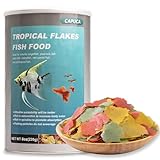
- High Quality Ingredients : Our Tropical fish food Tropical Fish is made from carefully selected natural ingredients, which are derived from fresh meat, vegetables and seaweed. No additives, artificial flavors, colors and other harmful ingredients. The main ingredients are Fish meat, Antarctic krill, Soy, Wheat,Corn, Spirulina, Astaxanthin, Carotene, Natural minerals, Vitamins(A, D3, C, E,B1, B2, B6 &B12)
- Enhanced Color Promote Growth : Tropical flakes fish food rich in astaxanthin and spirulina to promote the formation of rich, beautiful color tropical fish. A quality diet rich in high-quality protein, calcium and natural vitamins is ideal for the growth of tropical fish and enhances their immunity
- Keep Water Clean : Tropical flakes ultra fresh fish food contain probiotics that help dissolve the fish's excrement and residue, keeping the water clean
- Easy Ingestion and Digestion : The Ultrathin flakes are very suitable for All kinds of tropical fish to eat, and the Ultra-thin design allows Tropica fish to better digest and absorb
- Suitable Species : For all tropical fish such as - koi, colorful angelfish, peacock fish, betta fish, zebrafish, red parrot fish and so on
Body condition matters
Obesity can result from overfeeding, an unsuitable diet or a diet that lacks the diversity a species naturally eats. A veterinarian quoted by the University of Illinois Veterinary Teaching Hospital, Judilee Marrow, states: “Obesity can occur because the fish is being overfed, is being fed the wrong diet, or receives a diet that is not as diverse as it would naturally eat.”
When an automatic feeder helps
An automatic aquarium fish feeder is optional. It can provide consistent small meals for scheduled juvenile feedings, portion control or travel, but it cannot assess appetite, remove leftovers or respond to a sick fish. Test the device with the actual food before relying on it, protect food from humidity and arrange someone to check the aquarium during extended absences.
Quick Recap
Quick decisions by fish type
| Situation | Starting approach | Priority adjustment |
|---|---|---|
| Healthy adult community fish | One small daily feeding; finish within a few minutes | Reduce portions if leftovers appear. |
| Fry or juveniles | Smaller, more frequent meals | Use tiny particles and monitor waste closely. |
| Large-meal carnivore | Species-specific schedule, potentially once or twice weekly | Match meal size and frequency to the predator’s biology. |
| Cold or unusually inactive fish | Reduce frequency while conditions are outside the normal range | Check temperature and investigate the cause of inactivity. |
| Community tank with shy feeders | Distribute food or target-feed | Improve access instead of increasing the whole-tank portion. |
Product prices and availability are accurate as of the date/time indicated and are subject to change. Any price and availability information displayed on Amazon at the time of purchase will apply.