What’s actually slowing this PC down?
Pick the symptom - the matching free tool is one click away.
Deep-sea fish are fishes adapted to ocean habitats where sunlight is absent or extremely limited, pressure is intense, water is cold, and food is scarce. The term describes an ecological way of life—not one taxonomic family—so anglerfishes, lanternfishes, hatchetfishes, dragonfishes, rattails, barreleyes, and whalefishes may look and live very differently while solving many of the same problems.
How deep do deep-sea fish live?
There is no single depth boundary that defines every deep-sea fish. The environment usually meant by “deep sea” begins where sunlight becomes too weak for ordinary photosynthesis and vision is severely limited. Much of the relevant habitat lies below about 200 meters, and many species live hundreds or thousands of meters down.

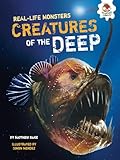


Conditions become more extreme with depth:
- Pressure: Water pressure rises by about one atmosphere (14 pounds per square inch) for every 10 meters. At 1,000 meters, pressure is roughly 100 times the pressure at the surface.
- Light: Sunlight is virtually absent in the deepest habitats, so fish cannot depend on normal daylight vision.
- Temperature: Below about 200 meters, ocean water averages approximately 4°C (39°F).
- Food: Sunlight cannot drive photosynthesis at these depths. Much of the food web depends on organic matter sinking from above, with additional support from local chemosynthetic ecosystems.
Deep-sea fish are not one family
“Deep-sea fish” groups animals by habitat rather than ancestry. Separate evolutionary lineages have independently developed features that help with darkness, pressure, cold, and unreliable meals. A deep-sea anglerfish and a rattail, for example, are both deep-sea fish but differ greatly in body shape, movement, feeding strategy, and sensory equipment.
NOAA describes deep-sea anglerfishes as the most species-rich primarily bathypelagic fish group, with 167 species in 11 families. Other commonly recognized examples include:
#1 Best Overall
- lanternfishes
- hatchetfishes
- viperfish
- dragonfishes
- rattails (also called grenadiers)
- barreleyes
- whalefishes
How do deep-sea fish survive the pressure?
Deep-sea fish have pressure-tolerant physiology rather than a simple “armor” that blocks pressure. Their bodies and biochemical systems function under the weight of the surrounding water. Many lack large, gas-filled spaces that would be difficult to maintain at depth, and their metabolism is commonly slow, conserving energy in a cold environment where food arrives unpredictably.
The exact pressure adaptations vary among species. A fish that swims through the midwater has different demands from a bottom-associated rattail, so “pressure adaptation” is a collection of solutions rather than one universal feature.
Why do deep-sea fish glow?
Bioluminescence is the production and emission of light by a living organism. It can result from a chemical reaction in the fish or from light-producing symbiotic microbes. NOAA reported that 80 percent of animals living between 200 and 1,000 meters are bioluminescent; that statistic applies to all animals in that depth range, not to fish alone.
Deep-sea fish use light for several different purposes:
Recommended Free Tools
Finding or attracting prey
An anglerfish can use a glowing structure as a lure, while other species produce flashes that help illuminate nearby prey or draw it within striking range.
Communication and mating
Specific flashes or glowing patterns can help individuals recognize one another and locate potential mates in darkness.
Rank #3
Defense
A sudden flash may startle or distract a predator, giving the fish a chance to escape.
Counterillumination
Some fish produce light on their underside that matches the faint light filtering down from above. Viewed from below, this reduces the animal’s silhouette and makes it harder to detect.
Not every deep-sea fish glows. Dark bodies are also useful: black or deep-brown coloration absorbs the brief flashes produced by nearby organisms and reduces reflection.
How do they sense the world without sunlight?
Eyes for faint flashes
Many midwater species have enlarged eyes that collect as much available light as possible and detect the flashes of bioluminescent animals. This does not mean every deep-sea fish has large eyes; species living where visual information is less useful may invest more in other senses.
Lateral lines for movement
The lateral-line system detects vibrations and water movement. It can reveal the approach of prey, predators, or a nearby object when visibility is poor.
Specialized light organs
Dragonfishes carry specialized light organs. These organs may produce species-specific signals or help with prey capture and concealment, depending on their position and structure.
Best Value
Unusual body designs
Whalefishes are described as having a whale-like body, no fins or scales, and a deep lateral line. Their form illustrates how different deep-sea lineages can become from familiar coastal fish while remaining effective in the same dark setting.
Independent reader supportYour contribution helps us test, update, and keep practical guides available for everyone.What do deep-sea fish eat?
Food is generally limited and unpredictable because no sunlight reaches the deep ocean to support local photosynthesis. Sinking organic particles, dead organisms, drifting animals, and prey migrating through the water column all contribute to the food supply. In some places, chemosynthetic ecosystems provide an additional energy source.
Adaptations that help fish cope with uncertain meals include:
- Large mouths and long teeth: These allow a fish to seize prey that may be nearly as large as itself and prevent escape.
- Expandable stomachs: A flexible stomach can accommodate a rare, oversized meal.
- Ambush tactics: Remaining still and striking suddenly reduces the energy cost of hunting.
- Slow metabolism: Conserving energy helps a fish endure long intervals between meals.
These traits are not present in exactly the same combination in every species. A small lanternfish, a large-mouthed anglerfish, and a bottom-dwelling rattail occupy different feeding niches.
The Tool Desk
Outbyte Driver Updater FREEScan for outdated or missing drivers - takes under a minuteDriver Scan →Outbyte PC Repair FREEClear out junk files and repair common Windows errorsFree Scan →Examples of deep-sea fish adaptations
| Fish group | Notable feature | How it helps at depth |
|---|---|---|
| Anglerfishes | Bioluminescent lure in many species | Attracts prey in darkness; some species also have large mouths and expandable stomachs. |
| Lanternfishes | Light organs and light-sensitive eyes | Supports communication, camouflage, and detection of faint flashes. |
| Hatchetfishes | Deep, laterally compressed body | Useful for midwater life where counterillumination and maneuvering matter. |
| Dragonfishes | Specialized light organs and elongated teeth | Combines signaling or concealment with effective prey capture. |
| Rattails | Long tapering tail and bottom-associated lifestyle | Fits life near the seafloor, where food particles and carrion can be located. |
| Barreleyes | Highly specialized visual equipment | Helps detect sparse light and silhouettes in the water column. |
| Whalefishes | Whale-like body, no fins or scales, deep lateral line | Relies strongly on movement sensing in an environment where vision is limited. |
Are all deep-sea fish black and glowing?
No. Bioluminescence is widespread but not universal, and coloration varies with habitat and behavior. Dark brown or black skin can absorb light and reduce the reflection of bioluminescent flashes. Other species use light organs, reflective surfaces, enlarged eyes, or vibration sensing instead. The diversity exists because “deep-sea fish” includes many unrelated groups living at different depths and eating different prey.
What makes deep-sea fish different from shallow-water fish?
Shallow-water fish generally operate with more light, warmer temperatures, lower pressure, and more predictable access to photosynthesis-supported food webs. Deep-sea fish must function when ordinary vision is unreliable, the water is near 4°C below about 200 meters, pressure rises rapidly with depth, and meals may be widely spaced. Their enlarged eyes, lateral lines, light organs, dark bodies, large mouths, slow metabolisms, and pressure-tolerant physiology are responses to those combined conditions.
Quick Recap
Product prices and availability are accurate as of the date/time indicated and are subject to change. Any price and availability information displayed on Amazon at the time of purchase will apply.




