Free tools Windows power users keep installed
One-click scans. No signup required.
A frozen saber-toothed cat cub found in Yakutia, Russia, is the first scientifically described mummy of Homotherium latidens. Dated to roughly 35,500–37,000 calendar years ago, it preserves fur, skin, whisker bases, forelimbs, paw pads and curved claws—providing the first direct view of an extinct mammal with no living equivalent.
What was found in Siberia?
The specimen was discovered in 2020 at the Badyarikha locality on the Badyarikha River, a right-bank tributary of the Indigirka River in Yakutia, Russia. It was frozen in Upper Pleistocene Yedoma permafrost.
The mummy preserves the head and front part of the body. The pelvic bones, femur and shin are incomplete and remain encased in ice. CT scans and jaw morphology identify the animal as the machairodontine cat genus Homotherium; the authors assign it to Homotherium latidens.
How old is the Homotherium cub?
Wool radiocarbon dating by the Center for Collective Use of the Accelerator Mass Spectrometry Complex at Novosibirsk State University produced an age of 31,808 ± 367 years BP in 2024. The Scientific Reports authors calibrated that result to 35,471–37,019 calendar years BP, with a 95.4% probability.
Windows Errors? Fix Them Before They Spread
Repair common Windows errors and clear accumulated junk for a smoother, more stable PC - no reinstall needed.Free scan · no reinstallOutdated Drivers Are Slowing You Down
One free scan finds every outdated or missing driver and matches the right update for your exact hardware.Free scan · exact hardware match#1 Best Overall

- Realistic replica of a Smilodon fatalis saber tooth, from one of the most iconic prehistoric predators
- Measures approximately 10 inches (24 cm) long, showcasing the dramatic size of its upper canine
- Based on original fossil specimens under license from LACMNH
- Made for display, education, or collectors interested in Ice Age megafauna
- A bold centerpiece for any fossil collection, evoking the power of the Pleistocene apex predator
Based on its development compared with modern lion cubs, the animal was approximately three weeks old when it died. That estimate is a developmental comparison, not a separate radiometric measurement.
What did the saber-toothed cat mummy look like?
The mummy retains short, thick, soft dark-brown fur about 20–30 millimeters long. Skin, whisker bases, forelimbs, broad foot pads and sharp, curved claws are also visible. Because no living species closely matches Homotherium, these tissues reveal its external appearance directly rather than through reconstruction from bones alone.
Rank #2
![Saber-Toothed Cat Tooth Resin Replica - Realistic Fossil Decor for Home, Classroom & Collection [RS-8147]](https://m.media-amazon.com/images/I/31mWoeQQPML._SL160_.jpg)
- REALISTIC FOSSIL REPLICA: Detailed Saber-Toothed Cat Tooth cast in high-quality resin, featuring ...
- MUSEUM-GRADE DETAIL: Each tooth is sculpted and hand-painted to replicate the size, shape, and te...
- DISPLAY-READY: Compact and striking design makes it ideal for desks, shelves, display cases, clas...
- EDUCATIONAL VALUE: Excellent visual aid for teaching paleontology, evolution, prehistoric life, a...
- PERFECT COLLECTOR'S GIFT: A thoughtful gift for fossil collectors, dinosaur fans, history buffs, ...
How its proportions differed from a lion cub
| Feature | Homotherium cub | Comparison with a similar-age lion cub |
|---|---|---|
| Mouth opening | Average opening measured | About 15.3% smaller than the Homotherium cub |
| Forelimbs | Longer forelimbs | Homotherium forelimbs were 18–23% longer |
| Neck thickness | 52.0 mm | The lion-cub comparison measured 32.0 mm; the Homotherium neck was more than twice as thick |
| Ear | Small and low-set | Interpreted as a cold-climate adaptation |
| Front paw | Broad, with preserved pads | Interpreted as useful on snow |
| Carpal pad | Absent | Reported from the mummy; no equivalent pad was identified on this specimen |
The combination of a thick neck, relatively long forelimbs and broad front paw gives the cub a noticeably different build from a modern lion cub. The small, low ear and missing carpal pad are interpretations of possible snow and cold adaptations, not proof of how the animal behaved.
Why this discovery is scientifically important
The specimen is described as the first H. latidens find reported from Asia and expands the known Late Pleistocene range of the genus. More broadly, it is the first direct opportunity to study the outside of an extinct mammal for which there is no modern analogue.
What’s actually slowing this PC down?
Pick the symptom - the matching free tool is one click away.
Rank #3
![Saber-Toothed Cat Tooth Resin Replica - Realistic Fossil Decor for Home, Classroom & Collection [RS-8139]](https://m.media-amazon.com/images/I/316qDO2YaqL._SL160_.jpg)
- REALISTIC FOSSIL REPLICA: Detailed Saber-Toothed Cat Tooth cast in high-quality resin, featuring ...
- MUSEUM-GRADE DETAIL: Each tooth is sculpted and hand-painted to replicate the size, shape, and te...
- DISPLAY-READY: Compact and striking design makes it ideal for desks, shelves, display cases, clas...
- EDUCATIONAL VALUE: Excellent visual aid for teaching paleontology, evolution, prehistoric life, a...
- PERFECT COLLECTOR'S GIFT: A thoughtful gift for fossil collectors, dinosaur fans, history buffs, ...
“For the first time in the history of paleontology, the appearance of an extinct mammal that has no analogues in the modern fauna has been studied.”
—A. V. Lopatin and colleagues, Scientific Reports, 2024
Rank #4
 Saber Tooth Tiger Skull Replica - Smilodon Skull | Museum Quality Fossil Replica | Sabertooth Skull Decor | Several Colors to Choose from | Paleontology Gift for Collectors (Aged Bone)
- MUSEUM-INSPIRED SABER TOOTH TIGER SKULL REPLICA: Closely modeled after the iconic Smilodon fatalis skull, this large-scale replica captures the fearsome detail of one of prehistory's greatest predators - from the elongated canine fangs to the textured bone structure. Impressive enough to anchor any shelf, desk, or display.
- PREMIUM CONSTRUCTION - A SKULL BUILT TO DISPLAY: Made from high-quality material that replicates the natural texture of fossilized bone. Durable, and fade-resistant so it looks great for years. - no setup required.
- A CONVERSATION PIECE THAT COMMANDS ATTENTION: Whether it's a man cave, home office, library, bar, or trophy room - this Smilodon skull stops people in their tracks. Saber Tooth Tigers roamed the Americas for over 2 million years and remain one of the most recognized symbols of prehistoric power. Now you can own a piece of that history.
- THE PERFECT GIFT FOR HISTORY & FOSSIL ENTHUSIASTS: An unforgettable gift for paleontology fans, natural history lovers, collectors, and anyone fascinated by prehistoric predators. Arrives ready to display straight out of the box - ideal for birthdays, Father's Day, Christmas, and graduation gifts.
- DETAILED ENOUGH FOR SKULL COLLECTORS, BOLD ENOUGH FOR DECOR: Designed with the fossil enthusiast in mind but striking enough for anyone who wants something genuinely unique on their shelf. Far more interesting than another generic sculpture - and a fraction of what a professional museum cast would cost.
It was not a saber-toothed tiger
Homotherium was a machairodontine cat, often called a scimitar-toothed cat. It is not a tiger, and it is not the same animal as Smilodon, the better-known dirk-toothed cat of the Americas. Using the correct name matters because these were different saber-toothed cat lineages with different ranges and anatomy.
Independent reader supportYour contribution helps us test, update, and keep practical guides available for everyone.What later studies add
Hair structure and cold-weather performance
A 2025 hair-microstructure study dated the material to approximately 31,808–37,019 years ago. It found short, tangled, poorly differentiated dark-brown hair. The hair medulla showed weak development associated with heat protection, while its mechanical strength was excellent. Those findings describe the preserved hair; they do not establish the cub’s complete coat density or the animal’s behavior.
Best Value
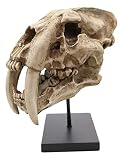
- This Sabertooth Fossil Skull Replica Statue measures 12" tall, 11" wide and 6.5" deep approximately. It weighs about 4.25 pounds.
- This Sabertooth Fossil Skull Replica Statue is made of high quality polystone, individually handpainted and polished. Because each piece is partially hand crafted, color tone may vary from pictures. The product mount is included with the item and you can display the skull with or without the mount. The base mount comes with a brass name plate that says "Sabertooth".
- This aged bone finish fantasy sabertooth skull figurine is a convincing prehistoric tiger fossil replica characterized by long, curved saber-shaped canine teeth which protruded from the mouth even when closed.
- Minimal assembly is required for the skull to set on the mount (included). Its quality is museum gallery superb and will be a fine centerpiece for any home!
- This is NOT a real sabertooth skull. Props and coke can used in photos are not included with the item. They are meant to provide size perspective of the item.
The surrounding landscape
A 2025 microfossil study reconstructed the habitat around the carcass as a floodplain with mature larch forest and mesic sedge–grass–forb meadows. This environmental reconstruction comes from the sediments and microfossils associated with the find, rather than from the mummy’s anatomy.
What the mummy cannot yet tell us
- The skeleton is incomplete, with parts of the pelvis and hind limbs still encased in ice.
- The published evidence does not establish the cub’s exact cause of death.
- It does not establish eye color, detailed behavior or a complete adult appearance.
- The discovery does not demonstrate that Homotherium can be cloned.
Those limits do not reduce the importance of the find: preserved external tissues answer questions that fossils usually cannot, while CT imaging and jaw morphology provide the taxonomic identification.
Quick Recap
Product prices and availability are accurate as of the date/time indicated and are subject to change. Any price and availability information displayed on Amazon at the time of purchase will apply.




