Recommended Free Tools
Service dogs are often grouped by the kind of disability-related work they perform: guiding, alerting, retrieving, interrupting dangerous behavior, or getting help. These labels are useful descriptions, but they are not separate legal categories under the Americans with Disabilities Act (ADA).
Under the ADA, a service dog is a dog individually trained to perform work or tasks directly related to a person’s disability. The dog’s breed, vest, certificate, and the number of tasks it performs do not determine its status. Here are eight common types of service dogs and the work they may do.
1. Guide dogs
Guide dogs help people who are blind or have low vision navigate their surroundings. They are trained to notice obstacles, follow routes, locate doors and crossings, and help their handlers move safely through public places.
A guide dog does not independently choose every destination. The handler provides direction, while the dog responds to trained cues and environmental information. In some situations, the dog may use what is commonly called intelligent disobedience: refusing a command when following it would create an immediate danger, such as moving into traffic.
#1 Best Overall
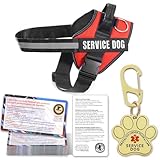
- Note: First point: If you want to quickly fit your "son" and "daughter" into well-fitting dog vests, you must measure their neck girth and chest girth, not just rely on suggested weights; this is a serious mistake. Second point: We do not provide services for engraving names and mobile phone numbers on dog tags. You can go to a pet store near you to have them engraved.
- Warning: This product has been registered and registered with USPTO & US Copyright Registration (OAS) and issued a certificate. Plagiarism, re-engraving, and legal risks will face it !
- Service Dog Vest: This service dog vest kit comes with a service dog vest*1, service dog patches*2 and service dog tag*1, and service dog information cards*50. It includes everything you need to safely use a service dog.
- Service Dog Harness: This service dog harness is specially designed for service dogs and can meet the needs of service dogs of different sizes. It can be evenly distributed on the service dog's body to prevent suffocation, ensuring that your service dog performs tasks in this best condition.
- Service Animal Vest for Dogs: This service animal vest for dogs are equipped with reflective tape to enhance visibility in low light conditions to ensure the safety of both the owner and the service dog. This sturdy D-ring on the service animal vest for dogs allows for easy attachment of your leash, making it perfect for both urban and outdoor activities.
Guide work requires more than a dog that walks calmly on a leash. The dog must be able to concentrate around people, vehicles, food, noise, and other distractions while responding reliably to its handler.
2. Hearing dogs
Hearing dogs alert people who are deaf or hard of hearing to important sounds. A dog may be trained to respond to a doorbell, telephone, smoke alarm, alarm clock, oven timer, a baby crying, or someone calling the handler’s name.
The alert usually involves physical contact. The dog may nudge or paw the handler, then lead the person toward the source of the sound. The exact sound list is tailored to the handler’s home and routine.
Hearing dogs are not necessarily trained to react to every noise. A dog trained to alert to a smoke alarm may not alert to car horns, sirens, or ordinary street noise. The relevant skill is recognizing selected sounds and performing a trained response.
Free tools Windows power users keep installed
One-click scans. No signup required.
3. Mobility service dogs
Mobility service dogs assist people with disabilities affecting movement, balance, strength, or coordination. Their tasks can include:
- Retrieving dropped objects
- Opening or closing doors
- Pressing accessible buttons
- Pulling a wheelchair when appropriate
- Helping with transfers
- Providing trained balance or stability support
Not every mobility dog performs every task. A dog that retrieves a phone for a person who cannot bend may be a mobility service dog even if it never provides physical support.
Handlers should not assume that any large, strong dog is safe to use as a brace or counterbalance device. Weight-bearing assistance depends on the person’s medical condition, the dog’s size and structure, and careful professional guidance. An unsuitable task can injure both the dog and the handler.
4. Autism service dogs
Autism service dogs perform specific tasks for people with autism-related disabilities. Their work varies considerably because autism affects people in different ways. Possible tasks include:
Do these 3 things before closing this tab:
1Fix the driver behind crashes, sound loss and screen glitches2Repair Windows errors before they cause bigger problems3Scan for outdated or missing drivers - takes under a minute- Interrupting dangerous or self-injurious behavior
- Redirecting repetitive behavior when that behavior creates a safety problem
- Helping a person transition between activities
- Retrieving a telephone or getting another person’s attention
- Locating a child who has wandered
- Providing trained positioning or safety support
For a child who may bolt or wander, a dog might be trained to track or locate the child and help an adult respond. For another handler, the dog might interrupt a harmful behavior with a nudge or another trained action.
Rank #2

- 【EASY TO GET ON/OFF】WINSEE tactical dog harness features four quick-release buckles for easy on and off, and four adjustable points to ensure a sung fit for dogs of all sizes.
- 【No pull & choke-free】WINSEE no pull dog harness featuring 2 sturdy D rings on the front/back range for attaching leash, a front clip that prevents pulling, and a back one for relaxed walking. The 2 D rings are reinforced on the extensional part which is not easily ripped off even by heavy pulling. Especially the metal buckle for a leash on the back give you more safety. Pulling pressure is evenly distributed to the body to prevent choking.
- 【Molle System & 10 velcro patches】The package contains a WINSEE dog vest harness and 10 pieces of dog patches. This Service dog vest features molle system equipped on both sides. You can attach the patches such as “ “Service dog”, “do not pet”, “in training”, “emotional support” and “best friend” when walking or training the dog outside.
- 【Reflective Nylon】- Higher visibility of the dog training harness allows you and your dog to be seen on early morning or evening strolls. With a Unique Design sturdy handle on the front you can easily and urgently restrain even extra-large dogs. Pulling pressure is evenly distributed to the body to prevent choking.
- 【Available in 4 colors & 4 size】Upgraded color and size designs are perfect for any occasions such like dog hiking, daily walking or training etc,. Measure around your dog's neck and chest to get the right fit (Measurement chart reference to the picture)
A dog’s calming presence, companionship, or general ability to make a person feel safer is not, by itself, a service task under the ADA. The dog must be trained to take a specific action that helps mitigate the disability.
5. Psychiatric service dogs
Psychiatric service dogs assist people with psychiatric disabilities, including conditions that affect daily functioning. They are different from emotional-support animals because their legal distinction depends on trained disability-related work, not simply comfort.
Examples of psychiatric service-dog tasks include:
- Interrupting a panic or dissociative episode
- Nudging or grounding a person who is losing awareness of their surroundings
- Retrieving medication, water, or a telephone
- Reminding a person to take medication
- Waking a handler from nightmares
- Guiding a handler to a safer location
- Checking a room when that action is directly related to the disability
A dog that notices signs of an anxiety episode and has been trained to respond with a particular action may perform a qualifying task. A dog that only provides reassurance through its presence does not automatically meet the ADA definition of a service animal.
6. Medical-alert dogs
Medical-alert dogs are trained to recognize changes associated with a medical condition and alert or assist their handlers. Depending on the dog’s training and the person’s needs, tasks may include alerting to a trained blood-glucose change, detecting a specific allergen, retrieving medication, bringing a telephone, or getting help.
“Medical alert” is a broad label, not a guarantee that a dog can diagnose or predict every medical event. A careful description identifies the trained behavior. For example, it is more accurate to say that a dog alerts its handler to a trained change associated with blood glucose than to say that dogs generally diagnose diabetes.
Medical-alert training should be designed around the handler’s condition and an emergency plan. The dog does not replace prescribed medication, medical monitoring, or professional advice.
7. Seizure-response dogs
Seizure-response dogs are trained to help during or after a seizure. Their work may include:
- Barking to alert another person
- Activating an alarm
- Staying beside the handler
- Helping protect the person from nearby hazards
- Fetching medication or a telephone
- Getting assistance
A seizure-response dog is not necessarily a seizure-alert or seizure-predicting dog. Some dogs appear to sense an approaching seizure, but the Epilepsy Foundation describes this ability as rare and not well understood. Claims that a trainer can reliably produce seizure-prediction behavior deserve caution.
There is also no evidence that seizure dogs reduce the risk of sudden unexpected death in epilepsy (SUDEP). They should not be treated as a substitute for a physician’s advice, nighttime supervision, or recommended monitoring.
Rank #3
- Note: First point: If you want to quickly fit your "son" and "daughter" into well-fitting dog vests, you must measure their neck girth and chest girth, not just rely on suggested weights; this is a serious mistake. Second point: We do not provide services for engraving names and mobile phone numbers on dog tags. You can go to a pet store near you to have them engraved.
- Warning: This product has been registered and registered with USPTO & US Copyright Registration (OAS) and issued a certificate. Plagiarism, re-engraving, and legal risks will face it !
- Service Dog Vest: This service dog vest kit comes with a service dog vest*1, service dog patches*2 and service dog tag*1, and service dog information cards*50. It includes everything you need to safely use a service dog.
- Service Dog Harness: This service dog harness is specially designed for service dogs and can meet the needs of service dogs of different sizes. It can be evenly distributed on the service dog's body to prevent suffocation, ensuring that your service dog performs tasks in this best condition.
- Service Animal Vest for Dogs: This service animal vest for dogs are equipped with reflective tape to enhance visibility in low light conditions to ensure the safety of both the owner and the service dog. This sturdy D-ring on the service animal vest for dogs allows for easy attachment of your leash, making it perfect for both urban and outdoor activities.
8. Allergen-detection dogs
Allergen-detection dogs are trained to alert their handlers to a particular allergen. The ADA regulations specifically give alerting a person to the presence of allergens as an example of service-animal work.
The dog’s training must connect the alert to the handler’s disability. A dog might recognize the scent of a specified food allergen and perform a trained alert before the handler eats or enters a contaminated area. The precise alert behavior depends on the dog’s training.
General vigilance, reassurance, or the dog’s mere presence is not enough. The dog must recognize the relevant substance and respond in a trained way.
What legally makes a service dog?
In the United States, the ADA defines a service animal as a dog individually trained to do work or perform tasks for the benefit of an individual with a disability. The work or task must be directly related to that disability. The ADA covers physical, sensory, psychiatric, intellectual, and other mental disabilities.
That definition focuses on what the dog has been trained to do, not on the name used for the dog. “Guide dog,” “medical-alert dog,” and “psychiatric service dog” describe different kinds of work, but the ADA does not create eight official service-dog classes.
| Question | ADA answer |
|---|---|
| Does the dog need a vest? | No. A vest, patch, ID card, or special harness is not required. |
| Does the dog need certification? | No. The ADA does not require professional training, certification, or registration in a national database. |
| Does the dog need to be a particular breed or size? | No. Breed and minimum size are not requirements. |
| How many tasks must the dog perform? | The ADA does not set a minimum number. One trained, disability-related task can qualify. |
| Can the handler train the dog? | Yes. The ADA does not require a professional trainer, although the dog must be trained before it is treated as a service animal in public under the ADA. |
State and local laws may address service dogs in training differently. Rules for housing, employment, schools, and transportation can also involve laws beyond the ADA, so a person should check the requirements that apply to the particular situation.
Quick wins for a faster PC:
Clear out junk files and repair common Windows errorsFree Scan →Fix the driver behind crashes, sound loss and screen glitchesFind Drivers →Repair Windows errors before they cause bigger problemsFix Now →What can a business ask?
When the dog’s work is not obvious, staff may ask only two questions under the ADA:
- “Is the dog a service animal required because of a disability?”
- “What work or task has the dog been trained to perform?”
They may not demand a certificate, medical records, proof of diagnosis, or a demonstration of the task. A business generally cannot require the dog to wear identifying equipment, either.
Service-dog access is not unlimited. A dog may be removed if it is not under control, is not housebroken, or poses a direct threat based on its actual behavior. The handler remains responsible for the dog’s care and supervision.
Rank #4

- 【Large Dog Molle Vest】: Neck Girth: 21-28 inch, Chest Girth: 24-39 inch, Belly Length: 24-39 inch, Back Length: 13.5 inch. Ideal for Large Breeds such as German Shepherds, Belgian Malinois, Golden Retrievers, Huskie, Labrador, Akita. A professional working dog vest for service, police, or military dogs, but also suitable for outdoor companion dogs. Please refer to our size chart, make sure match up your dog's measurement, Do not choose the size base on dog's weight or guess
- 【Molle System】: Equipped on both sides for pouches, water bottles, and tactical dog gear. Multiple Hook & Loop Panels for morale patches and badges to showcase your dog’s personality. A wide range of use for personal service, law enforcement, or outdoor recreation. The package contains a dog harness, and 10 pieces of dog patches, such as Service dog, do not pet, in training, emotional support and service dog in training, enough quantity for you to decorate the dog’s vest harness.
- 【2x Metal Shoulder Buckles】: Two Metal Shoulder Buckles can bear great pulling force, ensuring your dog is safely harnessed during training, working, and any other occasion. 4x Plastic Buckle( 250lb proof-loading) on chest and belly position. This dog harness is made with military grade materials and reinforced stitching. Well padded in every pressure load point to protect your dog, while the breathable air mesh keeps your dog ventilated and comfortable
- 【3 D Rings for Leash Clip】: This military service dog vest features 3 stainless steel D-rings gives the handler/owner various leash attachment options - One Anti-Pull Front Clip to control dogs on walks without choking or harming them; One heavy duty D-Ring near dog's neck for casual walking with short leash, another one on the rear of harness for hikes with long leash
- 【Double Padded Sturdy Handle】: The double handles are great for you to assist your dog in any position, it is much safer than pulling at a collar that is around the neck.
Are airline rules the same?
No. Airlines follow the Air Carrier Access Act rather than the ADA. Current U.S. Department of Transportation rules recognize trained dogs as service animals for air travel. An airline may require the applicable DOT forms about the dog’s health, behavior, and training. For flights scheduled to last eight hours or more, it may also require a relief-attestation form.
PC Slower Than It Used to Be?
A free scan shows the junk files, broken settings and background clutter dragging Windows down - then fixes them in one click.Free scan · Windows 10 & 11Outdated Drivers Are Slowing You Down
One free scan finds every outdated or missing driver and matches the right update for your exact hardware.Free scan · exact hardware matchAirlines can deny transportation for reasons such as safety concerns, significant disruption, health-law requirements, size, or missing documentation. Check the airline’s current process well before traveling.
Service dogs and miniature horses
The ADA service-animal definition is limited to dogs. Public entities may nevertheless have to make reasonable modifications for a trained miniature horse when the applicable regulatory conditions are met. That is not the same legal treatment as a service dog.
Airlines are required by federal air-travel rules to recognize and transport trained service dogs, but they are not required by the Air Carrier Access Act to transport other species as service animals.
FAQ
What is the most common type of service dog?
There is no single official or universally most common type. Guide, hearing, mobility, psychiatric, autism, medical-alert, seizure-response, and allergen-detection dogs are all descriptions of disability-related work. A dog’s legal status depends on its trained tasks and the handler’s disability-related need.
Is an emotional-support dog a service dog?
Not automatically. Comfort, companionship, and emotional support by themselves are not trained tasks under the ADA. A psychiatric service dog must perform specific work, such as interrupting an episode, retrieving medication, or waking a person from a nightmare.
Do service dogs need to wear vests or carry identification?
No. The ADA does not require a vest, ID card, certificate, registration, or special harness. These items may help with public communication, but buying one does not turn an untrained dog into a service dog.
Can a service dog go everywhere its handler goes?
Service dogs generally may accompany their handlers in places open to the public, but access is not unlimited. A dog can be removed if it is uncontrolled, not housebroken, or presents a direct threat based on its actual behavior. Airline rules are separate from ordinary ADA public-access rules.
The Bottom Line
There are no official federal “eight types” of service dogs. The categories are practical descriptions of the jobs dogs perform, from guiding and sound alerts to mobility assistance, medical alerts, and psychiatric support. The central rule is simple: a service dog must be individually trained to perform work or tasks directly related to a person’s disability. A vest, breed, certificate, or comforting presence is not what qualifies the dog.
What’s actually slowing this PC down?
Pick the symptom - the matching free tool is one click away.
Quick Recap
Product prices and availability are accurate as of the date/time indicated and are subject to change. Any price and availability information displayed on Amazon at the time of purchase will apply.




