Do these 3 things before closing this tab:
1Scan for outdated or missing drivers - takes under a minute2Clear out junk files and repair common Windows errors3Fix the driver behind crashes, sound loss and screen glitchesShould you keep a degu as a pet? Keep degus only if you can provide a compatible pair or group, a large secure enclosure, a high-fibre low-sugar diet, daily enrichment, careful handling, several years of care, and an experienced veterinarian. Degus are rewarding daytime companions, but they are not solitary, cuddly, or low-maintenance starter rodents.
That conditional answer reflects the species rather than a blanket beginner-pet label. Degus are active, social, intelligent animals with demanding housing, diet, temperature, and health requirements.
Key takeaways
- Degus are social and should normally live with at least one compatible degu rather than alone.
- A pair of degus needs a tall, secure, chew-resistant enclosure; Blue Cross gives a minimum of 90 cm deep by 60 cm wide by 120 cm tall for two to five degus.
- Unlimited grass hay, a measured low-sugar pellet or nugget, suitable forage, and constant clean water are the foundation of a degu diet.
- Degus are active during the day and need daily opportunities to climb, dig, forage, gnaw, exercise, socialize, and take dust baths.
- Degus often tolerate voluntary interaction better than being carried, and they must never be lifted by the tail.
- Keeping degus responsibly requires several years of care and access to a veterinarian experienced with exotic or small mammal patients.
What is the honest answer to “Should you keep a degu as a pet?”
You should keep a degu as a pet only if you want an active, social daytime animal and can provide a compatible pair or group, a large metal enclosure, a high-fibre low-sugar diet, daily enrichment, careful handling, and experienced veterinary care. Degus can be rewarding companions, but they are not solitary, cuddly, or low-maintenance starter rodents.
A degu is a good match for an attentive adult, an older child with close supervision, or a family that enjoys observing intelligent, active animals during daylight hours. A degu is probably a poor match if you want one small pet kept alone, an animal that enjoys frequent handling, or a pet that can cope with a small cage and minimal daily interaction.
#1 Best Overall

- IDEAL FOR 12-20 LB DOGS: Measures 24.5 x 17.5 x 19.5 inches - perfect for Fox Terriers, Pugs, Chihuahuas & similar breeds. For dogs near 20 lbs, consider sizing up to our 30-inch model so they have plenty of room to get comfortable.
- WE DON'T CUT CORNERS, WE PERFECT THEM: Precision welding, rounded corner clips & slide-bolt latch with Paw Block mitigate snags, cuts & escapes. With rigorous safety testing, iCrate provides peace of mind knowing your dog is safe while you're away.
- DURABLE CONSTRUCTION: Sturdy metal wire design with a protective black e-coat finish, the iCrate resists rust and everyday wear. Complete with leak-proof tray, rubber feet, carry handle, and tool-free assembly, it's ready for years of use.
- SUPPORTS CRATE TRAINING: A divider panel lets the crate grow with your dog, from puppy kennel to full-size crate. Large openings and low thresholds ease the crate training process and help your dog feel more at home.
- LIFE GOES BETTER WITH PETS: A family-owned business based in Indiana, MidWest Homes for Pets brings over 100 years of pet product expertise and a commitment to quality, rigorous safety testing, and excellent US-based customer service.
What are degus like as pets?
Degus are social rodents native to Chile. In the wild, Blue Cross describes degus living in groups of up to 100 in complex burrows containing nests and food stores. In a home, that social nature means human attention cannot replace compatible degu companionship. Blue Cross’s degu care guidance explains the species’ social, housing, handling, and enrichment needs.
Degus are diurnal, meaning they are generally awake and active during the day and sleep at night. Their normal activities include climbing, digging, burrowing, gnawing, foraging, vocalizing, and social grooming. Blue Cross describes them as follows: “Degus are diurnal which means they’re active during the day and sleep in the night.”
That schedule can work well for a household that wants to watch and interact with a pet after school or during the day. It does not mean a degu is quiet or inactive: a properly enriched enclosure can be busy, noisy, and constantly changing as the animals explore and chew.
Can you keep one degu alone?
You should not normally keep one degu alone. Blue Cross states, “Degus are a social species that should never be kept alone,” because isolation can cause stress and related health or behavior problems.
Same-sex pairs or groups are usually the most straightforward arrangement. Mixed-sex housing requires responsible neutering, careful planning, and advice from a suitably experienced veterinarian. The practical decision is therefore not whether you can care for one small animal: you must be able to house and budget for a compatible pair or group.
Unfamiliar degus should be introduced gradually rather than placed directly into an established animal’s territory:
- Place separate cages near one another so the degus can see and smell each other safely.
- Swap scents between the cages.
- Arrange controlled meetings in neutral territory.
- When the relationship is progressing safely, clean the shared enclosure thoroughly.
- Provide several food, water, hiding, and nesting resources so neither degu has to defend a single essential resource.
Rushing an introduction can trigger conflict. Keep bonded animals together where possible, and make a contingency plan for the surviving companion if one degu dies or must be separated temporarily. Blue Cross has documented a bereaved degu being successfully matched with new companions, but any future introduction still needs to be gradual and carefully managed.
How large should a degu cage be?
Two to five degus need a tall, spacious, secure, chew-resistant enclosure rather than a typical hamster cage. Blue Cross gives a minimum living-space measurement of 90 cm deep by 60 cm wide by 120 cm tall for two to five degus. A separate Blue Cross publication gives 93 cm by 63 cm by 159 cm for two to four degus, so published guidance is not identical; the consistent welfare message is to provide substantial usable floor area and vertical space.
Rank #2
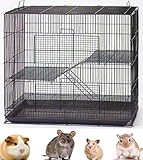
- Easy Portable Design: Cage dimensions measure 24 inches length by 16 inches width by 24 inches height, featuring all-metal construction with 3 levels, wire shelves, and ladders with tight 3/8-inch cross bar spacing
- Narrow 3/8-Inch Wire Spacing: Prevents escape and stuck incidents for baby to adult size small animals including chinchillas, ferrets, rats, dwarf hamsters, guinea pigs, rabbits, mice, gerbils, sugar gliders and other small critters
- Two Front Access Doors: Features doors measuring 6.5 inches by 11.5 inches with locking door clips for extra security, includes 1/2-inch wire spacing, metal grated floor, platforms and ladders with chew-proof construction
- Easy To Clean Design: Includes removable raised 3/8-inch bar spacing bottom grate and pull-out washable tray with animal safe epoxy coated finish for convenient maintenance
- Easy Foldable and Setup: Collapsible design folds for storage with two top side carrier handles for travel convenience, requires no tools for assembly and setup
Choose a metal or genuinely chew-resistant enclosure with good ventilation. Degus chew plastic, so a cage being marketed as a “small-animal cage” does not make it suitable. Check the usable internal dimensions, safe bar spacing, solid flooring, stability, and whether a quoted size excludes the stand.
| Enclosure decision | What a responsible setup requires | Why it matters |
|---|---|---|
| Minimum published size | 90 cm deep × 60 cm wide × 120 cm tall for two to five degus | Degus need room for multiple animals, levels, hides, activity, and exercise. |
| Construction | Metal or genuinely chew-resistant; secure and well ventilated | Degus can chew through unsuitable plastic and may escape. |
| Flooring | Solid flooring or safe floor coverings, not exposed unsafe wire | Solid footing reduces foot and leg hazards. |
| Exercise wheel | Large, solid running surface; Blue Cross recommends a 35 cm diameter wheel | A solid, appropriately sized wheel reduces pinch and entanglement risks. |
| Interior layout | Platforms, ramps, shelves, hides, tunnels, branches, a digging area, and a dust bath | These resources support climbing, hiding, burrowing, gnawing, and natural activity. |
When shopping, a large metal degu cage is a reasonable search starting point, not an automatic welfare guarantee. Check the actual listing against the dimensions, bar spacing, flooring, chew resistance, stability, and room required for a pair or group before buying.
Essential equipment includes several nest spaces and hides, tunnels or clay piping, untreated branches or other safe chew items, replaceable wooden furnishings, a digging box, a dust bath, food bowls, a reliable water bottle, and a carrier for veterinary visits. Degus should live indoors. Blue Cross gives a preferred temperature range of 18–21°C, while Iowa State’s veterinary care sheet warns that degus easily succumb to heat stress above 86°F. Keep the enclosure away from direct sun, radiators, and poorly ventilated hot rooms.
What do degus eat?
Degus should receive unlimited grass hay, a measured low-sugar pellet or nugget, suitable leafy forage, and constant access to clean water. Hay should make up most of the diet; Blue Cross gives one tablespoon of pellets per day alongside unlimited hay, while the RSPCA’s degu feeding guidance emphasizes constant hay availability. RSPCA summarizes the species’ need clearly: “Compared to some other rodents, degus eat large amounts of fibre.”
What’s actually slowing this PC down?
Pick the symptom - the matching free tool is one click away.
Diet is a health issue because degus are prone to diabetes. Select food by its ingredients rather than its front-of-pack marketing. Look for high fibre, low sugar, no molasses, and no dried fruit. Avoid sugary treats, fresh fruit, and seed-heavy or muesli-style mixes that allow selective feeding.
| Food or feeding practice | Use for degus | Reason or qualification |
|---|---|---|
| Grass hay | Unlimited and constantly available | Hay supplies fibre and supports normal tooth wear. |
| Low-sugar degu pellets or nuggets | Measured portion; Blue Cross gives one tablespoon daily | Choose a product without molasses or dried fruit. |
| Suitable guinea-pig or chinchilla nuggets | Possible substitute when specific degu nuggets are unavailable | Use only if the ingredients meet the low-sugar, no-molasses requirement. |
| Rabbit, hamster, or gerbil food | Do not use | RSPCA identifies these foods as unsuitable for degus. |
| Chinchilla mixes containing dried fruit | Do not use | Dried fruit adds inappropriate sugar. |
| Fruit and sugary commercial treats | Avoid | Sugar is a particular concern because degus are diabetes-prone. |
Do not make a branded food the central recommendation without checking its current ingredients. Formulas can change, and “degu” on the label does not by itself prove that a food is low in sugar or free from unsuitable ingredients.
Do degus like being held?
Many degus enjoy human interaction but do not generally enjoy being picked up and carried. A tame degu may take food from your hand or climb onto a seated person, but tameness is not the same as liking restraint. Plan for observation, floor-level interaction, and voluntary climbing rather than frequent lifting.
Never grab a degu by the tail. PDSA states, “Never pull or pick up a degu by their tail.” A frightened degu can lose part of its tail as a defence response, which is painful and may require veterinary care. If lifting is necessary, Blue Cross recommends gently scooping the degu with both hands and keeping the animal close to a safe surface because falls can cause serious injury.
Outdated Drivers Are Slowing You Down
One free scan finds every outdated or missing driver and matches the right update for your exact hardware.Free scan · exact hardware matchWindows Errors? Fix Them Before They Spread
Repair common Windows errors and clear accumulated junk for a smoother, more stable PC - no reinstall needed.Free scan · no reinstallRank #3

- IDEAL FOR 21-40 LB DOGS: Measures 30.5 x 19.25 x 21.5 inches - perfect for French Bulldogs, Welsh Terriers, Dachshunds & similar breeds. For dogs near 40 lbs, consider sizing up to our 36-inch model so they have plenty of room to get comfortable.
- WE DON'T CUT CORNERS, WE PERFECT THEM: Precision welding, rounded corner clips & slide-bolt latch with Paw Block mitigate snags, cuts & escapes. With rigorous safety testing, iCrate provides peace of mind knowing your dog is safe while you're away.
- DURABLE CONSTRUCTION: Sturdy metal wire design with a protective black e-coat finish, the iCrate resists rust and everyday wear. Complete with leak-proof tray, rubber feet, carry handle, and tool-free assembly, it's ready for years of use.
- SUPPORTS CRATE TRAINING: A divider panel lets the crate grow with your dog, from puppy kennel to full-size crate. Large openings and low thresholds ease the crate training process and help your dog feel more at home.
- LIFE GOES BETTER WITH PETS: A family-owned business based in Indiana, MidWest Homes for Pets brings over 100 years of pet product expertise and a commitment to quality, rigorous safety testing, and excellent US-based customer service.
What health problems do degus have?
Degus need species-aware veterinary planning, not just emergency treatment. Important concerns include dental disease, diabetes, heat stress, respiratory illness, falls, escape injuries, and tail injuries. Locate an exotic-animal veterinarian before bringing degus home, and ask whether the practice regularly treats degus or other exotic small mammals. The EARPS care guide recommends annual veterinary examinations.
Dental disease deserves particular attention because degu teeth continue growing and require suitable fibre and chewing opportunities. A 2022 Scottish Government evidence review, summarizing cited degu dental-case literature, reported acquired dental disease in around 60% of clinical cases. That figure is not a population-prevalence estimate: it describes the reviewed clinical-case data, not 60% of all pet degus.
The same review describes molar malocclusion as chronic and painful and notes that severe tooth problems can interfere with eating, hydration, weight, and breathing. Seek veterinary advice promptly if a degu drools, struggles to eat, loses weight, becomes unusually quiet, has breathing difficulty, or shows a major change in drinking or urination.
How long do pet degus live?
Pet degus commonly represent roughly five to nine years of care, with published guidance varying by source and individual animal. Blue Cross gives five to nine years; Iowa State gives five to eight years typically and says up to ten years is possible; EARPS gives approximately six to eight years.
| Source | Published lifespan guidance | How to use the figure |
|---|---|---|
| Blue Cross | Five to nine years | A practical expected range, not a guarantee. |
| Lloyd Veterinary Medical Center, Iowa State University | Five to eight years typical; up to ten years possible | Some individuals may live beyond the typical range. |
| Exotic Animal Rescue and Pet Sanctuary | Approximately six to eight years | Another care-guide estimate within the broader published range. |
Budget for recurring hay and food, enclosure cleaning, replacement wooden furnishings, enrichment, and potentially specialized veterinary expenses. Also decide in advance how you will support a surviving degu after the death of its companion.
Are degus good pets for beginners?
Degus can be suitable for a committed first-time owner, but their care is advanced compared with what their small size may suggest. EARPS labels degu care “Advanced,” and Blue Cross highlights specialized housing, diet, handling, and enrichment requirements.
| Your priority | Are degus a likely fit? | Why |
|---|---|---|
| An active pet to observe during the day | Yes, potentially | Degus are diurnal and naturally climb, dig, forage, gnaw, vocalize, and socialize. |
| One animal kept alone | No | Degus are highly social and should normally have compatible degu companionship. |
| A pet that enjoys frequent cuddling or carrying | Usually no | Many degus prefer voluntary interaction to being picked up. |
| A small, simple cage | No | A pair needs a tall, spacious, secure, chew-resistant enclosure. |
| Low-effort feeding | No | Hay must dominate the diet and sugar must be restricted because of diabetes risk. |
| Care without an exotic-pet veterinarian nearby | Risky | Dental disease, diabetes, heat stress, and injuries may require species-specific care. |
Before adopting, confirm that everyone in the household understands the handling limits, that the enclosure can fit safely indoors, that daily care is practical, and that veterinary costs are manageable. Children should interact under close adult supervision, especially because a dropped or frightened degu can be injured quickly.
Independent reader supportYour contribution helps us test, update, and keep practical guides available for everyone.Where should you get a degu?
Rescue or rehoming is worth considering before purchase. Blue Cross says rescue organizations may have adult or young degus needing homes. If you use a breeder, see the young animals with their mother and assess the health, cleanliness, and space of the adults rather than relying only on an advertisement.
Rank #4

- Protective Liner – This guinea pig cage is designed with a waterproof liner placed outside the frame, effectively preventing pets from chewing and ensuring long-lasting use.
- Secure Hook Connection – The liner attaches with hooks, keeping it stable while making removal and reinstallation simple. Smart design makes cleaning your rabbit cage faster and easier.
- Convenient Door Opening Design – The waterproof liner includes a reserved space for the cage door, allowing it to open smoothly so pets can freely enter and exit without obstruction.
- Customizable Layout – Create the perfect habitat with freely connectable panels. Whether you need a spacious guinea pig cage, a compact rabbit cage, or an expandable bunny cage, the modular design adapts to your space and your pet’s needs.
- Multi-Pet Friendly – Ideal not only as a guinea pig cage but also as a rabbit cage, or even a small pet playpen. A versatile choice for families seeking a secure and cozy home for their furry companions.
Keep bonded animals together whenever possible. Do not casually separate a pair because one degu is more convenient to buy or house. Ask the rescue or breeder about sex, age, health history, current diet, social relationships, and whether the animals have lived together successfully.
Are degus legal to own in your state?
There is no single nationwide yes-or-no answer for every US location in the sources reviewed. Rules can vary by state and locality, and import, transport, sale, or possession may involve different requirements. Before purchasing or moving degus, check the current rules with your state wildlife or agriculture authority and local government. USDA APHIS explains that live-animal movement can involve multiple federal and state agencies in its regulated live-animal imports FAQ and provides separate guidance for rodents entering the United States.
Pre-purchase checklist
- Can you house at least two compatible degus, or provide a responsible plan for introductions?
- Can you fit a tall enclosure meeting or exceeding the published minimum of 90 cm × 60 cm × 120 cm for two to five degus?
- Is the enclosure metal or genuinely chew-resistant, secure, ventilated, and equipped with solid flooring?
- Can you provide unlimited hay, low-sugar food without molasses or dried fruit, clean water, and safe forage?
- Do you have space and budget for a large solid wheel, hides, platforms, tunnels, chew items, a digging box, and a dust bath?
- Can you keep the enclosure indoors at a safe temperature and protect the animals from heat?
- Is an experienced exotic-animal veterinarian available before an emergency occurs?
- Are you comfortable with a pet that may climb onto you but may not want to be picked up?
- Can you commit to roughly five to nine years of care and plan for the surviving companion if one degu dies?
- Have you checked current state and local ownership rules?
Frequently Asked Questions
Can one degu live alone?
A degu should not normally live alone because degus are highly social. If a companion dies, seek advice from a rescue or exotic-animal veterinarian about a careful rehoming or introduction plan rather than immediately placing an unfamiliar degu in the enclosure.
Are degus good pets for beginners?
Degus can suit a committed first-time owner, but they are not low-maintenance beginner pets. Their advanced requirements include social housing, a large enclosure, strict sugar control, daily enrichment, heat management, careful handling, and access to an experienced veterinarian.
Quick wins for a faster PC:
Fix the driver behind crashes, sound loss and screen glitchesFind Drivers →Clear out junk files and repair common Windows errorsFree Scan →Scan for outdated or missing drivers - takes under a minuteDriver Scan →Do degus like to be held?
Degus usually prefer voluntary interaction, such as taking food from a hand or climbing onto a seated person, rather than being picked up and carried. Never grab a degu by the tail; scoop the animal gently with both hands when lifting is necessary.
How long do pet degus live?
Pet degus typically live about five to nine years, although published guidance varies: Iowa State gives five to eight years typically and says up to ten years is possible, while individual lifespan depends on health and care.
Are degus legal to own in my state?
Ownership rules can vary by US state and locality, so there is no single nationwide answer for every location. Check current state, local, import, transport, and sale requirements before acquiring a degu.
The Bottom Line
Bottom line: Keep degus if you want an active, social daytime animal and can meet the specialized welfare needs of a bonded pair or group. Do not keep degus if you want a solitary, cuddly, or low-maintenance pet.
Free tools Windows power users keep installed
One-click scans. No signup required.
Quick Recap
Product prices and availability are accurate as of the date/time indicated and are subject to change. Any price and availability information displayed on Amazon at the time of purchase will apply.




