Do these 3 things before closing this tab:
1Repair Windows errors before they cause bigger problems2Fix the driver behind crashes, sound loss and screen glitches3Clear out junk files and repair common Windows errorsFishing quotas can support sustainable fisheries, but a quota by itself does not guarantee a healthy stock. Results depend on how the limit is calculated, allocated, monitored, enforced and revised, as well as on controls for bycatch, discards, habitat impacts and illegal fishing. A fair evaluation therefore examines biological, ecological, economic, social and institutional outcomes together.
What a fishing quota is
A quota is a catch limit set for a defined period, species, stock, area or fleet. The most basic form is a total allowable catch (TAC): the combined amount all vessels may land. Managers can then divide that total among vessels, companies, cooperatives or other eligible participants through individual quotas. Some individual quotas are transferable, allowing shares to be bought or leased.
| Approach | What it limits | Potential management effect | Main design questions |
|---|---|---|---|
| Total allowable catch (TAC) | Aggregate removals from a stock or fishery | Sets an overall ceiling if every source of mortality is counted and the limit is respected | Is the TAC based on a reliable assessment, and does it cover all relevant catches? |
| Individual quota | A specified portion of the TAC for a person, vessel, company or group | Can give participants a predictable share and reduce incentives to catch as quickly as possible | Who receives shares, how are concentration and access controlled, and can catches be transferred? |
| Individual transferable quota (ITQ) | An individual share that may be transferred under stated rules | May improve scheduling and economic efficiency, but can change ownership and access patterns | What transfer limits, community protections and monitoring apply? |
FAO’s analysis emphasizes that quota performance depends on the management system and allocation rules, not on the TAC number alone (FAO quota-management analysis).
How quotas are intended to prevent overfishing
- Estimate the stock. Scientists combine surveys, catch records and other information to estimate abundance, recruitment, fishing mortality and uncertainty.
- Set a defensible limit. Managers translate advice into a TAC or other catch rule, ideally using precautionary reference points when information is incomplete.
- Assign responsibility. Individual or sector allocations can make it clearer who is accountable for staying within the total limit.
- Track removals. Logbooks, electronic monitoring, observers, landing controls and traceability are used to compare actual removals with authorized catches.
- Adjust the rule. New assessments, unexpected recruitment, environmental change or implementation problems should trigger a management response.
FAO describes fisheries management as a system of science-based objectives implemented through context-specific strategies, regulations and tools; a quota is one of those tools, not the whole system (FAO, Improving fisheries management).
#1 Best Overall
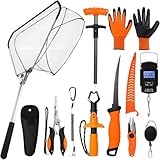
- What You Get: you will get 10 pcs fishing tool kit, including 1 pcs fishing pliers with 1 pcs lanyard and 1 pcs protective sheaths, 1 pcs fishing landing net, 1 pcs fillet knife, 1 pcs fish scale, 1 pcs fishing gripper, 1 pcs fishing hook remover, 1 pcs fishing braid scissors, 1 pair gloves; It is a good birthday or holiday gift for fishing enthusiasts
- Quality Fishing Pliers: the 6.9 inch fishing pliers are made of quality stainless steel and non-slip rubber handles, which are convenient for grabbing various hooks, as well as cutting fishing lines; And the fishing pliers come with a sheath and a retractable lanyard, which is convenient for carrying and long-term use
- Fillet Knife with Sheath: the fish fillet knife uses a stainless steel blade, which is delicate, and is ideal for fine precision cutting; The handle is designed with non-slip rubber, which can be held more steadily, safely and comfortably during use; With a plastic sheath, it is safer to carry and protects the blade when not in use
- Foldable Fishing Landing Net: small fishing landing net is made of quality net and sturdy aluminum handle; Fixed handle is 12 inches long, total handle length with hoop is 20 inches, the net is foldable for easy carrying, and the net will open and lock in place with a flip of the handle
- Other Fishing Gear Accessories: the fish scale can weigh fish ranging from 0.2 lbs to 110 lbs in size; The fish lip gripper helps clamp the fish mouth, and the fish hook remover can easily remove the fish hook and split ring; 4.5-inch folding scissors, suitable for cutting fabrics and single-strand fishing lines, and equipped with protective gloves, etc.; These fishing tools provide convenience for you to catch fish
When quotas are most likely to work
Sound biological design
The limit should match the actual management unit. A TAC for the wrong stock, an unrecognized population mixture or an incomplete accounting of mortality can appear precise while protecting the wrong biological unit. Effective systems specify the species and stock covered, use precautionary reference points, address uncertainty and account for catches discarded at sea or taken in other fisheries.
Complete monitoring and compliance
Catch limits only constrain fishing that managers can observe and enforce. Reliable reporting, independent monitoring, controls at landing, at-sea inspections, vessel tracking where appropriate, and penalties that deter violations help keep removals within the limit. Illegal landings and unreported catch can make a nominally conservative TAC biologically unsafe.
Rules that fit mixed-species fisheries
In a single-species fishery, a vessel may be able to stop when its quota is exhausted. In a mixed fishery, it may catch several species together. A quota for one species can therefore force early closure, encourage discarding, or shift pressure onto another stock unless managers coordinate limits, gear rules, area measures and discard controls. FAO identifies mixed catches and bycatch as recurring challenges in quota design (FAO discussion of TAC suitability).
Adaptive management
Fish populations respond to recruitment, climate, predators, prey and habitat conditions. A quota regime needs scheduled reviews, transparent triggers for action and the institutional capacity to reduce or redistribute fishing opportunities when evidence changes. Static rules can lag behind a rapidly changing stock.
Recommended Free Tools
Rank #2
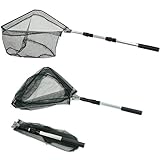
- Fishing landing net is made of sturdy netting and Aluminum handle; ensure long term performance and reliable use. Suitable catch small fish in salt water and fresh water!
- The telescopic handle extends from 18" to 36", total handle with hoop expend to 50 inches, allows for the extra reach needed to get to your catch, great for kids and adults.
- Lightweight soft mesh will not damage fish, making it a perfect tool for both beginner and advanced fishermen to use for catch and release.
- Fishing net with handle is foldable and retractable, easy fit into a storage or rod locker.
- A flip of the handle opens and locks the net into place.
How quota systems can fail
Race-to-fish incentives
A short season with a common TAC can produce a race in which vessels invest in more power, gear and capacity to secure a share before the limit is reached. The result may be dangerous fishing conditions, crowded markets and excess capacity even when the aggregate catch is capped. Individual allocations can reduce this race, but they introduce their own allocation and concentration questions.
Weak or biased catch limits
If scientific advice is uncertain, ignored or based on incomplete data, the TAC may be too high. A quota also fails if managers count only reported landings while omitting discards, recreational removals, bycatch mortality or illegal catch.
Discarding and high-grading
When vessels encounter fish for which they have no quota, they may discard them, sometimes selecting higher-value individuals and retaining lower-value ones. This undermines the conservation objective and can distort official catch data. Monitoring and rules for full accountability are essential.
Overcapacity and economic pressure
Too many vessels competing for limited shares can keep businesses financially fragile and create pressure to lobby for higher limits. Transferable systems may improve flexibility but can also concentrate quota ownership unless transfer caps, owner-operator rules or community safeguards are used.
Rank #3

- What You Get: you will get 10 pcs fishing tool kit, including 1 pcs fishing pliers with 1 pcs lanyard and 1 pcs protective sheaths, 1 pcs fishing landing net, 1 pcs fillet knife, 1 pcs fish scale, 1 pcs fishing gripper, 1 pcs fishing hook remover, 1 pcs fishing braid scissors, 1 pair gloves; It is a good birthday or holiday gift for fishing enthusiasts
- Quality Fishing Pliers: the 6.9 inch fishing pliers are made of quality stainless steel and non-slip rubber handles, which are convenient for grabbing various hooks, as well as cutting fishing lines; And the fishing pliers come with a sheath and a retractable lanyard, which is convenient for carrying and long-term use
- Fillet Knife with Sheath: the fish fillet knife uses a stainless steel blade, which is delicate, and is ideal for fine precision cutting; The handle is designed with non-slip rubber, which can be held more steadily, safely and comfortably during use; With a plastic sheath, it is safer to carry and protects the blade when not in use
- Foldable Fishing Landing Net: small fishing landing net is made of quality net and sturdy aluminum handle; Fixed handle is 12 inches long, total handle length with hoop is 20 inches, the net is foldable for easy carrying, and the net will open and lock in place with a flip of the handle
- Other Fishing Gear Accessories: the fish scale can weigh fish ranging from 0.2 lbs to 110 lbs in size; The fish lip gripper helps clamp the fish mouth, and the fish hook remover can easily remove the fish hook and split ring; 4.5-inch folding scissors, suitable for cutting fabrics and single-strand fishing lines, and equipped with protective gloves, etc.; These fishing tools provide convenience for you to catch fish
Unequal access and weak legitimacy
Initial allocations can favor historical participants, larger firms or better-capitalized operators. Excluding small-scale, Indigenous or community fishers can damage compliance and undermine social objectives even if the stock indicator improves. Allocation, participation, transparency and appeal processes are therefore part of effectiveness, not administrative details.
How to evaluate whether a quota regime is effective
Evaluation should separate how the system was designed and implemented from what it achieved. FAO’s co-management guide recommends planning the evaluation, compiling information, judging performance against indicators and feeding the findings back into adaptive management (FAO Guidebook for evaluating fisheries co-management effectiveness).
| Evaluation dimension | Questions to ask | Useful indicators |
|---|---|---|
| Biological | Does the limit cover the correct stock, and are removals compatible with rebuilding or maintaining it? | Spawning biomass, recruitment, fishing mortality, age structure, stock trend and performance against reference points |
| Ecological | Does fishing affect non-target species, habitats or food-web relationships? | Bycatch and discard rates, protected-species interactions, habitat damage and ecosystem indicators |
| Economic | Does the system support viable operations without rewarding excess capacity? | Profitability, costs, capacity, safety, employment and product quality where measured |
| Social | Who gains access, who bears restrictions and are benefits distributed acceptably? | Participation, community access, employment, food security, equity and conflict levels |
| Institutional and governance | Can authorities monitor, enforce and revise the rules legitimately? | Reporting coverage, violations, penalty effectiveness, transparency, stakeholder participation and decision speed |
A stock trend alone cannot show that quotas caused a recovery: changes in effort, gear, habitat, predation, climate, market conditions or other regulations may also matter. Conversely, a stable stock does not prove that the quota system is equitable or economically viable.
Independent reader supportYour contribution helps us test, update, and keep practical guides available for everyone.What the available evidence shows
Historical evidence illustrates why a quota should not be treated as a guaranteed solution. FAO’s 1997 publication discusses an OECD-reviewed set of 22 quota-managed fisheries: six maintained steady catch levels, while 16 experienced declines or collapses at some point. These are older, selected observations with different designs and contexts, not a current global failure rate or a controlled comparison. The same publication reports positive economic signals in selected individual-quota cases while warning about race-to-fish incentives, overcapacity, discarding, illegal landings, weak advice and allocation trade-offs (FAO quota-management performance chapter; FAO quota-management conclusions).
Rank #4

- 【Premium Floating Design Fishing Net】Engineered with integrated buoyant foam padding, our fishing net remains afloat for instant retrieval if dropped. Features a fish-friendly rubber-coated nylon mesh that prevents snagging and protects fish, making it ideal for catch and release. Ensures hassle-free and responsible fishing.
- 【Foldable & Telescopic for Maximum Portability】Incorporating a triangular folding net hoop and a retractable aluminum alloy handle, this landing net collapses into an ultra-compact form. Perfect for storage in backpacks, boats, or car trunks, offering great convenience for anglers on the move.
- 【Non-Slip Handle for All Conditions】Equipped with a bright, highly visible EVA foam handle that ensures quick spotting in low light. Its non-slip texture offers a secure and comfortable grip even with wet or cold hands, enhancing control and safety.
- 【Durable & Lightweight Construction】Built with a high-strength aluminum alloy handle and reinforced frame, this fish landing net delivers outstanding durability without excess weight. Suitable for both freshwater and saltwater environments.
- 【Complete Carrying Kit with Accessories】Includes a storage bag, elastic lanyard, and built-in belt clip for easy transport and quick access. Designed for kayak, wading, and bank fishing, keeping your gear organized and hands-free during adventures.
What current global stock figures do—and do not—prove
FAO’s 11 June 2025 global assessment reports that 64.5 percent of assessed fish stocks were at biologically sustainable levels and 35.5 percent were overfished. When weighted by production, 77.2 percent of global landings came from biologically sustainable stocks. In the Northeast Pacific, an area described as being under effective management, 92.7 percent of stocks were sustainably fished (FAO 2025 global marine stock assessment).
Those figures describe stock status and the management context in which fisheries operate. They do not isolate the causal effect of quotas from other measures such as effort controls, protected areas, gear restrictions, scientific institutions or enforcement. FAO’s 2025 release attributes strong outcomes in places including the Antarctic, Northeast Pacific and Southwest Pacific to combinations of strong institutions, comprehensive monitoring, scientific evidence, precautionary and ecosystem-based approaches—not to quotas in isolation.
A practical checklist for assessing a quota fishery
- Scope: Is the quota tied to a clearly defined species, stock, area and season?
- Science: Is the stock assessment current, peer reviewed or otherwise independently scrutinized, and explicit about uncertainty?
- Precaution: Are there reference points, rebuilding rules and automatic responses when limits are exceeded?
- Coverage: Are bycatch, discards, recreational catch, illegal catch and other sources of mortality included?
- Monitoring: Can authorities verify catches from capture through landing and sale?
- Incentives: Does allocation reduce a race to fish without encouraging high-grading, quota concentration or under-reporting?
- Ecology: Are habitat effects, protected species and food-web interactions evaluated?
- People: Are small-scale and customary users represented, and are allocation decisions transparent?
- Adaptation: Can managers change quotas quickly when new evidence or environmental conditions warrant it?
- Outcomes: Are biological gains accompanied by acceptable economic, social and governance results?
Further reading on evaluation methods
FAO’s 2022 Guidebook for evaluating fisheries co-management effectiveness is a 96-page reference focused on co-management rather than quotas alone. Its design-and-outcomes framework is useful for examining how a quota regime is planned, implemented and revised (FAO publication summary).
Quick Recap
Product prices and availability are accurate as of the date/time indicated and are subject to change. Any price and availability information displayed on Amazon at the time of purchase will apply.
Quick wins for a faster PC:
Clear out junk files and repair common Windows errorsFree Scan →Fix the driver behind crashes, sound loss and screen glitchesFind Drivers →Repair Windows errors before they cause bigger problemsFix Now →



