Quick wins for a faster PC:
Fix the driver behind crashes, sound loss and screen glitchesFind Drivers →Repair Windows errors before they cause bigger problemsFix Now →Scan for outdated or missing drivers - takes under a minuteDriver Scan →Alnashetri cerropoliciensis was a tiny, meat-eating alvarezsauroid that lived in Patagonia about 95 million years ago. Its nearly complete skeleton, described in Nature on February 25, 2026, shows that the group’s evolution was not a simple march from large dinosaurs to smaller ones.
What dinosaur was found in Argentina?
The fossil is Alnashetri cerropoliciensis, an alvarezsauroid theropod from the La Buitrera fossil area near Cerro Policía in Río Negro Province, Patagonia. Researchers describe the new specimen as the most complete and smallest South American alvarezsauroid taxon known.
Before this discovery, Alnashetri was known mainly from fragmentary leg bones. The new skeleton provides much broader anatomical evidence for identifying the animal, reconstructing its body and testing where it belongs on the alvarezsauroid family tree. The peer-reviewed description appeared in Nature on February 25, 2026.
How small was Alnashetri?
| Feature | Best-supported estimate or description |
|---|---|
| Height | Under 40 centimeters |
| Length | About 70 centimeters, with more than half of that length in the tail |
| Mass | About 1 kilogram, an estimate reported by EL PAÍS in 2026 |
| Overall scale | Roughly chicken-sized, but a small carnivorous dinosaur rather than a bird |
| Age | About 95 million years ago, during the Late Cretaceous |
| Environment | An arid or desert-like Patagonian landscape |
The animal appears to have had many small teeth and large eyes. Feathers are considered likely from its evolutionary position, but feathering is an inference rather than a directly preserved feature in the reported specimen.
#1 Best Overall

- Resin Cast Replica
- 5.5 inches
Did it really live among giant dinosaurs?
Yes—but “among” means in the same broad regional ecosystem and period, not that the skeleton was found physically beside a named giant dinosaur. Late Cretaceous Patagonia contained animals of dramatically different sizes, and Alnashetri occupied the small-predator end of that food web.
Its tiny body would not make it a miniature version of a giant theropod. Instead, it shows that an ecosystem famous for large dinosaurs also supported very small hunters with their own ecological roles.
What did Alnashetri eat?
Researchers infer that Alnashetri probably hunted small vertebrates. That interpretation should not be replaced with the specialized ant- and termite-eating lifestyle associated with some later alvarezsauroids.
Alvarezsauroids are known for an unusual evolutionary trajectory in which later members developed highly specialized digging forelimbs, minute teeth and enhanced sensory abilities. Those adaptations are linked to insect feeding in later forms, whereas the reported diet for Alnashetri is small vertebrates.
Rank #2
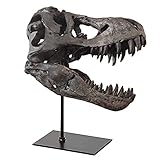
- 【Home Office Desktop Shelf Decor 】Dinosaur head sculptures skull model is hand cast from high-quality solid resin. The surface is made of antique craftsmanship, and the convincing colours and details make it look very realistic and eye-catching. Add some aesthetic to your room
- 【Supplement Your Collection】T-Rex is one of the most popular dinosaurs in the world. For dinosaur lovers or palaeontology lovers, the tyrannosaurus rex skull is a fantastic replica. It will also be a fun teaching tool for any child or teen
- 【Home Decor and Conversation Starter】A lifelike dinosaur skeleton decor. This impressive sculpture looks great on a table or bookshelf. It will be a great conversation starter and conversation piece for any family
- 【Suitable for Many Occasions】This Tyrannosaurus Rex skull replica comes with a metal base. There are 4 non-slip pads on the bottom of the stand to protect the surface of your furniture. It can be placed on various occasions such as office, hallway, TV cabinet, wine rack, living room, etc
- 【Perfect Christmas/Birthday Gift】10.2x 5.9x 11.8 inches.It only takes 2 minutes to complete the installation.Give it as a gift to children, adults, husbands, and friends, no one will refuse it
Was the dinosaur female?
Possibly, but the evidence is not conclusive. Calcium deposits in the bones could be related to producing eggs, leading researchers to suggest that the specimen may be female. Lead author Peter Makovicky cautioned that pathology remains another possible explanation, so the sex assignment is tentative.
What does the fossil change about dinosaur evolution?
The key result comes from the new phylogenetic analysis. Alnashetri falls among basal, non-alvarezsaurid alvarezsauroids and occupies an early-branching position among relatives that were generally larger-bodied.
Earlier interpretations suggested that alvarezsauroids progressively shrank as their forelimbs and feeding specializations evolved. The new analysis finds no support for that single, directional miniaturization trend. Instead, it supports repeated evolution of small body size within a relatively narrow range.
“The early branching position of Alnashetri among larger-bodied relatives revises best-fit models of body size evolution in alvarezsauroids—we find no support for evolutionary miniaturization but, rather, find support for repeated evolution within a narrow body size range,” wrote Peter J. Makovicky and co-authors in Nature.
Recommended: Update Every Outdated Driver on Your PC in One Scan - Free →Recommended: Fix Windows Errors and Clear Junk Files in Minutes - Free Scan →Recommended: Crashes or Glitches? A Free Driver Scan Usually Finds the Culprit →Special offer. See more information about Outbyte and uninstall instructions. Please review EULA and Privacy policy.Rank #3
 Utahraptor Dinosaur Life Size Raptor Claw Fossil Replica
- Utahraptor was a large theropod dinosaur that lived during the Early Cretaceous period, known for its sharp claws and hunting abilities
- This replica is based on a real Utahraptor fossil discovered in Utah, accurately capturing the shape and detail of the original claw
- The Utahraptor’s curved claw was used for gripping and slashing, making it a key tool for hunting prey
- Cast in durable resin, this 5.5-inch replica offers museum-quality detail and texture
- Made in the USA, this fossil reproduction is perfect for collectors, educators, and dinosaur enthusiasts
In practical terms, the family tree looks more like a branching pattern in which small forms evolved repeatedly than a ladder in which every lineage steadily became smaller. That distinction changes how scientists interpret the relationship between body size, forelimb anatomy and feeding behavior.
Independent reader supportYour contribution helps us test, update, and keep practical guides available for everyone.What does it reveal about alvarezsauroid biogeography?
The study also supports a model in which early alvarezsauroids had a distribution inherited from a Pangaean ancestor, followed by vicariance as landmasses separated. Under that scenario, geographic isolation helped split lineages rather than requiring tiny animals to make implausibly long journeys between distant continents.
Makovicky summarized the problem this way: “Given their size, it doesn’t make sense that an animal could have dispersed across both Asia and South America. They are the two farthest points from each other on the planet.”
The Argentine fossil therefore contributes to two connected questions: how body size evolved and how alvarezsauroid lineages became distributed across the ancient world.
Rank #4

- IT FROM XUQCAH MATERIAL AND FOIMOJSK PAR ENT AND Thurder LOVER
- Museum Quality Replica
- Please thoroughly read discription
Was it related to Tyrannosaurus rex?
Alnashetri was a coelurosaur, so it belonged to a broad branch of theropod dinosaur ancestry that also includes Tyrannosaurus rex. It was not a miniature T. rex, and it was not a direct descendant of T. rex.
The comparison is useful because it illustrates the depth of theropod diversity. Very small, lightly built predators and enormous apex predators could exist within the same broad Late Cretaceous world without one being a scaled-down version of the other.
Why a nearly complete skeleton matters
A nearly complete skeleton allows researchers to study far more than isolated leg bones. It can improve reconstructions of the animal’s muscles, movement, posture, sensory anatomy and evolutionary relationships.
Jorge Meso of Universidad Nacional de Río Negro described the specimen as “just the tip of the iceberg,” noting that it opens the way to muscle reconstruction, biomechanical locomotion analyses and paleoneurology. Those studies may refine how Alnashetri moved, found food and interacted with its environment.
Do these 3 things before closing this tab:
1Scan for outdated or missing drivers - takes under a minute2Repair Windows errors before they cause bigger problems3Fix the driver behind crashes, sound loss and screen glitchesQuick Recap
What is established—and what remains cautious?
- The species name, alvarezsauroid classification and early-branching position are based on the Nature study published in 2026.
- The height, length and mass are approximate estimates, not measurements of a living animal.
- Its likely feathers are inferred from evolutionary evidence rather than reported as directly preserved skin or feather impressions.
- The suggestion that the specimen was female is provisional because egg-related calcium deposits can be confused with pathological changes.
- Its coexistence with giant dinosaurs refers to the same broad Patagonian ecosystem and time interval, not a claim that the fossils were found in direct physical association.
Product prices and availability are accurate as of the date/time indicated and are subject to change. Any price and availability information displayed on Amazon at the time of purchase will apply.