Powelliphanta augusta, the threatened Mount Augustus snail of New Zealand, can release an egg from a genital pore on the right side of its body, immediately below the head. That location is often described as the “neck,” but the egg does not travel through the throat or respiratory system. The unusual anatomy lets the snail lay while only briefly extending from its shell.
Which snail lays eggs near its neck?
The species is Powelliphanta augusta, commonly called the Mount Augustus snail. It is found only in New Zealand and is one of at least 20 Powelliphanta species, alongside 59 recognised subspecies in the genus.
The New Zealand Department of Conservation (DOC) highlighted the animal on 7 May 2025 after ranger Lisa Flanagan filmed a captive snail laying an egg. DOC said it was the first time staff caring for their captive snails had recorded the event on video. The footage shows a small, hard-shelled egg, resembling a tiny hen’s egg, emerging from an opening below the head.
How can an egg come out through the “neck”?
Powelliphanta has a genital pore on the right side of its body, just below the head. In popular descriptions this is called the neck area because it sits so far forward, but it is a reproductive opening—not the mouth, throat or breathing passage.
#1 Best Overall
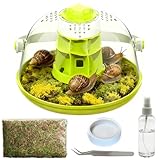
- 【Snail Terrarium Kit】Our snail observation kit includes a snail breeding box, feeding bowl, tweezers, spray bottle and 1.8 oz dried moss, covering all the basic tools needed for feeding, humidity maintenance and daily cleaning. You can easily set up a complete snail incubator ecosystem to restore the natural habitat of snails without extra time and purchase
- 【Ideal Insect Observation Container】Our insect terrariums are made of drop-resistant, sturdy plastic, safe and odor-free. The 360° transparent top design ensures plenty of light and excellent visibility, ideal for observing and studying insect behavior. The top has multi-directional ventilation holes to maintain air circulation and allow pets to grow better. All parts of the insect enclosure can be disassembled and cleaned easily
- 【Practical Feeding Accessories】The moss plays a role in natural decoration and humidity regulation, and the spray bottle assists in moisturizing, which can maintain stable temperature and humidity, provide a comfortable space for insects to grow up, and reduce stress reactions. Tweezers can feed accurately to prevent disturbing snails. A set of tools for feeding care is efficient and hassle-free
- 【Easy to Carry and Practical 】Snail breeding box design has a handle, easy to carry, want to change the position or take out the door to let snails bask in the sun, are very convenient, break the traditional breeding box heavy feeling. The central grid column provides excellent climbing and living space for snails and other insects, all designed to create an ideal habitat for your small pet
- 【Wide Application】This snail terrarium kit is suitable for a variety of small pets, including snails, tarantulas, mantis, beetles, geckos and so on. It is a practical feeding box placed on the desktop, and it is also a micro habitat with natural interest, which not only meets the feeding needs, but also decorates the living space
During mating, each hermaphroditic snail extends its penis through this pore and into its partner’s pore. The two snails exchange sperm at the same time. They can store received sperm and later use it to fertilise their own eggs.
When an egg is ready, the snail pushes it through the same reproductive opening. Because the pore is close to the head, the snail only needs to “peek” out of its shell, as DOC senior science adviser Kath Walker explained. The egg therefore emerges from a neck-side genital opening rather than passing through any part of the digestive or respiratory system.
Rank #2

- Complete Explorer's Kit – Everything in One Box:Receive a comprehensive habitat set including a 11.22" x 7.87" x 6" (28.5x20x15 cm) transparent acrylic terrarium (simple assembly required), a 7-inch climbing wall for your pets, and a 2.1oz bag of premium substrate. It's the perfect starter home for snails, isopods, pill bugs, and other small critters, making it an ideal educational gift for kids.
- Premium Crystal-Clear Acrylic for Optimal Viewing:Crafted from 0.12-inch thick high-transparency acrylic, this cage offers a crystal-clear view for observing your pets' natural behaviors. Unlike cheaper plastic, this material provides excellent clarity for STEM learning and classroom observation, allowing children to safely watch snails eat, move, and explore.
- Natural Climbing Wall & Enrichment:Encourage your pet's natural instincts with the included handmade 7-inch climbing wall. Made from natural materials, it provides a textured surface that small animals love to explore. The included natural snail substrate (simply soak, squeeze, and place) helps maintain humidity and creates a cozy, naturalistic environment that attracts snails and reptiles to play and hide.
- Sturdy Assembly & Easy to Set Up:Designed with user-friendliness in mind, the critter keeper features precision-cut pieces and special reinforced splicing openings. Simply follow the included visual instructions for a strong, durable assembly that holds its shape. Setup is a fun, quick 5-minute activity before introducing your live insect habitat to its new home.
- Important Use Tip for Lasting Durability: We‘ve prioritized ultra-clear transparency for the best viewing experience. This high-clarity acrylic is lightweight but less impact-resistant than opaque plastics. Please handle with care and avoid dropping the terrarium from
Are Powelliphanta snails hermaphrodites?
Yes. Each Powelliphanta has male and female reproductive organs. Usually, two snails mate and exchange sperm, then each stores the sperm it receives until its eggs mature. DOC also reports that occasional self-fertilisation may help a snail reproduce when neighbours are too scarce to find a mate.
Hermaphroditism does not make reproduction rapid. These snails grow slowly, reach sexual maturity at about eight years and lay only around five large eggs per year. A single egg can take more than a year to hatch.
Outdated Drivers Are Slowing You Down
One free scan finds every outdated or missing driver and matches the right update for your exact hardware.Free scan · exact hardware matchPC Slower Than It Used to Be?
A free scan shows the junk files, broken settings and background clutter dragging Windows down - then fixes them in one click.Free scan · Windows 10 & 11Rank #3

- This is a house shape geometric terrarium made of tin-selaed glass panels features a swing glass lid with latch; The two glass panels at the top are set with 4 small round acrylic sheets with airholes to allow good ventilation. It allows space for your snails
- This glass terrarium is also suitable for snails, insects, or any other mini creatures you pick up from garden or park
- NOT DESIGNED TO HOLD WATER: Not designed to hold standing water. May leak if water is added directly. However, a small spray of water to keep the interior of the terrarium moist is ok
- Suitable for miniature tabletop arrangements, It is also ideal for ferns, small succulents, small plants
- Size: 10.2 x 5.9 x 8.2 inches; What is included: terrarium only ( NO Plants )
What are the eggs and young like?
- DOC’s species account gives roughly five eggs annually for P. augusta; information for the wider genus gives about five to 10 large eggs a year.
- Powelliphanta eggs can be up to 12 millimetres long, pearly pink and hard-shelled.
- Hatching may take more than 12 months, so a population cannot recover quickly after losses.
- Some captive individuals are 25 to 30 years old, according to ranger Lisa Flanagan.
That combination—late maturity, few eggs and lengthy incubation—means that every adult and egg matters disproportionately to the survival of a local population.
How is this different from an introduced garden snail?
| Feature | Powelliphanta augusta | Introduced garden snail |
|---|---|---|
| Diet | Carnivorous; Powelliphanta prey on other invertebrates. | Generally plant-eating. |
| Reproduction | About five large eggs a year; maturity at about eight years. | DOC describes production reaching thousands of offspring, with a much shorter life cycle. |
| Eggs | Large, hard-shelled and up to 12 mm long; hatching can take over a year. | Smaller eggs produced in much greater numbers. |
| Longevity | Slow growing and long lived; captive examples are 25–30 years old. | Short-lived compared with captive Powelliphanta, according to DOC. |
| Status | Threatened, native only to New Zealand. | Introduced and widespread in many settled areas. |
Why does the Mount Augustus snail need protection?
The Mount Augustus ridgeline habitat was damaged by coal mining. After Solid Energy began mining there, DOC started captive management in 2006. Conservation teams have since established new wild populations and returned captive-bred or translocated snails to new and rehabilitated habitat.
Rank #4

- This is a house shape glass terrarium, made of tin-selaed glass panels, with a swing acrylic lid housing multiple airhoes to allow ventilation. It allows plenty of ventilation on the front acrylic panel, It allows space for your snails
- This glass terrarium is also suitable for insects, or any other mini creatures you pick up from garden or park
- NOT DESIGNED TO HOLD WATER: Not designed to hold standing water. May leak if water is added directly. However, a small spray of water to keep the interior of the terrarium moist is ok
- This product cannot be exposed to humidity, since humid environment can cause the acrylic lid warping or bending out of shape
- Size: 10.2 x 5.9 x 8.2 inches; What is included: terrarium only
Predators
Possums, rats and other introduced animals eat Powelliphanta or their eggs. Predation is especially serious for a species that replaces adults slowly.
Drying habitat
Vegetation loss and increasingly dry summers can dry the soil. Powelliphanta cannot seal their shells tightly enough to stop dehydration, so prolonged drying can kill them even when predators are absent.
Best Value

- Materials: We value the ecological link and adhere to sustainable development. Begeterday moss comes from agricultural farmland and forested areas that can be cultivated in a beautiful environment, far from pollution, ensuring the quality of the moss from the source, through artificial cultivation and careful management to obtain sustainable moss.
- Size: It comes in a small mini compressed package, please don't be fooled by its small size, it is made of 3.5 ounces of compressed moss, when you submerge it in water you will get about 4 quarts of moist moss.
- Safe and healthy: Begeterday moss has been hand-screened several times to remove the dirt, stones, leaves and twigs mixed in the natural moss to ensure that the moss is clean. We strongly resist any chemical dyes to ensure your pet can use it with confidence!
- Natural functions: Not only does it help to maintain the humidity levels in your pet snail enclosure, it provides the right environment for your snails. And it can add a touch of natural color to your pet snail environment.
- Notes: Keep the enclosure clean by removing uneaten food, maintains a healthy environment.
DOC’s response
DOC keeps threatened snails in chilled captive conditions, manages and restores habitat, and reintroduces animals to suitable sites. Captive care is a safeguard, not a substitute for protecting functioning forest and soil ecosystems in the wild.
Does it really “give birth” through its neck?
Not in the mammalian sense: the snail lays an egg rather than giving birth to a live young. The accurate description is that a hard-shelled egg exits through a genital pore positioned just below the head. “Through the neck” is a memorable shorthand for that location, not a description of an egg moving through the neck’s internal organs.
Quick Recap
Product prices and availability are accurate as of the date/time indicated and are subject to change. Any price and availability information displayed on Amazon at the time of purchase will apply.




