Yes—wahoo are members of the tuna-and-mackerel family, Scombridae. They are not tuna themselves. Wahoo are the species Acanthocybium solandri, the only species in the genus Acanthocybium. True tunas are species in tuna genera such as Thunnus. In short: wahoo and tuna share a family, but they are different fish.
What family does wahoo belong to?
Wahoo’s accepted scientific name is Acanthocybium solandri (Cuvier, 1832). NOAA places it in the following classification:
| Rank | Classification |
|---|---|
| Kingdom | Animalia |
| Phylum | Chordata |
| Class | Actinopterygii (ray-finned fishes) |
| Order | Scombriformes |
| Family | Scombridae |
| Genus | Acanthocybium |
| Species | Acanthocybium solandri |
FishBase places wahoo in the subfamily Scombrinae, alongside mackerels, tunas and bonitos. The International Commission for the Conservation of Atlantic Tunas (ICCAT) also identifies Acanthocybium solandri as a scombrid.
What “tuna family” means
“Tuna family” is a family-level description, not a statement that every member is a tuna. Family Scombridae contains several lineages. Wahoo occupy their own genus, while familiar true tunas are classified in genera including Thunnus. The precise wording is therefore: wahoo are scombrids and tuna relatives, but not tuna species.
#1 Best Overall

- 【200PCS Treble Hooks Set】20pcs 2#, 20pcs 4#, 20pcs 6#, 20pcs 8#, 20pcs 10# and 100pcs Split Ring. All the items are put in a hard and reusable fishing box.
- 【Sharp Hooks】The hook body is hard and not easily damaged. 3 fishing hooks with barbs not easy to let the fish escape.
- 【High Strength】The tweeter hook is made of high carbon steel with high strength, corrosion resistance, good toughness and not easy to bend. Fit for fresh or salt water fishing.
- 【Hooks Application】As a replacement hook, you can replace the old hook on the bait, save the cost of new bait.
- 【Split Rings】100pcs split ring made of stainless steel, suitable for connecting hooks and bait.
How can you identify a wahoo?
Wahoo have a distinctive, streamlined appearance built for speed:
- An elongated body with an iridescent bluish-green back and silvery sides.
- About 24–30 cobalt-blue vertical bars that extend below the lateral line.
- A long, narrow snout; NOAA notes that the snout is about as long as the remainder of the head.
- A large mouth armed with strong, triangular, serrated teeth.
The long snout, prominent teeth and blue bars help distinguish a wahoo from the deeper-bodied tuna commonly seen in seafood markets. Color can fade after capture, so body shape and the tooth-filled mouth are useful additional clues.
How large do wahoo get?
Published maximums differ because they come from different datasets and measurement systems:
Rank #2
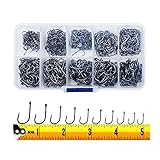
- OUR PRODUCTS: A reasonable combination of fish hooks, 3#, 4#, 5#, 6#, 7#, 8#, 9#, 10#, 11#, 12#, a total of 10 types of fish hooks 30PCS each.
- SPECIAL DISIGN: Sharp tip with barbs, to ensure that the fish caught by the hook is not easy to break free, tail with holes, easy to thread quickly and lock the fish hooks.
- HIGH QUALITY MATERIAL: The fishhook is made of high carbon steel, excellent material, high strength, high toughness, corrosion resistance.
- HIGH APPLICABILITY: Fishing hooks are suitable for all kinds of fresh and saltwater environments, allowing you to catch salmon, carp, bass and many other fish easily.
- AFTER-SALES SERVICE: Thank you for your purchase!If you have any quality problem when you receive the product or use the product, please contact us in time. We will ensure to provide you with satisfactory service.
| Source and context | Reported size |
|---|---|
| NOAA Fisheries, 2026 Pacific profile | Up to 8 feet and 158 pounds; common Pacific fish are about 3.3–5.4 feet long. |
| FishBase database record accessed in 2026 | Maximum length 250 cm total length and maximum published weight 83.0 kg. |
These figures should not be treated as one standardized record. The NOAA figures use feet and pounds and include a “common” range, while FishBase reports a metric maximum from its compiled records.
Where do wahoo live?
Wahoo are offshore, oceanic, near-surface predators. FAO describes them as an “offshore epipelagic species.” FishBase gives a recorded depth range of 0–20 metres, usually 0–12 metres.
They occur in tropical and subtropical waters of the Atlantic, Indian and Pacific oceans, including the Caribbean and Mediterranean seas. Their broad range explains why anglers encounter wahoo in many warm-water ocean regions rather than in one restricted habitat.
Rank #3

- 【200PCS Treble Hooks Set】20pcs 2#, 20pcs 4#, 20pcs 6#, 20pcs 8#, 20pcs 10# and 100pcs Split Ring. All the items are put in a hard and reusable fishing box.
- 【Sharp Hooks】The hook body is hard and not easily damaged. 3 fishing hooks with barbs not easy to let the fish escape.
- 【High Strength】The tweeter hook is made of high carbon steel with high strength, corrosion resistance, good toughness and not easy to bend. Fit for fresh or salt water fishing.
- 【Hooks Application】As a replacement hook, you can replace the old hook on the bait, save the cost of new bait.
- 【Split Rings】100pcs split ring made of stainless steel, suitable for connecting hooks and bait.
What do wahoo eat and how do they behave?
Fast, fish-eating predators
Wahoo are rapid piscivores that also eat squid. NOAA lists frigate mackerel, butterfish, porcupine fish and round herring among documented prey. Their diet overlaps with that of tuna, so the two groups can compete for similar forage.
Solitary hunters rather than schooling tuna
FishBase reports that wahoo are often solitary or found in small, loose aggregations instead of compact schools. This is an ecological difference from the strongly schooling behavior associated with many tuna fisheries.
The Tool Desk
Outbyte Driver Updater FREEScan for outdated or missing drivers - takes under a minuteDriver Scan →Outbyte PC Repair FREERepair Windows errors before they cause bigger problemsFix Now →Why the teeth matter
NOAA scientists theorize that wahoo’s sharp teeth allow them to process prey larger than themselves into bite-size pieces. The teeth are therefore part of the animal’s feeding adaptation, not merely an identification feature.
Rank #4

- Enough Quantity and Sizes - Afmivs worm hooks for bass fishing hooks, 6 sizes fishing hooks freshwater. 20pcs each for #1, 1/0, 2/0, 3/0, 15pcs each for 4/0 and 5/0, total 110pcs/box. fishing hook meet your needs, ensure the fun of fishing!
- Easy to Carry - 110pcs bass hooks fishing are nicely combined in a reusable super hard plastic box. the fishing worms box sizes 4.6x3.1x0.9 inches and has a hanging loop on the side for safety, practicality and easy portability!
- Wide Range of Use - offset worm hooks for bass fishing, ewg bass hook, trout hooks, bass hooks for plastic worms and offset hooks for bass fishing. hooks for fishing suitable for catching a variety of fish in freshwater and saltwater.
- High Quality of Materials - fishing hooks for bass are made of strong carbon steel, mechanically ground hook points for better penetration, barbs to help you catch your prey better and good rust resistance in fresh and salt water all well.
- 100% Satisfaction Guarantee - worm hook, very sharp, please use with care and keep them away from children. if there is any problem with our products, please contact us, afmivs team will be very happy to help you solve the problem.
When and how do wahoo reproduce?
NOAA reports year-round spawning in tropical waters and summer spawning at higher latitudes. Females can release millions of eggs annually. NOAA’s Atlantic profile estimates annual egg production at approximately 0.5 million to 45 million eggs, while its Pacific profile likewise describes production in the millions.
Because spawning timing and egg output vary with latitude, population and individual size, these are broad biological estimates rather than a fixed number for every female.
Independent reader supportYour contribution helps us test, update, and keep practical guides available for everyone.Are wahoo and tuna the same fish?
No. Their relationship is best understood across several biological and practical differences:
Windows Errors? Fix Them Before They Spread
Repair common Windows errors and clear accumulated junk for a smoother, more stable PC - no reinstall needed.Free scan · no reinstallOutdated Drivers Are Slowing You Down
One free scan finds every outdated or missing driver and matches the right update for your exact hardware.Free scan · exact hardware matchBest Value
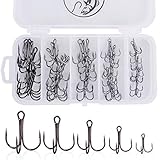
- Unique Design: Barb hooks, Extremely sharp, Closed eye, Small wide gap, Special bend. 3 curved hooks back and barbed designed. The snagging hooks point combines a more efficient point design with a new sharpening process to enhance the quality. Our treble hook set is a perfect gift for emergency repairs for damaged fishing hooks on your lure
- High Strength and Corrosion Resistance: Quick penetration, the treble hooks tip is sharper than other fishing hooks. The stability is strong, more preventing fish from escaping. Suitable for freshwater and saltwater fishing
- Premium Quality: Treble Hooks are made of 2X Strong High Carbon Steel with black nickel coating. Super Needle Points, very sharp saltwater freshwater hooks to catch the big fishes
- Perfect Choices for Fishing Enthusiasts: Perfect and reliable replacement treble fishing hooks. Treble Hooks are loaded in a re-usable plastic box, perfect for damaged hooks on your lure. Great gift for novice and experienced anglers
- What you Get: 50pcs sharp treble hooks for size 2#,4#,6#,8#,10#. 5 different sizes of fishing hooks are well assorted in a reusable ultra hard plastic box
| Comparison | Wahoo | True tunas |
|---|---|---|
| Family | Scombridae | Scombridae |
| Genus | Acanthocybium | Several genera, especially Thunnus |
| Species | Acanthocybium solandri | Multiple tuna species |
| Typical appearance | Very elongated body, long snout, blue vertical bars and serrated teeth | Generally more familiar tuna body forms; appearance varies by species |
| Social pattern | Usually solitary or in small, loose groups | Many species commonly form schools, depending on species and life stage |
| Water column | Near-surface epipelagic waters, usually 0–12 m in FishBase’s account | Varies among tuna species |
| Seafood name | Marketed and managed as wahoo | Marketed by individual tuna species or tuna categories |
Calling wahoo simply “tuna” erases the genus and species distinction. Calling them a close family relative of tuna is accurate.
How are wahoo caught and managed?
NOAA describes U.S. wild-caught Pacific and Atlantic wahoo as managed under U.S. regulations. The Atlantic profile lists rod-and-reel, handline, bandit and pelagic-longline gear, and identifies wahoo as popular with recreational fishermen.
NOAA’s 2024 recreational-landings figures were 3.6 million pounds for the Pacific profile and 1.6 million pounds for the Atlantic profile. These are regional U.S. recreational-landings totals, not estimates of worldwide commercial or recreational catch.
What is wahoo like as a food fish?
NOAA describes wahoo as lean, mild and firm, with large flakes after cooking. It is sold as a distinct seafood rather than as tuna because it is a different species with its own fishery and market identity.
Do these 3 things before closing this tab:
1Clear out junk files and repair common Windows errors2Scan for outdated or missing drivers - takes under a minute3Repair Windows errors before they cause bigger problemsPreparation, handling and local consumption advisories can affect whether a particular fish is suitable to eat. Those considerations are separate from its taxonomic relationship to tuna.
Bottom line: a tuna relative, not a tuna
Wahoo belong to Scombridae, the same family that contains tunas, mackerels and bonitos. Their own genus and species—Acanthocybium solandri—make them a separate branch of that family. The clearest answer is: wahoo are part of the tuna family in the taxonomic sense, but they are not a type of tuna.
Quick Recap
Product prices and availability are accurate as of the date/time indicated and are subject to change. Any price and availability information displayed on Amazon at the time of purchase will apply.




