No fish can be said to “only swim at night” based on the examples covered here. Some species are more active after dark, when they feed or hunt, while resting, schooling or sheltering during the day. Gray snapper, grunts, nurse sharks, sailfin sculpins and sweepers are examples—but their habits depend on species and habitat.
What does it mean for a fish to be active at night?
“Nocturnal” describes a daily activity rhythm, not a rule that a fish never moves in daylight. A fish may shelter or school by day and forage after dark; another may emerge from cover to hunt. Feeding, movement and resting can follow different schedules, and environmental conditions can influence those rhythms. A 2024 review of fish sleep and activity discusses this variation rather than establishing one schedule for all fish: the review article.
Nighttime prey can help explain the timing. The National Aquarium identifies prey availability at night as one indicator of nocturnal behavior in its Aquarium After Dark article.
Examples of fish that feed or become active at night
| Fish | Night behavior | Day behavior or habitat | Where documented |
|---|---|---|---|
| Gray snapper (Lutjanus griseus) | Forages at night over seagrass for small fish, shrimp, crabs, gastropods and cephalopods. | Adults school during the day. | South Florida seagrass beds; Florida Museum of Natural History and University of Florida. |
| Grunts | Feed at night over nearby seagrass. | Live on reefs during the day. | South Florida; the University of Florida account does not identify a grunt species in this passage. |
| Hardhead catfish (Arius felis) and other seagrass visitors | Visit seagrass beds at night. Other named visitors include fantail mullet, Atlantic thread herring, scaled sardine, silver perch and ladyfish. | Daytime behavior is not specified for these visitors in the cited account. | South Florida; University of Florida. |
| Nurse shark (Ginglymostoma cirratum) | Hunts near the bottom for fish, stingrays, mollusks and crustaceans. Adults and large juveniles may move into shallower water after dark. | Rests on sandy bottoms, in caves or crevices. | Florida Museum of Natural History. |
| Sailfin sculpin (Nautichthys oculofasciatus) | More active at night, feeding on zooplankton, small crabs or fish. | Specific daytime behavior is not stated in the cited account. | NOAA describes the species’ range from the Northern Bering Sea to central California: NOAA Fisheries. |
| Temperate-reef sweepers (Pempheris affinis and P. multiradiata) | Most emerged into the water column at night in a New South Wales field study. P. multiradiata made extensive horizontal and vertical movements; tagged P. affinis often moved less than 20 m. | Sheltered at deeper reef sites during the day. | Temperate reefs in New South Wales; Annese and Kingsford (2005), “Distribution, movements and diet of nocturnal fishes on temperate reefs”. |
Why do some fish feed after dark?
Night can change where prey are available and how fish move between feeding and shelter. In the New South Wales sweeper study, amphipods eaten by large pempherids were found only at night and were concentrated in shallow water. That is a finding about those fish and that study site, not a universal explanation for nocturnal feeding.
The Tool Desk
Outbyte Driver Updater FREEScan for outdated or missing drivers - takes under a minuteDriver Scan →Outbyte PC Repair FREEClear out junk files and repair common Windows errorsFree Scan →#1 Best Overall

- HALF MOON AQUARIUM KIT: Clear plastic, half-moon-shaped front allows for unobstructed viewing.
- IDEAL FOR BETTAS: Bettas require minimal maintenance and make great species for beginners.
- MOVABLE LIGHT: Energy-efficient LEDs can be positioned to light tank from above or below.
- CONVENIENT FEEDING: Clear canopy has a hole to make feeding fish easy.
- PERFECT FOR BEGINNERS: Small aquariums like this 1.1-gallon tank are a great way to get started in the freshwater fishkeeping hobby.
South Florida reef-associated fish illustrate another pattern: some live or school on reefs by day, then feed over nearby seagrass after dark. The movement is tied to the habitat and food available there, rather than a claim that the fish are inactive throughout daylight.
Are all members of these species active at night?
Not necessarily. The examples describe observed tendencies, not an identical schedule for every individual. The New South Wales study found differences even between two related sweeper species, and a 2024 review describes activity rhythms as responsive to environmental cues. Species, habitat, size and conditions can all matter.
Rank #2
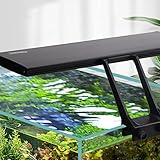
- DEFAULT MODE(24/7 Natural Mode): Gradient Orange light (sunrise) from 6am to about 8am; Gradient White light from about 8am to 10:00pm/22:00; Gradient Blue light (moonlight) from about 10:00pm/22:00 to 10:50pm/22:50; The 24/7 lighting aquarium lights are off in other time periods. The overall default time period can be delayed or advanced
- DIY MODE: Full spectrum aquarium light also can change the time + brightness + color. Setting time(TIMER key): 3 kinds of time, 6h, or 10h, or 12h; Brightness(up/down key): 5 kinds of brightness. Color(ON-OFF/ M key): White, Red, Blue, Green, Purple, Orange, Cyan, Cycle Color (no brightness selection)
- NEW UPGRADE: Clip style bracket( tank walls less than 0.9in thick), easy to install, aquarium LED light can be used for different thickness of glass, the body of the fish tank light can be taken off and installed horizontally or vertically. The separable adapter, even if it is damaged, no need to replace the whole light to avoid waste. Thicken aluminum to increase heat dissipation efficiency
- USEFUL FISH LIGHT: The hygger aquarium light is soft, the color rendering index is close to natural light, up to 85%, protecting eyes and fish, to refuse the discomfort caused by stroboscopic for fish and viewers. Using high-quality 2835 + 5050 model lamp beads, long service life, at least 50,000 hours. Easy to maintain
- 14W PRODUCT PARAMETERS: Power:14W; Led QTY:68PCS(White:32PCS/BLUE:12PCS/ RED:7PCS/GREE:3PCS/ RGB:14PCS); CRI:85; Application(for Fish Tnak long):12’’-20’’ ; Power Cord: 4.9ft+2.3ft; Input Votage:AC100-240V; Output Votage:DC20V; Kelvin: White 6500K, Blue 455nm, Red 620nm, Green 560nm; Lumens:817
There is no established global count or exhaustive inventory here of fish species active at night. The examples above are region-specific observations: South Florida seagrass and reefs, New South Wales temperate reefs, and the broad range reported for sailfin sculpin.
Quick Recap
Best Value

- Made of high grade driftwood, solid and durable, long lasting in underwater or arid environments
- Authentic natural wood adds realistic beauty.Unique shapes that adds to the aesthetic value of the tank
- Prolonged boiling recommended,boiling/soaking for 3-4 hours. You have to boil it for at least an 1 hour (maybe twice boiled and dump the tannin concentrated water midway both times). Afterwards, completely submerge the wood in a bucket with water, weighing it down with something i.e. a rock , heavy glass cup etc, until it doesn't float anymore when the weight is taken off.
- Visual variety - no two pieces are alike.Sizes varies from 5 to 9 inches in length.Each pieces are carefully selected, the pictures shown are only some of the driftwoods, what you get may be different from pictures show
- Your driftwood will quickly become the focal point of your aquarium decor. Nocturnal fish,ghost shrimp and smaller fish like a driftwood shelter for hiding
Rank #4
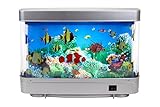
- No.1 IN SENSORY AQUARIUMS SINCE 2007 Lightahead is the undisputed pioneer of Sensory Aquariums, having introduced this innovative product before any of its competitors. Their revolutionary Sensory Aquariums have set an unbeatable standard in the industry, providing customers unparalleled calming and therapeutic benefits. You deserve the best, so you should choose Lightahead over Imitations. Please don't settle for less, trust the brand that started it all and experience the difference yourself.
- EXPERIENCE THE LIGHTAHEAD DIFFERENCE :PIONEERS IN AQUARIUM LAMPS: Fascinating and mesmerizing “MOVING PICTURE” of realistic, lifelike fish in a tank creates a beautiful, tranquil, peaceful, and soothing deep-sea ambiance. This can help reduce stress and is great for adults, seniors with special needs, including dementia, ADHD, and autism. It may help improve mood and well-being. Please note that the tank contains a moving picture of vibrant and colorful fish and not real or fake fish.
- Lightahead Artificial Tropical Fish Aquarium is a fascinating alternative to a regular aquarium. A moving picture creates the illusion of water and tropical fish in motion. Multi Colored Artificial Fish. A virtual Ocean in Motion> There may be a little sound of the motor while operating .However it will be minimum. Adapter included
- Realistic Tranquil, peaceful, soothing beautiful deep-sea environment for home or office.A great stress-buster.Ideal for your desktop, living room and practically any other room in your house. Great gift for anyone who loves sea life or simply wants to make a unique design statement. Very easy to install. No maintenance required. Approx 12 x 10 inches.It is 110V with USA Plug
- For best performance, please follow these guidelines: 1. Please do not place in the following locations: a. Near strong vibrations b. In dusty areas 2. Do not touch while in motion 3. Do not clean with paint or other chemical materials. Please use mild soap or cleaner as a cleaning liquid. 4. This product is not designed for lighting purposes and should not be used continuously for periods exceeding 8 hours. 5. Do not place the product near flammable objects or curtains. Please contact us if you face any issues while operating the product..6.It is Teflon/ptfe/pfoa free.
Rank #3

- Fast-Sinking Wafers for Bottom Feeders: Large 13–14mm wafers sink rapidly to give Plecos, Catfish, Loaches, and other bottom-dwelling fish quick access to nutrition where they naturally feed
- Designed for Nocturnal Feeding: Scrapers remain firm in water for hours, providing an extended feeding window for nocturnal species that become active after the aquarium lights go out
- Cellulose for Natural Feeding Needs: Formulated with cellulose extract from Stinging Nettles to help provide an important dietary component for Plecos and Catfish that naturally scrape wood, roots, and other surfaces
- Nutrient-Dense Ingredient Blend: Green peas are combined with fish, herring, kelp, shrimp, and spirulina to provide a diverse blend of plant- and marine-derived nutrition for bottom-dwelling species
- Encourages Natural Feeding Behavior: The large, durable wafer format allows Plecos and other scrapers to graze over time, helping replicate the feeding behavior they exhibit on submerged surfaces in their natural environment
Sources
- University of Florida, South Florida Aquatic Environments: “Life in Seagrasses.”
- Florida Museum of Natural History, Discover Fishes: “Nurse Shark.”
- Florida Museum of Natural History, Discover Fishes: “Gray Snapper.”
- NOAA Fisheries: “A View From Inside the Kodiak Lab Aquarium – Post 3.”
- Danielle M. Annese and Michael J. Kingsford, “Distribution, movements and diet of nocturnal fishes on temperate reefs,” Environmental Biology of Fishes 72 (2005), pp. 161–174. Article.
- National Aquarium: “Aquarium After Dark,” March 28, 2022.
- “The interplay between sleep and ecophysiology, behaviour and responses to environmental change in fish,” 2024 review article.
Product prices and availability are accurate as of the date/time indicated and are subject to change. Any price and availability information displayed on Amazon at the time of purchase will apply.