What’s actually slowing this PC down?
Pick the symptom - the matching free tool is one click away.
Archerfish catch many prey by shooting a pulsed jet of water at an animal above the surface. The impact knocks it into the water, where the fish can eat it. Studies also show that archerfish can adjust their shots, and that smallscale archerfish can jump out of the water to capture prey.
How does an archerfish use water to catch prey?
An archerfish sights an insect or other prey above the water, aims its mouth toward it, and expels a jet that knocks the target down. The fish then takes the fallen prey from the water. This is the best-known feeding method, but the jet is not simply a fixed squirt: experiments show that its dynamics can vary with the feeding context.
How does the water jet deliver an impact?
In a study of Toxotes jaculatrix, researchers proposed that hydrodynamic instability in the pulsed jet helps gather water into a larger drop as it travels. That drop can strike with substantial momentum, amplifying the impact at the target rather than relying on an internal structure in the fish that stores unusually large mechanical energy (Vailati, Zinnato, and Cerbino, 2012).
The same study estimated typical specific power at impact at about 3,000 W/kg and cited about 500 W/kg as the estimated maximum specific power deliverable by vertebrate muscle. These are study-specific estimates, not exact values for every fish or shot (Vailati, Zinnato, and Cerbino, 2012).
#1 Best Overall
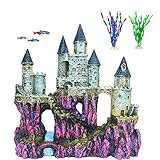
- High Quality Material:Castles for aquariums is made of environmental protection resin material.safe and non-toxic and non-pollutant fish tank castle decorations,castle for fish tank doesn’t pose harm to your aquatic animals nor create any ill impact on water quality
- Product Features:The resin castle fish tank unique structure design,Vivid colors description and realistic image make decorations look beautiful and elegant.Also it looks more brighter and colorful underwater.Fish can in the castle clearance swim shuttle back and forth provides shelter,hiding spots,entertainment venues for the fish,which will become the unique scenery of home
- Specification Size:The Resin castle driftwood size is approximately 9.1x3.6x10.0 inches(LxWxH),Weight Approx 1.3 lb.Castle won't fade when the time goes long,Castle aquarium decor absolutely safe for fish and best of all,fish castle for aquarium won't die, rot or cause any algae problems.Tip: Please check if the product size will fit your pet before you buy
- Application:Aquarium castle decorations is doubled sided and flat bottom designed and can be placed anywhere ornament in your fish tank.Large castle aquarium decor is perfect for all in medium&large size freshwater&saltwater aquariums
- Suitable Pets:Aquarium decor castle can be used for guppies,shrimp,cichlid,small animals. fish tank castle is adds a mysterious to your fish tank,Provide a place for to have fun and for fish to breed,play and feed
Can archerfish adjust their shots?
Yes. Research on aerial and underwater shooting reports the same basic dynamic mechanism in both settings. In underwater trials, fish used a short pulse to lift food from a substrate made of large particles and a longer pulse over finer-grained substrate. These are findings from experimental conditions, not a rule that applies to every feeding situation (underwater shooting study; aerial and underwater shooting study).
Archerfish also maintain shot impact over a range of tested distances. In experiments with Toxotes chatareus, average force on the target at the farthest tested distance—5.8 body lengths—was less than 15% lower than at the closest distance, 2.3 body lengths. When offered two targets, fish tended to shoot at the closer one first. These results describe that species and those experimental distances, not a universal performance guarantee (2015 force study).
Do archerfish ever catch prey without shooting it?
Yes. Smallscale archerfish (Toxotes microlepis) have been observed jumping out of the water to capture prey. Shih, Mendelson, and Techet described the behavior in three phases: “hovering to sight prey at the surface,” a rapid upward thrust, and gliding toward prey after leaving the water. Their study reported jumps up to 2.5 body lengths (Shih, Mendelson, and Techet, 2017).
Rank #2

- Reliable Fish Net To Use --- Its soft nylon mesh material will not affect your fish during transfer. The fine holes will not make gill plates or fins to be stuck or cause injury.
- Your Maintenance Equipment is Right Here! --- For anyone who owns or takes care of home aquariums would know that maintenance doesn't come effortlessly.
- Durable, Vinyl-Coated Handle --- The plastic coating that frames the neck of the fish net offers an overall sturdier grip, and the cushiony soft padding wrapped around the handle allows for a smooth and comfortable grip.
- Refined Mesh Netting for Smoother Flow --- Made out of a soft, close-knit mesh and delicate nylon that avoids discomfort for the fishes when capturing. The fine netting endorses smooth and fluid movements through your aquarium's water without a hitch.
- Not Just a Single Use Object! --- SunGrow's aquarium net fine mesh is not made just to capture your fish. You can also use it to fish debris out or separate it from your tank such as extra food and excessive decoration.
Jumping is a documented alternative in this studied species; the available studies do not establish how often wild archerfish use jumping rather than shooting across the genus, species, or habitats.
Free tools Windows power users keep installed
One-click scans. No signup required.
How shooting and jumping differ
| Method | Where the prey is | Capture sequence | Evidence described |
|---|---|---|---|
| Water jet | Above the surface, or food on an underwater substrate in experiments | The fish shoots a pulsed jet; prey is dislodged and then taken from the water | Aerial and underwater shooting studies, including work on Toxotes jaculatrix and distance tests with Toxotes chatareus |
| Jump | At or above the surface | The fish sights prey, thrusts upward, then glides toward it after leaving the water | Observed and analyzed in smallscale archerfish, Toxotes microlepis |
The methods are not shown to be mutually exclusive across archerfish. The evidence establishes capabilities in particular studies, not the relative frequency of each method in the wild.
Quick Recap
Product prices and availability are accurate as of the date/time indicated and are subject to change. Any price and availability information displayed on Amazon at the time of purchase will apply.




