
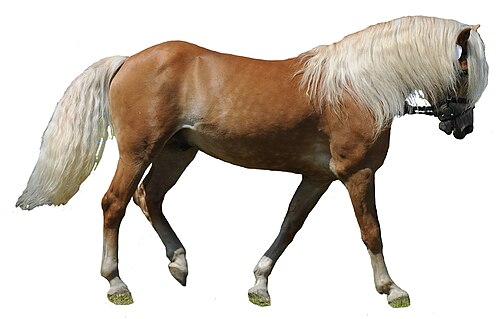
 Photo: Böhringer Friedrich · CC BY-SA 2.5
horse breed · 671 on Animalso
Haflinger Horse: Origin, Work and Traits
- Animal
- Horse
- Origin
- Italy, Austria
- Weight
- 415 kg
The Haflinger, also called the Avelignese, is a horse developed in Austria and northern Italy in the late 19th century. It was shaped for mountainous terrain and later used as a military packhorse. The breed is always chestnut with a flaxen mane and tail. Its recorded weight is 415.
What the Haflinger is
The Haflinger is a horse breed developed in Austria and northern Italy during the late 19th century. It is also known as the Avelignese.
Its history is tied to work in mountainous terrain. During World War II, breeders favored shorter, more draft-like horses for military pack work.
Getting to know the breed
The breed traces its ancestry to the Middle Ages, although several origin theories exist. Its modern form reflects Arabian and other European bloodlines added to native Tyrolean ponies.
Every Haflinger traces its lineage to the foundation sire 249 Folie through one of seven bloodlines.
Notable traits
Haflingers are relatively small and well muscled, with an elegant build. They are always chestnut and have flaxen manes and tails.
Their gaits are described as energetic but smooth, and the breed is known for hardiness in mountain country.
Points to check
The recorded weight is 415. No height or life-expectancy figure is provided here.
The breed's appearance and size changed over time. After World War II, breeding shifted toward greater refinement and height.
Price
No purchase price is provided for the Haflinger in these facts.
Who may want another breed
If you need a horse selected for a different historical job, compare it with other horse breeds. Readers focused on Italian origins can also browse horse breeds from Italy.
Verdict
The Haflinger suits readers drawn to a compact mountain horse with a documented Austrian and northern Italian history. Its chestnut coat, flaxen hair and seven-lineage ancestry make it easy to recognize. Choose another breed if the information available here does not cover the height or lifespan details you need before deciding.
What stands out
- Developed in Austria and northern Italy.
- Bred for work in mountainous terrain.
- Always chestnut with a flaxen mane and tail.
- Lineage traces to 249 Folie through seven bloodlines.
Worth knowing
- Height is not recorded in the supplied facts.
- Life expectancy is not recorded in the supplied facts.
- Its historical type changed after World War II.
Suits
- Readers seeking a compact mountain-work horse.
- People interested in Austrian and northern Italian origins.
- Those drawn to chestnut horses with flaxen hair.
Think twice if
- You need a documented height or life-expectancy figure before choosing.
- You want a breed with a different historical working role.
In short
Choose the Haflinger if you want a relatively small horse linked to mountain work, with a chestnut coat, flaxen mane and tail, and a recorded history reaching back through 249 Folie. Its background also includes military packhorse use. Consider another breed when height or life expectancy must guide your choice, because those figures are not supplied here. The breed’s story includes changes in size and refinement after the wars, so its historical type is not fixed to one period.
Questions
What is another name for the Haflinger?
The Haflinger is also called the Avelignese.
Where did the Haflinger originate?
It was developed in Austria and northern Italy. The listed origin is Italy.
When was the Haflinger developed?
The breed developed during the late 19th century.
What work was the Haflinger bred for?
It was developed for use in mountainous terrain. During World War II, shorter, draft-like horses were favored as military packhorses.
What color is a Haflinger?
Haflingers are always chestnut with a flaxen mane and tail.
How much does a Haflinger weigh?
The recorded weight is 415.
How is Haflinger ancestry organized?
All Haflingers trace their lineage to foundation sire 249 Folie through one of seven bloodlines.
More horse breeds from Italy
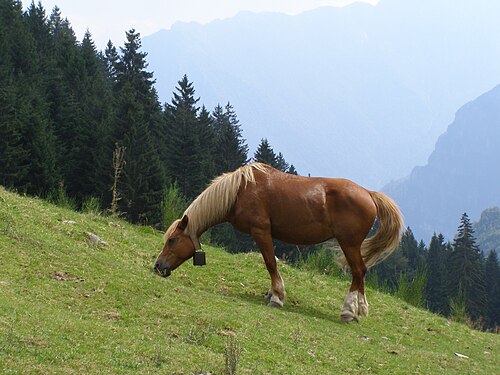 Avelignese Italy Photo: Nicola Fotonico · CC BY-SA 4.0
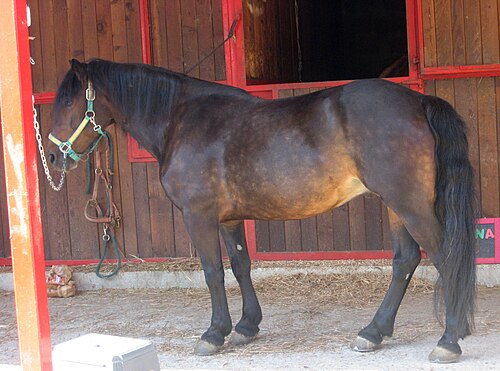 Bardigiano Italy Photo: Fioravante Patrone · CC BY 3.0
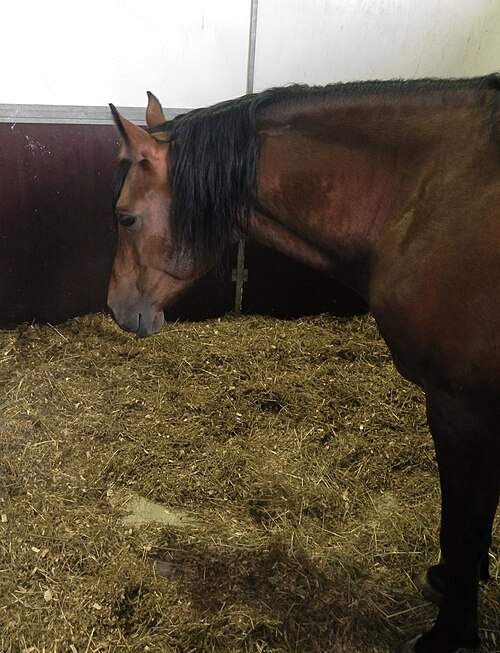
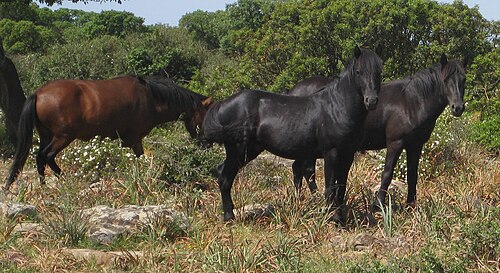
Photo credits9 photographs on this page
- Haflinger — Böhringer Friedrich · CC BY-SA 2.5 · file page
- Avelignese — Nicola Fotonico · CC BY-SA 4.0 · file page
- Bardigiano — Fioravante Patrone · CC BY 3.0 · file page
- Catria horse — Justlettersandnumbers · CC BY-SA 4.0 · file page
- Cavallo Appenninico — Justlettersandnumbers · CC BY-SA 3.0 · file page
- Cavallo del Delta — Justlettersandnumbers · CC BY-SA 3.0 · file page
- Cavallo Romano della Maremma Laziale — Justlettersandnumbers · CC BY-SA 3.0 · file page
- Esperia Pony — Justlettersandnumbers · CC BY-SA 3.0 · file page
- Giara horse — Helga Steinreich · CC BY-SA 3.0 · file page
Photographs come from Wikimedia Commons under the licence each one names. How Animalso credits photographs.