Crashes, No Sound, or Screen Glitches?
Random freezes, missing sound and display glitches usually trace back to one bad driver. Find and replace yours safely.Free scan · under a minutePC Slower Than It Used to Be?
A free scan shows the junk files, broken settings and background clutter dragging Windows down - then fixes them in one click.Free scan · Windows 10 & 11Mollies can share an aquarium with many peaceful community fish, but sharing a tank is not the same as producing hybrids. Mollies reliably reproduce with other mollies; documented crosses are concentrated within the genus Poecilia. Most usual tankmates—including guppies—are compatibility choices, not proven molly breeding partners.
Can mollies breed with other fish?
Usually, no. A molly may court or live alongside another species without producing offspring. Check two separate questions: whether the fish can tolerate the same aquarium, and whether their reproductive biology is compatible.
Documented molly-to-molly hybrids
Evidence is strongest among closely related Poecilia species. In a 1997 laboratory study, George and Pandian reported that 70% of attempts to cross the sailfin molly (Poecilia velifera) with the shortfin molly (P. sphenops) produced true hybrids. Most of those hybrids were infertile, so a successful mating did not establish a fertile new line. The same study reported a 40% reduction in fecundity after heterospecific insemination. These are controlled laboratory findings, not a prediction that the same percentage will occur in a community aquarium.
Another sailfin-molly cross
Ptacek’s 2002 study documented reciprocal crosses between sailfin molly (P. latipinna) and Atlantic or shortfin molly (P. mexicana). First-generation males showed intermediate dorsal-fin traits, and courtship behavior varied partly according to which species was the father. This supports the possibility of crosses among some closely related mollies, while also showing that results can depend on the direction of the pairing.
#1 Best Overall
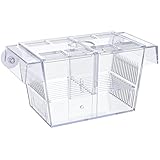
- Medium Hatching Box: With inner size of 5.3" L x 3.5" W x 3.9" H, it protects newborn fry from being eaten or attacked, improving the survival rate of newborn fish.
- Versatile Uses: 2 removable separators constitute 3 rooms. The bottom is the hatchery for baby fish, and another 2 rooms can be used to isolate aggressive or sick fish.
- Floating Design: The balancing panel and 2 handles help keep the box floating in water, it can also be secured inside the tank with 2 suction cups. Space-saving during use.
- Acrylic Material: The highly transparent acrylic box allows you to watch the breeding process or fish fighting without any barriers, bringing you with endless enjoyment.
- Easy to Use: The incubator can be easily installed or disassembled for cleaning without any tool. And its side vents ensure optimum water flow, requiring no heater or air pump.
The Amazon molly is a special case
The Amazon molly (P. formosa) reproduces gynogenetically: sperm from a compatible relative can trigger development. A 2023 study found this activation with sperm from several related Poecilia and Limia species, whereas males from several other poeciliid genera did not produce offspring or late-stage embryos. This specialized system is not evidence that an ordinary community fish will hybridize with a molly.
Can mollies and guppies mate?
Guppies are commonly listed as compatible community tankmates, but a direct, reliable rate for ordinary guppy–molly hybridization has not been established in the available primary evidence. Treat guppies as companions rather than a dependable breeding partner. If a seller or hobbyist reports a guppy–molly hybrid, ask for a specific, verifiable source before treating the claim as settled.
Rank #2

- Safe & secure tank for breeding, isolating or acclimating fish
- Multi-purpose use
- Space saving design
- Hangs on the outside of the aquarium
- 0.3 gallons
What fish can live with mollies?
Aquarium Co-Op’s practical rule is: “They do well with other community fish that live in similar environmental conditions and are close in size to avoid predation.” Common possibilities include the following, provided the individual species, tank and filtration are suitable.
| Tankmate group | Why it is considered | Checks before adding | Fry outlook |
|---|---|---|---|
| Platies | Peaceful livebearers often kept in similar community setups | Match adult size, temperature and hardness/pH; plan for rapid reproduction | Newborns may be eaten by tank inhabitants |
| Guppies | Commonly listed peaceful livebearers | Do not assume hybrid offspring; account for their own breeding and long fins | Fry can be lost to adult fish |
| Swordtails | Community livebearers with similar care considerations | Allow for adult size, swimming room and population growth | Protect fry if survival matters |
| Tetras and rasboras | Often suitable schooling community fish | Verify temperature, hardness/pH, school size and adult size | Any free-swimming fry may be prey |
| Danios | Active community fish listed by Aquarium Co-Op | Provide room for constant activity and ensure they are not outcompeted | Use cover if you want to raise babies |
| Rainbowfish | Potential companions when size and conditions overlap | Check the adult species’ size, swimming space and filtration demand | Assume some fry predation in a mixed tank |
| Corydoras | Bottom-oriented community catfish frequently used with livebearers | Match water conditions and maintain adequate floor space | Do not rely on them—or any other fish—to leave fry alone |
| Loaches and barbs | Some species work in community aquariums | Evaluate species-specific temperament; avoid fin-nippers and aggressive varieties | Fry survival is uncertain without cover |
Slow, long-finned fish are poor choices when faster tankmates may harass or nip them. “Peaceful” on a list is not a guarantee: compare adult size, temperament, swimming level, water chemistry, temperature and the aquarium’s filtration capacity.
Rank #3
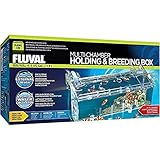
- Compatible with Most Aquariums: Easily attaching to the side of most aquariums up to 1” thick, the Multi-Chamber Holding & Breeding Box provides up to 3 separate compartments for protecting fry, sick/weak fish or new fish that require acclimation.
- Required Parts: Please note that this multi-chamber will require an Air Pump (1 L/per minute) and Airline Tubing, both of which are sold separately.
- Usage: Ideal as a hatchery and incubator to help protect newborn fry from being eaten (which improves survival rate). Provides a safe haven for injured or weak fish. Helps acclimate new fish as water circulates from the aquarium
- Space-Saving: This chamber’s design measures 10.25″ L x 5.5″ W x 4.75″ H (26 x 14 x 12 cm) and holds 0.5 US Gal (1.9 L) of water. Hangs onto aquarium exterior for easily observing fish and convenient maintenance.
- Versatile: Utilizes the same conditioned water as your aquarium, no additional heater or filter required. Can be used with fresh and saltwater aquariums.
Six compatibility checks that matter more than a species list
- Adult size and aggression: A fish that is harmless as a juvenile may become a predator, bully or fin-nipper as an adult.
- Water conditions: Temperature and hardness/pH must overlap for the specific species, not merely for the common name “community fish.”
- Space and filtration: Active fish and prolific livebearers can exceed a tank’s biological capacity even when they are not aggressive.
- Sex ratio: Male livebearers court continuously, so an imbalanced group can create chronic harassment.
- Fry predation: Decide whether newborns are expendable in a display tank or need protection.
- Your objective: A mixed display aquarium requires different planning from a controlled species or hybrid-breeding project.
How many female mollies should I keep per male?
Aqueon advises approximately two or three females for every male. Male livebearers can be aggressive toward one another and are constantly attempting to mate; spreading that attention across several females reduces the pressure on any one fish. This ratio does not prevent pregnancy: female mollies can store sperm and may continue producing broods after a male is removed.
Tank size, stocking and water checks
PetMD recommends at least 30 gallons for larger sailfin mollies and groups of at least four mollies. Treat that as guidance for those larger fish, not a universal minimum for every molly variety or community combination.
Rank #4
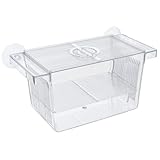
- Tiny Hatching Box: With inner size of 4.2" L x 2.7" W x 2.8" H, it protects newborn fry from being eaten or attacked. Suitable for feeding tiny fish or shrimp ONLY.
- Slotted Bottom Panel: It can effectively prevent soiling of the box by debris, food residues or excrement, and the slim slots in it keep the newborn fish from escaping.
- Floating Design: The balancing panel and 2 handles help keep the box floating on water, it can also be secured inside the tank with 2 suction cups. Space-saving during use.
- Acrylic Material: The highly transparent acrylic box allows you to watch the breeding process or fish fighting without any barriers, bringing you with endless enjoyment.
- Easy to Use: The incubator can be easily installed or disassembled for cleaning without any tool. And its side vents ensure optimum water flow, requiring no heater or air pump.
Add fish gradually rather than filling the aquarium at once. After each stocking change, check ammonia, pH and nitrate with an aquarium water test kit, and correct problems before adding more livestock. Overcrowding is especially easy when mollies and their tankmates are all livebearers that reproduce quickly.
Independent reader supportYour contribution helps us test, update, and keep practical guides available for everyone.Will other fish eat molly fry?
Often, yes. Newborn livebearers are small enough for many adult fish—including other mollies—to eat. In an ordinary community aquarium, assume that only a fraction of fry will survive unless you provide a refuge.
Do these 3 things before closing this tab:
1Fix the driver behind crashes, sound loss and screen glitches2Clear out junk files and repair common Windows errors3Scan for outdated or missing drivers - takes under a minuteBest Value

- Breed, Isolate, Raise - All-in-1 Box: Serves as a hatchery for livebearers like guppies and mollies, an isolation/quarantine cage for sick or aggressive fish (e.g., bettas), a dedicated acclimation space for introducing new fish, and a protected zone where shrimp can molt or feed with confidence.
- Dual-Chamber & Dual-Layer Design: Dual chambers (with a removable divider panel) let you keep fish or fry apart as needed. The upper compartment lets a pregnant fish give birth, and newborn fry drop into the lower nursery section—shielding them from adult fish and improving survival outcomes.
- Dual Mounting Methods: The breeder box easily attaches with the included hanging hook or suction cups for flexible placement inside the tank. The adjustable spacer ring sets the box at the right distance from the tank wall so fish won’t get trapped. (For stability, keep the breeder box fully submerged during use.)
- Gentle on Delicate Fry: A secure lid with a feeding opening helps keep fish from jumping out. Fine 0.04" slit vents deliver ample water flow through the breeder while keeping even the tiniest fry contained. Crystal-clear walls turn the unit into a fish tank viewing box for observing behavior and health at a glance without disturbance.
- Easy Assembly & Complete Kit: Assembles in minutes with no tools required, and the removable bottom tray makes it simple to clean or release fish. Includes a fine-mesh net for safely catching or transferring fry, and cleaning pipettes for feeding babies or removing waste. Comes with all the accessories you need for convenient fish breeding and isolation.
To maximize survival
- Fill areas of the aquarium with dense live plants or floating cover so fry can break the adults’ line of sight.
- Use a hanging breeder net when you need a contained nursery; move the pregnant female only if the extra handling will not cause undue stress.
- Feed appropriately sized food in small portions and remove uneaten material so a nursery does not foul the water.
- As fry grow, sort them by size and plan where surplus fish will go; reproduction can outpace the tank’s capacity.
If your goal is simply a natural community, plants and normal losses may be sufficient. If your goal is to raise a known line, use a separate, species- or line-specific setup and remove unrelated males before mating occurs.
Choose the setup that matches your goal
For a peaceful display community
Select similarly sized, non-aggressive fish, introduce them gradually, and accept that some molly fry may be eaten. Keep the male-to-female ratio balanced and monitor water after every stocking change.
For maximum fry survival
Use dense plant cover or a hanging breeder net, limit potential predators and prepare additional grow-out space. A community tank will not reliably raise every brood.
For controlled hybrid research or line breeding
Do not rely on a mixed community aquarium. Keep identified parent species separately, control which males have access to females, record pairings and offspring, and expect that documented hybrids may be infertile. The laboratory results for Poecilia crosses cannot be used as a guaranteed aquarium success rate.
Recommended Free Tools
Quick Recap
Product prices and availability are accurate as of the date/time indicated and are subject to change. Any price and availability information displayed on Amazon at the time of purchase will apply.




