Yes. Fish respire. Most fish extract oxygen gas dissolved in water with their gills and release carbon dioxide. They are not breathing water molecules: respiration is the gas exchange that supplies oxygen for cellular metabolism.
What respiration means for a fish
Respiration is the exchange of gases needed to release energy in cells. Fish need oxygen just as other complex animals do. As NOAA Fisheries puts it, “Fish breathe oxygen, not air.” For most species, that oxygen is already dissolved in the surrounding water.
Water contains far less available oxygen than air. The American Museum of Natural History notes that air is about 21% oxygen, while water usually contains about 8 parts per million (ppm) dissolved oxygen. Fish therefore have to move a large volume of water across an efficient respiratory surface to obtain enough oxygen.
How gills move oxygen into the blood
The basic route is:
- Water enters through the mouth.
- It passes across the gill filaments.
- It flows over microscopic structures called lamellae.
- Oxygen diffuses across the thin lamellae into nearby blood vessels.
- Carbon dioxide diffuses from the blood into the water, which leaves through the gill opening.
Diffusion moves each gas from an area of higher concentration toward an area of lower concentration. Water arriving at the gills has more available oxygen than the deoxygenated blood arriving in the lamellae, so oxygen enters the blood while carbon dioxide moves out.
Recommended Free Tools
#1 Best Overall
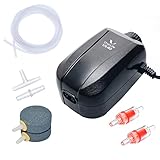
- Steady Output: Max Air Flow Rate: 64 GPH; Pressure: 0.016 MPa; Power: 4 W. Perfect for aeration in 10 - 100 gallon fresh water and marine aquariums.(The data is measured with experimental equipment and may deviate slightly from the actual data. The air volume may be insufficient due to the blocked air intake cotton. Please replace the cotton yourself if the air volume is insufficient.)
- Adjustable Air Flow: Feature a rotary knob to control the amount of air for dual outputs, allowing for your desired air flow to fully oxygenate your fish tank.
- Quiet Operation: The pump emits 25 dB sound under the “Low” mode and maximum 45 dB noise like the hum of a refrigerator under the highest air flow.
- 2 Air Stone Discs: Produce lots of dense medium bubbles bursting into the surface of water steadily. A great way to aerate your tanks and enliven the aquatic life.
- Pump Accessories: Include 2 air stones, 6.5-foot airline tubing, 2 check valves and 2 connectors. Complete accessories to build the basic aeration setup in your tank.
Why gills are so effective
- Large surface area: numerous filaments and lamellae expose a broad exchange surface.
- Thin membranes: the distance between water and blood is small, allowing rapid diffusion.
- Dense blood supply: capillaries carry oxygen away and bring carbon dioxide to the exchange surface.
- Counter-current flow: in most fish, blood and water move in opposite directions across the lamellae. This maintains a concentration gradient along the entire exchange surface. The AMNH describes an example in which roughly 75% of the oxygen passing over the gills is extracted.
Not every fish must swim continuously to ventilate its gills. Some actively pump water with movements of the mouth and gill covers. Ram-ventilating species depend more on forward movement to force water across the gills, although the exact balance varies by species and activity.
Are fish breathing oxygen or water?
Fish obtain oxygen from water; they do not split water molecules to breathe their oxygen. The oxygen is atmospheric oxygen that has dissolved into the water. The AMNH summarizes the distinction: “The oxygen that fish breathe is not the oxygen that is chemically combined with hydrogen to form water molecules, but oxygen from the air that is dissolved in the water.”
Rank #2

- Steady Output: Max Air Flow Rate: 50 GPH; Pressure: 0.013 MPa; Power: 1.25 W. The pump supplies steady air flow with low power consumption. Work great for fish tanks or buckets up to 60 gallons.
- Adjustable Air Flow: There is a rotatable knob on the top to manually adjust the air volume. Greatly meet your desired air flow to keep fish or roots healthy.
- Quiet Operation: With 4 shockproof rubber feet to minimize vibration, the pump greatly reduces noise to less than 30 dB like a soft speaking voice. No disturbance to your daily life.
- Reliable Construction: The fish tank pump is well constructed with a sturdy ABS shell and a heavy-duty inner structure. Really lightweight and space-saving.
- Pump Accessories: Contain 6.5-foot 3/16" airline tubing (ID: 4 mm), 2 small air stone cylinders, 2 connectors (straight & T-shape) and 2 check valves. All build the basic aeration setup in your fish tank.
This is why a fish can suffocate in water. Being submerged does not guarantee that enough dissolved oxygen is present for its metabolism.
What happens when dissolved oxygen is too low?
Gills can only extract oxygen that is available in the water. Warm water holds less dissolved oxygen than cold water. Oxygen can also fall when algae, bacteria and other organisms respire at night or when decomposing organic matter consumes oxygen. Stagnant, heavily stocked or poorly circulated water is especially vulnerable.
Rank #3

- POWERFUL AERATOR PUMP & ENERGY CONSERVATION - AQQA fish tank air pump 3 watt equipped with a high-quality pump, the pump delivers stable output while conserving energy for optimal performance. Air volume for up to 80 gallon tank, the max pressure is 18Kpa and max air volume is 100GPH, can be easily connected to different type air stones, can be used for larger fish tanks, aquariums.
- NOISE REDUCTION ULTRA QUIET FUNCTION - The aquarium air pump features a sturdy double-layer structure with a built-in air pump and thickened casing, the bottom of the pump is designed with four soft rubber pads, which not only reduce noise, the max noise does not exceed 35dB but also prevent the pump from moving excessively during operation.
- DURABLE STAINLESS STEEL DUAL OUTLET DESIGN - The fish air pump designed with 2 stainless steel outlets, long service life, that can be used in multiple fish tanks or aquariums, making it suitable for both freshwater and seawater setups.
- ADJUSTABLE AIR FLOW SWITCH - The air pump aquarium is equipped with a knob on top, allowing you to easily adjust the air volume or switch without the need for frequent unplugging and plugging, making it more user-friendly.
- PACKAGE INCLUDED - 1 × Aquarium air pump with 5.91ft power cord; 2 × Air stones; 2 × 4.92ft Air tubes; 2 × Check Valves; 1 × User Manual. And you will get a 1-year after-sale product service and 7*24H lifetime customer service.
University of Florida IFAS Extension guidance says many fish show distress at roughly 2–4 milligrams per liter (mg/L) dissolved oxygen, with substantial differences among species. That range describes a common danger zone, not a universal lethal cutoff.
Signs of oxygen stress
- Gasping or lingering at the surface, where water may contact air more readily
- Fast gill movements, unusual lethargy or loss of coordination
- Fish clustering near a filter return, bubbler or other area of stronger circulation
- A sudden die-off, especially near dawn after a night of respiration
These signs can have other causes, including toxins or disease, so test water rather than assuming oxygen is the only problem.
Rank #4
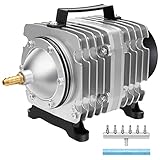
- HIGH PRESSURE, LARGE OUTPUT – This aquarium air pump delivers large output and high pressure of compressed air. Flow rate 600GPH, pressure 0.02Mpa, powered by a 18Watt electromagnetic motor.
- GREAT HEAT DISSIPATION - The housing of this air pump for aquariums is made of aluminum alloy with enlarged surface for the best heat dissipation. (Reminder – the air pump is highly recommended to be placed at a well-ventilated location. A cooling fan will help extend the life of the pump)
- EENRGY EFFICIENT, LONG LIFE – This air compressor is with lubricant free design. The high-quality cylinder and piston are made of wear-resistant materials to ensure the low consumption of power and long life.
- ACCESSORIES – Chrome coated metal air manifold. A 6-outlet manifold is provided for this pond aerator for easy access of oxygenation to anywhere you desire. The air output of each outlet is adjustable by simply turning the adjusting knob on the outlet.
- MULTIPLE APPLICATIONS – This commercial air pump is ideal for oxygenation of aquarium, pond, hydroponics, fish farm, and seafood restaurant, also great for compost tea brewing and air assist for laser cutting.
Do aquarium fish need an air pump?
An air pump is not automatically required in every aquarium. Its bubbler adds movement at the surface, where gases exchange with the atmosphere, and can improve circulation. A filter return, spray bar or other surface-agitating outlet may provide the same practical benefit. The appropriate setup depends on tank shape, temperature, stocking level, plant and algae activity, and species needs.
Useful checks when aeration may be inadequate
- Measure dissolved oxygen if you have a reliable test, and check temperature at the same time.
- Inspect whether the filter is operating and whether the surface is visibly moving.
- Check stocking density and remove decaying organic material.
- Increase circulation or add an air pump and diffuser if oxygen is low or fish are gasping.
- Recheck conditions, particularly before dawn, when photosynthesis has stopped overnight.
Do not treat vigorous bubbles as a substitute for water-quality maintenance. A pump cannot remove ammonia, nitrite or other pollutants, and excessive current can stress species adapted to quiet water.
Best Value

- Ultra Quiet: Made of ABS thickening engineering plastics, super silent aquarium air pump. Soft rubber foot pads, further palliation for noise.
- Long Service Life: Manually adjustable air volume, won’t cause shakes and electric field fluctuation, much safer than electronic adjustment, lower failure rate.
- Aquarium Air Pump with 2 outlets, dual hose fish tank air pump, 3W air pump fit for fish tanks from 10 to 100 gallon.
- Unique Design: The air intake cotton is replaceable, it can filter the impurities in the air and extend the service life of the air pump, also come with 1 more replacement.
- Complete Accessories: Comes with everything you need, includes: Return Valve*2, Air Stone*2,Air Tube (2 x 4.9ft)*2, Suction Cup*2, Air Regulating Valve*2, T-Connector*1, Air Intake Cotton*1. Original quality, professional manufacturer.
Can any fish breathe air?
Some fish have evolved supplementary ways to obtain oxygen from the atmosphere. These are specialized adaptations, not evidence that ordinary fish breathe water molecules.
| Respiratory strategy | Primary oxygen source | Is water flow over gills required? | Representative example | Typical context |
|---|---|---|---|---|
| Standard gill respiration | Oxygen dissolved in water | Yes; water must pass across the gills | Most familiar aquarium and wild fish | Well-oxygenated aquatic habitats |
| Air-breathing gas bladder | Atmospheric air | Not for the supplementary air-breathing organ, though gills may still function | Tarpon | Warm, oxygen-poor or periodically stressful waters |
| Cutaneous respiration | Oxygen from air or very shallow water across moist skin | Reduced reliance on gills in suitable conditions | Mudskippers | Moist intertidal surfaces; skin must remain wet |
| Other atmospheric-air adaptations | Air above the water | Varies by species and organ | Some specialized air-breathing fish | Habitats where dissolved oxygen regularly becomes scarce |
Tarpon can use a modified gas bladder in a lung-like way. Mudskippers can exchange gases through moist skin while out of water for periods of time. Such species still have adaptations with limits: a dry skin surface, unsuitable temperature or prolonged exposure can prevent effective gas exchange.
Why fish kills can occur even when water is present
Fish kills are often oxygen emergencies rather than a lack of water. A hot spell lowers the water’s oxygen-holding capacity; a dense algal bloom can consume oxygen after dark; and decomposition can use oxygen faster than it is replenished. The U.S. Geological Survey states, “Fish, like all other complex life forms, need oxygen to survive.” When dissolved oxygen falls below a species’ tolerance, fish may become distressed, lose normal function and die.
Surface mixing, wind, flowing water and photosynthesis can replenish oxygen, while stratification or still conditions can isolate low-oxygen water. The most vulnerable fish are not necessarily the same across habitats, because species differ in oxygen demand and tolerance.
Do these 3 things before closing this tab:
1Clear out junk files and repair common Windows errors2Fix the driver behind crashes, sound loss and screen glitches3Repair Windows errors before they cause bigger problemsThe direct answer in one sentence
Fish do respire: most take oxygen dissolved in water across gill lamellae, transfer it into the blood by diffusion, and release carbon dioxide, while a minority supplement or replace gill use with specialized adaptations for breathing atmospheric air.
Quick Recap
Product prices and availability are accurate as of the date/time indicated and are subject to change. Any price and availability information displayed on Amazon at the time of purchase will apply.




