Usually, you should not assume a fish sold as a “freshwater shark” will make a suitable goldfish tankmate. The name covers several species with different adult sizes and behavior, and the care guides reviewed do not establish that any of them are compatible with goldfish. Identify the exact species and compare its adult needs with the goldfish’s before considering a shared aquarium.
Why the name “freshwater shark” is not enough
“Freshwater shark” is a trade name, not one species or a true-shark group. It can refer to fish such as bala (silver), red-tailed black, rainbow, harlequin, and black sharks, which differ in adult size and care needs. Aqueon and the Ornamental Aquatic Trade Association (OATA) both stress that the group includes fish with varied requirements.

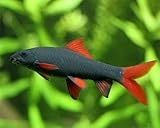

That variation matters for compatibility: advice about a territorial red-tail or rainbow shark does not automatically apply to a bala shark, and neither answers the goldfish question on its own. Before stocking, confirm the fish’s exact common or scientific name.
What the common aquarium “sharks” need
Red-tailed black and rainbow sharks
These fish grow to around 15 cm, according to OATA. Both OATA and Aqueon warn that they can become territorial as they mature. OATA advises mixing them only with active, slightly larger, robust fish; Aqueon recommends that older individuals be kept singly and given space and shelter. Those recommendations do not identify goldfish as tested tankmates, so they are not grounds to assume a peaceful pairing.
Do these 3 things before closing this tab:
1Clear out junk files and repair common Windows errors2Fix the driver behind crashes, sound loss and screen glitches3Repair Windows errors before they cause bigger problems#1 Best Overall
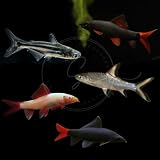
- Swimming Creatures 2 Rainbow Shark (Epalzeorhynchos frenatum) Live Tropical Freshwater Aquarium Fish (Approx. Size: 1.5-2")
- Bring vibrant energy to your aquarium with the Rainbow Shark, a striking addition to any freshwater setup. Known for its sleek, torpedo-shaped body and bold coloration, the Rainbow Shark is a captivating choice for hobbyists looking to add a touch of elegance and movement to their tanks.
- Perfect for intermediate aquarists, the Rainbow Shark thrives in well-maintained tanks with compatible tank mates. Order today and enhance your aquarium with this dynamic and stunning species!
Bala or silver sharks
Bala sharks are a different proposition: they grow upwards of 30 cm and are active, shoaling fish. OATA recommends keeping at least five, and its care guide recommends an aquarium at least 180 cm long and 300 L in capacity. Aquarium Co-Op describes them as reaching about 12 inches, preferring groups of four or more, and needing ample swimming room; it says many keepers use a 125–150-gallon aquarium for a single bala shark. These are recommendations from the respective care guides, not universal minimum standards.
Other fish sold under the name
Other species may also be marketed as freshwater sharks, with their own adult sizes and husbandry requirements. Petco’s guide illustrates the breadth of the category with species-dependent tank guidance ranging from 20+ gallons to 300+ gallons. Do not use a broad label or a care figure for one species to make a stocking decision about another.
Rank #2
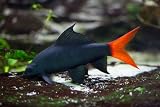
- Swimming Creatures 2 Rainbow Shark (Epalzeorhynchos frenatum) Live Tropical Freshwater Aquarium Fish (Approx. Size: 1.5-2")
- Bring vibrant energy to your aquarium with the Rainbow Shark, a striking addition to any freshwater setup. Known for its sleek, torpedo-shaped body and bold coloration, the Rainbow Shark is a captivating choice for hobbyists looking to add a touch of elegance and movement to their tanks.
- Perfect for intermediate aquarists, the Rainbow Shark thrives in well-maintained tanks with compatible tank mates. Order today and enhance your aquarium with this dynamic and stunning species!
How to assess a possible pairing
The available care guides cover freshwater sharks but do not provide a goldfish parameter range or a direct compatibility ruling. That means the evidence does not show that every freshwater shark will attack goldfish, but it also does not support recommending the pairing. A shared temperature reading alone would not establish that the fish can live together successfully.
Before considering any combination, compare these factors for the exact species and the goldfish:
What’s actually slowing this PC down?
Pick the symptom - the matching free tool is one click away.
- Water conditions: OATA gives group-level freshwater-shark guidance of 22–27°C and pH 6.5–8.0; Aqueon says most freshwater sharks need 74–80°F. These are shark-care ranges, not a goldfish comparison. Check species-specific guidance for both fish rather than inferring compatibility from a possible temperature overlap.
- Adult size and risk: Plan around each fish’s adult size, not the size of a juvenile in a shop. The marked size difference between red-tail/rainbow and bala sharks also shows why the exact species matters.
- Temperament and activity: Account for territorial behavior, swimming activity, and whether either fish needs a particular swimming area. OATA’s advice for red-tail and rainbow sharks favors robust, active tankmates, not an unspecified peaceful community setup.
- Social needs and aquarium capacity: Consider whether the shark should be kept alone or in a group, and whether the aquarium can support the mature fish and its swimming needs. A tank that accommodates one small juvenile is not necessarily suitable for the adult or a recommended group.
- Separation plan: Do not begin a trial unless you can separate the fish promptly if aggression or other incompatibility appears. A larger tank or better water testing does not by itself make incompatible tankmates compatible.
Prepare and monitor the aquarium
OATA recommends a suitable filter, heater, secure cover for fish prone to jumping, appropriate substrate and shelter, and regular water checks. Its guide recommends testing at least weekly for ammonia, nitrite, nitrate, pH, and water hardness; ammonia and nitrite should be at zero before fish are added. It also advises weekly partial water changes and conditioning tap water. These are husbandry recommendations, not a way to resolve a poor tankmate match.
For shark-specific water guidance, OATA lists ammonia at 0 mg/L, nitrite at 0 mg/L, and nitrate no more than 20 mg/L above normal tap-water levels. It advises checking the individual species’ needs because its figures are group-level guidance. Aqueon’s temperature guidance for most freshwater sharks is 74–80°F. Neither source supplies the goldfish values needed to make a quantified comparison.
Independent reader supportYour contribution helps us test, update, and keep practical guides available for everyone.Practical decision
Until you have identified the shark and confirmed that its adult size, behavior, social requirements, and water needs can be accommodated alongside the goldfish, keep them in separate aquariums. In particular, do not casually pair goldfish with territorial red-tail or rainbow sharks, or treat an active bala shark as a small community fish. The care sources support caution; they do not establish a goldfish pairing as safe.
Sources: Aqueon’s Freshwater Sharks Care Guide; OATA’s freshwater-shark care sheet; Petco’s freshwater shark guide (updated September 15, 2023); Aquarium Co-Op’s freshwater-shark overview.
Quick wins for a faster PC:
Clear out junk files and repair common Windows errorsFree Scan →Fix the driver behind crashes, sound loss and screen glitchesFind Drivers →Repair Windows errors before they cause bigger problemsFix Now →Quick Recap
Product prices and availability are accurate as of the date/time indicated and are subject to change. Any price and availability information displayed on Amazon at the time of purchase will apply.




