For an established freshwater aquarium, plan a partial clean every week. Remove waste from the substrate and replace part of the water, then adjust the amount and frequency according to water-test results, fish load, tank size and filtration. Published guidance ranges from 10–25% weekly to 30% weekly; PetMD also lists 25% every other week as an option. Cleaning is ongoing maintenance, not an occasional full teardown.
What “cleaning” a fish tank actually includes
Several jobs are often called cleaning, but they do not happen on the same timetable:
- Partial water change: remove some old water and replace it with conditioned water at the aquarium’s temperature.
- Substrate cleaning: siphon waste and uneaten food from gravel or sand while removing the old water.
- Algae removal: wipe or scrape the glass when growth obstructs the view or affects equipment. Use a tool compatible with the tank material.
- Filter care: rinse clogged media gently in water removed from the aquarium so beneficial bacteria are not destroyed.
Do not routinely empty and sterilize the entire aquarium. Large, sudden changes can destabilize temperature, chemistry and biological filtration.
How often to change water in an established tank
There is no single percentage that suits every aquarium. These are the published starting points:
Quick wins for a faster PC:
Repair Windows errors before they cause bigger problemsFix Now →Fix the driver behind crashes, sound loss and screen glitchesFind Drivers →Clear out junk files and repair common Windows errorsFree Scan →#1 Best Overall

- FUNCTION --- Easy to control, convenient to siphon fish faeces, impurities, turbid water out of fish tank.
- 5 Feet HOSE --- Made from clear & elastic plastic. Makes it more durable and anti-kinking. Harmless to fishes & No peculiar smell.
- GRAVEL TUBE --- Sinkable, with a detachable filter screen inside. Will not disturb fish or decor when it's working.
- SIPHON BALL --- All you need to do is to pinch it several times, water will flow out automatically. Without striking a blowing.
- WARRANTY --- For 3 months after the date of purchase, we take care of all quality-related issues with a FREE replacement or refund. If you have any questions, do not hesitate to contact our professional after-sale service.
| Source | Starting recommendation | How to use it |
|---|---|---|
| PetMD (Jessie Sanders, DVM, DABVP; May 7, 2026) | 10% weekly or 25% every other week | Use as a starting schedule for an established tank, then verify with tests. |
| RSPCA Australia | 10–25% weekly after the biofilter matures | Choose a volume within the range based on stocking, filtration and measured water quality. |
| RSPCA UK | 30% weekly | A more conservative weekly schedule for maintaining water quality. |
These recommendations differ because aquariums differ. A heavily stocked or lightly filtered tank may need more frequent changes; a lightly stocked, well-filtered tank may remain stable with the lower end of the range. Test results should decide whether your chosen routine is adequate.
New tanks and new filters need closer attention
During roughly the first four to six weeks, a new aquarium or newly installed filter may not contain enough beneficial bacteria to process toxic waste immediately. RSPCA Australia recommends initially frequent 10–25% partial changes together with gravel cleaning during this establishment period.
Test more often while the biological filter develops, and respond to results rather than waiting for the regular weekly day. Once the biofilter is mature and readings are consistently safe, move to a routine schedule and continue monitoring.
Rank #2

- 【Upgraded 6-in-1 Multi-Functional Aquarium Gravel Cleaner】This upgraded gravel vacuum integrates six essential functions: water changing, sand washing, debris removal, water filtration, water showering, and flow control. Designed for use in both freshwater and saltwater aquariums, it is compatible with tanks of various depths and water volumes.
- 【High-Efficiency 28W Pump with 1700L/H Flow Rate】Equipped with a 110V/28W high-torque motor, the pump delivers a maximum flow rate of 1700 liters per hour (L/H). It can drain a 180-gallon (681L) tank in approximately 30 minutes under optimal conditions. The adjustable flow valve allows precise control of suction strength for gentle or deep cleaning.
- 【Powerful Cleaning Performance】The strong suction effectively removes fish waste, uneaten food, algae, and fine debris from gravel and substrate without disturbing beneficial bacteria. Ideal for routine maintenance and deep cleaning, it ensures efficient water changes and a healthier tank environment.
- 【Adjustable Telescopic Tube for Universal Fit】The telescopic cleaning tube extends from 23.6 inches (60 cm) to 37.7 inches (96 cm), accommodating water depths from 13.7 inches (35 cm) to 47.2 inches (120 cm). The ergonomic design allows comfortable operation in shallow or deep tanks, with secure locking mechanisms to prevent accidental retraction.
- 【3-Year Warranty & 24/7 Customer Support】We stand behind our product with a 3-year warranty covering manufacturing defects. Our professional technical team provides round-the-clock support. If you have any questions or encounter issues, please contact us directly—we respond within 24 hours and are committed to your satisfaction.
Use water tests to move the schedule forward
PetMD’s fish-veterinarian-authored guide advises a water change when ammonia is above 0.25 mg/L, nitrite is above 0 mg/L or nitrate is above 20 mg/L. Treat these as PetMD’s guidance, not universal limits for every species or aquarium; species tolerance, pH, temperature and the test method matter. If readings are concerning or fish are unwell, contact a fish veterinarian.
The Tool Desk
Outbyte Driver Updater FREEFix the driver behind crashes, sound loss and screen glitchesFind Drivers →Outbyte PC Repair FREEClear out junk files and repair common Windows errorsFree Scan →An aquarium water test kit helps reveal problems before fish show symptoms. Record results alongside the date, water-change volume and any stocking or equipment changes. A rising reading between scheduled changes is a reason to increase testing and maintenance while you identify the cause.
How to perform a routine weekly clean safely
- Prepare replacement water. Add tap-water conditioner according to its label and bring the water to the aquarium’s temperature. Avoid adding untreated tap water.
- Switch off equipment as needed. Turn off heaters, pumps and filters whenever the water level could expose them or the cleaning process requires it. Follow the equipment maker’s instructions.
- Leave the fish in the aquarium. Catching and relocating them for ordinary maintenance adds handling stress and is unnecessary.
- Siphon the substrate. Use an aquarium gravel siphon or compatible gravel vacuum to lift waste while removing the planned portion of water. Stirring gravel without siphoning leaves waste in the tank.
- Remove algae. Use an aquarium-safe algae scraper suited to glass or acrylic. Do not use soap, household cleaners or tools that can scratch the surface.
- Refill slowly. Add conditioned, temperature-matched water to avoid shocking fish or disturbing the substrate.
- Restart and check equipment. Confirm the filter, heater and circulation are operating normally and that no fish or plants are trapped by equipment.
When and how to clean the filter
RSPCA Australia advises a light rinse when the filter begins to clog or monthly, whichever comes first, while warning against over-cleaning. RSPCA UK likewise says to swish filter media in removed aquarium water, never under the tap. Chlorinated tap water can damage the bacterial community that processes waste.
Rank #3
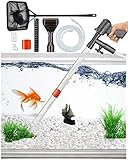
- Mufti-functional cleaning kit: Aquarium gravel vacuum cleaner kit is a mufti-functional aquarium cleaner that uses (adopts)the siphon design principle, which includes the aquarium, aquarium sand washing, algae scraping, fish excrement cleaning, aquarium residual debris, and aquarium water changing. Quick water change gives fish (provides)a clean and comfortable aquarium living environment.
- New safety design: new manual press design, no electricity required and silent while working. Fish tank cleaning tools uses a high-quality pressure resistant air bag, durable, super strong siphon pressure can quickly draw out the muddy water in the fish tank. The aquarium vacuum pipe has a filter net attached to the filter basket to block the blockage caused by the suction of gravel, while preventing your cute fish and the small gravel in the bathtub from being sucked out of the tank.
- Easy to install: This newly upgraded aquarium vacuum is easier to use than traditional fish tank vacuum. Simply hold the handle and press several times until you see water begin to flow out. You can also use a tube to agitate the gravel in the aquarium, causing fish manure, food debris, etc. to drain out of the aquarium with the current. The aquarium cleaning tools is securely attached to the aquarium so you can easily release your hands.
- A wide range of multi-combination accessories: aquarium cleaner vacuum crusher is suitable for different types and sizes of fish tanks, equipped with 2 water pipes and 1 joint, press pump, water flow clip, water pipe clip extended outlet hose, aquarium temperature stickers, fishing nets, plastic algae scraping plate, and detailed aquarium vacuum pump manual.
- Easy to use: The aquarium cleaning kit dust and water changer is hand-held, easy to use and operate, the aquarium cleaners can work stably and efficiently without electricity and without noise, which greatly saves your time and brings more convenience for fish tank cleaning.
Clean only enough to restore flow, retain biological media whenever possible and follow the filter manufacturer’s instructions for cartridges, impellers and replacement intervals. A filter that repeatedly clogs may indicate excess food, too much debris, inadequate mechanical media or a stocking problem rather than a need for increasingly aggressive washing.
Independent reader supportYour contribution helps us test, update, and keep practical guides available for everyone.What changes the right frequency?
Stocking and feeding
More fish produce more waste. Overfeeding adds uneaten food and can push ammonia and nitrate upward, so a crowded tank or generous feeding routine generally requires closer observation and potentially larger or more frequent partial changes.
Tank size and filtration
Small water volumes can change chemistry quickly. Effective, correctly sized filtration provides biological processing but does not remove the need to siphon waste or replace water. RSPCA UK states: “No fish should be kept in tanks without a well set up and maintained filter.”
Rank #4
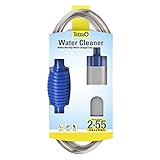
- TETRA WATER CLEANER: Gravel siphon used to easily clean aquariums.
- COMPATIBLE AQUARIUM SIZE: For aquariums up to 55 gallons.
- MAKES MONTHLY WATER CHANGES EASY: It only takes 30 minutes to replace 30% of water every 30 days.
- REMOVE DEBRIS: Siphons are a great way to easily remove debris from gravel by moving the water cleaner throughout the gravel.
- INCLUDED: Tetra Water Cleaner comes with gravel siphon, priming bulb and clip for bucket for a simple set up.
Measured chemistry
Stable readings support your current routine; recurring ammonia, nitrite or high nitrate means the routine, stocking, feeding, filtration or source water needs attention. There is no evidence-based formula that converts tank size and fish count into one exact percentage for every aquarium.
Algae and visible debris
Algae can be removed whenever it becomes objectionable, while substrate waste should be siphoned during regular partial changes. Frequent algae does not by itself justify replacing all the water; investigate light, nutrients and maintenance instead.
Common mistakes to avoid
- Full water replacement as routine: it can cause abrupt temperature and chemistry shifts.
- Washing filter media under the tap: rinse in removed aquarium water instead.
- Using soap or household spray: residues can harm fish and the biofilter.
- Making a sudden, very large change: match temperature and make gradual corrections unless an aquatic veterinarian directs emergency action.
- Removing fish for every cleaning: keep them in place for ordinary maintenance.
- Relying on appearance alone: clear water can still contain toxic ammonia or nitrite, so test it.
A simple schedule you can start today
- Every week: test as appropriate for your system, siphon waste and complete a partial water change using your selected 10–30% starting point; remove algae if needed.
- Weekly while new: during the first four to six weeks or after a new filter is installed, test more frequently and make the RSPCA Australia-recommended 10–25% partial changes as readings require.
- Monthly or when clogged: gently rinse filter media in removed aquarium water, without over-cleaning it.
- Any time tests are abnormal: perform the PetMD-triggered water change guidance for ammonia, nitrite or nitrate, and seek veterinary advice when chemistry or fish health is concerning.
Keep a written log of test results, water volume, filter work and symptoms. After several weeks, that record will show whether your aquarium remains stable between cleanings and whether the interval needs adjustment.
PC Slower Than It Used to Be?
A free scan shows the junk files, broken settings and background clutter dragging Windows down - then fixes them in one click.Free scan · Windows 10 & 11Outdated Drivers Are Slowing You Down
One free scan finds every outdated or missing driver and matches the right update for your exact hardware.Free scan · exact hardware matchQuick Recap
Product prices and availability are accurate as of the date/time indicated and are subject to change. Any price and availability information displayed on Amazon at the time of purchase will apply.




