Do these 3 things before closing this tab:
1Repair Windows errors before they cause bigger problems2Scan for outdated or missing drivers - takes under a minute3Clear out junk files and repair common Windows errorsYour aquarium current is probably too strong when a fish cannot hold its position, is repeatedly pushed or tumbled, avoids the filter outlet, or spends much of its time hiding from the flow. Watch the fish and the flow pattern rather than applying a single gallons-per-hour rule. Keep enough surface movement for gas exchange, but diffuse or redirect any concentrated jet.
Signs your aquarium flow is too strong
Observe the tank for several minutes with the filter running. A fish may briefly swim through a fast stream during normal activity; the warning signs are persistent and leave it unable to choose where to rest, feed or swim.
- It continually fights to stay in place or slides backward whenever it stops swimming.
- It is repeatedly whipped around, tumbled or pinned against decor.
- It avoids the outlet, stays in a corner, or hides in shelters to escape the stream.
- Plants or fine-leaved decorations are being bent and whipped continuously by the jet.
- The fish can only rest in one small dead spot instead of moving normally between areas.
Perpetual fighting against fast flow can whip fish around, drive them into shelters and create chronic stress, according to Aquarium Co-Op. The practical test is normal behavior: the fish should be able to swim, rest, feed and select both moving and calmer water.
There is no universal “safe” GPH number
Comfortable flow depends on species, swimming ability, tank dimensions, plants and hardscape, outlet shape and the filter itself. A turnover figure that feels mild in a long, heavily decorated aquarium can become a harsh jet in a small bare tank.
PC Slower Than It Used to Be?
A free scan shows the junk files, broken settings and background clutter dragging Windows down - then fixes them in one click.Free scan · Windows 10 & 11Crashes, No Sound, or Screen Glitches?
Random freezes, missing sound and display glitches usually trace back to one bad driver. Find and replace yours safely.Free scan · under a minute#1 Best Overall
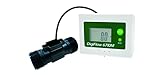
- Easy installation and operating
- Flow totalizing up to 99, 999 gallon
- Flow rate display from 0.8 – 14.5 gal./min
- Power off memorization of last status
- Low battery power alert
| Fish or setup | Typical flow consideration |
|---|---|
| Betta, fry and other slow swimmers | Usually need gentler, dispersed movement and a reliable resting area. |
| Rainbow shiners and hillstream loaches | Often appreciate faster, well-oxygenated flow when the aquarium also provides suitable resting and feeding areas. |
| Mixed community aquarium | Create several flow zones so weaker swimmers can leave the main stream without losing circulation elsewhere. |
Aquarium Co-Op lists a 211-gallon-per-hour (800-liter-per-hour), 10-watt powerhead as one product specification; that figure describes that example powerhead, not a target for every aquarium or species.
Why surface movement matters
Do not solve a strong jet by shutting circulation off entirely. Agitation at the surface helps carbon dioxide leave the water and oxygen enter it. The aim is to lower localized velocity while retaining circulation, biological filtration and some surface movement.
Rank #2

- PANEL-MOUNT: Fittings on the back let you install this flowmeter in instrument panels. Mount them vertically inline with your piping system, so liquid flows up from the bottom. As liquid passes through, it pushes an indicator up the scale, showing you the flow rate. The flow range is 0.05 to 0.5 gpm / 0.2 to 2 lpm.
- ACRYLIC RECTANGULAR BODY: With an acrylic plastic body and the white backing, this water flowmeter is completely clear, so you can inspect your liquid's color and clarity for any problems.
- DUAL SCALE DESIGN: This dual calibrated scale design in Gallons Per Minute (GPM) and Liters Per Minute (LPM) enables instant, intuitive, and accurate flow value reading, greatly improving working efficiency for both commercial and industrial applications.
- PIPE CONNECTION: Flowmeters with a female נmale connection have internal 1/4" BSP female threads and external 1/2" BSP male threads.
- FITTING MATERIAL: Choose a fitting material that is compatible with the liquid you're running through your line. PVC fittings work with a wide range of chemicals. However, they can crack from impact or when overtightened.
A calm refuge behind plants, rocks or other decor lets fish leave the main stream. In a well-arranged tank, higher-flow and low-flow areas can coexist.
How to slow or diffuse a filter safely
- Use the built-in control. Turn down the filter’s adjustable output and observe the fish again. Fluval states that the AquaStop output on its G Series can be reduced by 50% without damaging the pump; this applies to that G Series equipment, not to every filter.
- Redirect the outlet. Aim it at the back wall, a side panel or the surface so the impact is spread across a larger area. Keep enough movement at the surface for gas exchange.
- Add a diffuser. Fit a coarse aquarium pre-filter sponge over the outlet where compatible, or use an aquarium filter spray bar to distribute water across multiple openings. Secure any sponge so it cannot detach and block the outlet.
- Break the stream with the layout. Place plants, wood or rock between the outlet and the swimming area, while leaving clear paths for water to circulate and for fish to retreat.
- Protect the intake. A pre-filter sponge reduces the chance of fry or shrimp entering the intake and can soften suction at the intake side. Clean it regularly so debris does not restrict the filter.
- Resize the equipment if necessary. If the filter remains excessive for the livestock even after diffusion, choose a slower-flow model or a gentle-flow aquarium sponge filter while retaining adequate biological media and surface movement.
Choosing a flow-control solution
| Option | Reduces a concentrated jet | Preserves circulation and filtration | Intake or livestock protection | Adjustment and cleaning |
|---|---|---|---|---|
| Built-in flow control | Directly lowers output; the amount depends on the filter. | Usually yes, when operated within the manufacturer’s stated range. | Does not by itself protect fry or shrimp at the intake. | Easy to adjust; inspect and clean the control as directed. |
| Outlet aimed at wall or surface | Spreads the stream and reduces its direct impact. | Yes, while maintaining surface agitation. | No intake protection. | Fast to change; recheck that the outlet has not shifted. |
| Coarse pre-filter sponge | Diffuses flow and softens a narrow outlet when fitted appropriately. | Yes, but a clogged sponge can restrict output. | Helps keep fry and shrimp out of the intake when installed there. | Requires regular rinsing in removed aquarium water and secure attachment. |
| Spray bar | Distributes water through multiple openings instead of one jet. | Yes, if the bar and pump are compatible and kept clear. | No intake protection unless paired with an intake guard. | Direction and hole placement can be adjusted; openings need cleaning. |
| Plants, wood or rock as a break | Creates sheltered zones and interrupts the stream. | Yes, provided the layout does not block circulation. | No direct intake protection. | Simple to alter; monitor for debris accumulation. |
| Slower-flow or sponge filter | Replaces an oversized source of flow. | Provides filtration appropriate to its capacity; retain adequate media and surface movement. | A sponge filter is inherently protective for small livestock at the intake. | Requires equipment change and routine cleaning. |
When a fish is stuck to the intake
A fish being held against an intake does not, by itself, prove that the current is too strong. Fluval notes that a fish stuck to an intake is likely already sick or weakened. Treat the incident as an emergency for that fish, check its condition, and add an intake sponge for vulnerable fish while adjusting outlet flow to suit the species.
Rank #3

- RANGE IS 25-250L/H: This water flow meter is made of plastic, used for testing the instantaneous flow liquid. Its measure flow range is 25-250L/H
- MEASURING ACCURACY IS 4%: This flow meter features stable performance, clear scale line, and its measuring accuracy is 4%
- PLASTIC SHELL: The flow meter float is made of plastic shell, so it has good resistance to acid and alkali corrosion resistance
- WIDE APPLICATIONS: It mainly used in chemical, petroleum, light industry, medicine, chemical departments, chemical fiber, food, environmental protection and scientific research departments
- 0-60°C: This flow meter work under 0-60°, can be used for both clod and warm water
Check that the problem is really excessive current
A sudden change in output can indicate equipment trouble rather than a new flow requirement. A weak or noisy filter may have a clogged intake, trapped air or another maintenance issue.
- Compare the current behavior with the tank’s normal pattern and inspect the outlet.
- Unplug the filter safely before opening it, then clean the intake, impeller and media according to the filter manual.
- Remove trapped air as the manual describes and confirm that hoses, tubing and fittings are seated.
- Restart the filter and watch both the flow and the fish. Do not compensate for a malfunction by permanently restricting a filter that is meant to run freely.
Recheck after every adjustment
Change one thing at a time, then observe again. The adjustment is working when the fish can hold position without continuous effort, rest without being swept away, feed normally and move between faster and calmer zones. If it still struggles, increase diffusion or move to gentler equipment rather than removing all circulation.
Quick Recap
Rank #4

- PAR Meter for Aquarium specially. IP68 Waterproof Sensor with a 3F telescopic rod.
- Test the PAR for kinds of lights accurately. Can search "compare" in Q&A to see the comparison between VBR-AQUA and other brand.
- Show the PAR of the blue, green, and red in the light seperately. Know the PAR of Blue that is very important for your coral growth, health, and coloration.
- Record 400 points of PAR, convenient to record the PAR of each position in the tank. DLI for 28 days.
- 3 AAA batteries can ensure the PAR meter last for 100 hours. Also can use the adapter for continuous testing.
Product prices and availability are accurate as of the date/time indicated and are subject to change. Any price and availability information displayed on Amazon at the time of purchase will apply.




