For American lobster traps, start with fresh local fish or shellfish that can stay secured inside the trap. Lobsters are opportunistic feeders, so no single bait has been proven to outperform every other option in every fishery. Freshness, scent release, retention and local regulations matter as much as the species of bait.
What lobsters actually eat
NOAA Fisheries describes American lobsters as opportunistic feeders: they eat whatever prey is most available, and their diet varies by region. Adults commonly consume crabs, mollusks, worms, sea urchins, sea stars, fish and macroalgae.
That diet supports a practical strategy: use marine bait that is fresh, locally available and legal where you are fishing. It does not establish a universal ranking such as “herring always beats clams.” NOAA outreach material also reports that researchers found lobsters catching mainly fresh food, apart from bait, including fish, crabs, clams, mussels, sea urchins and occasionally other lobsters.
Best bait options for American lobster traps
| Bait | What the evidence supports | Practical considerations |
|---|---|---|
| Fresh fish | Strong fit with the lobster’s documented diet and observations of fresh-food capture. | Releases a food scent but must be fastened so lobsters cannot remove it quickly. |
| Crabs | Crabs are documented lobster prey. | Availability, size and legality vary by area; protect the bait from being stripped. |
| Clams or mussels | Mollusks are documented prey, and both are reported among fresh foods lobsters take. | Shells can help retention, but local rules may restrict collection or use. |
| Sea urchins | Sea urchins appear in the documented diet and fresh-food observations. | Use only where lawful and practical to secure in the trap. |
| Fishery by-product bait | A 2025 commercial field study’s best-performing prototype caught 53% as many lobsters as traditional Atlantic herring bait. | Promising for reducing reliance on forage fish, but not proof that the prototype is best in every location. |
The comparison is about suitability, not a guaranteed catch ranking. Water temperature, depth, currents, trap design, soak time, bait quantity and local lobster abundance can change results.
Outdated Drivers Are Slowing You Down
One free scan finds every outdated or missing driver and matches the right update for your exact hardware.Free scan · exact hardware matchWindows Errors? Fix Them Before They Spread
Repair common Windows errors and clear accumulated junk for a smoother, more stable PC - no reinstall needed.Free scan · no reinstall#1 Best Overall
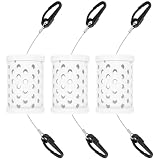
- Basic Information: H 5.9", Diameter: 4.1’’, every bait cage weighs 0.77 pounds, total 3 Packs.
- Material: A1FISHER seal proof bait cage is made of rigid PVC tubing, which is not easy to break and helps to protect the baits from seals, sea lions and other predators. The durable stainless cables and quick release clips will help attach this bait holder to loop net rings and traps. A removable lid and the clips on each side help synchronize baits, and also makes the cage easy to clean.
- Advantages: The removable cover is not easy to come off, convenient to use. And the weep holes are small, measures 0.5’’ in diameter.
- High Capacity: The tubing design is good for holding a lot of bait.
- A perfect choice for outdoor crab fishing.
Is herring still the best lobster bait?
Atlantic herring remains a traditional reference bait, but the available evidence does not show that it is universally superior. The 2025 field result gives a useful benchmark for one fishery-by-product prototype—53% of the catch achieved with traditional herring under that study’s commercial conditions—but it should not be treated as a global performance guarantee.
A sensible approach is to compare herring with one or two legal local alternatives while keeping trap style, soak time and fishing area as consistent as possible. Record bait condition when the trap is hauled; a bait that disappears before retrieval cannot provide a useful comparison.
Fresh fish or clams: which should you choose?
Both are defensible choices because fish and mollusks are documented lobster foods. Choose fresh fish when it is readily available and can be held securely. Choose clams or mussels when shellfish are legal to use, affordable and easier to retain in your trap.
Rank #2

- Seal Proof Bait Tube for Lobster and Crab Traps - Marine Grade
- Premium PVC Materials and Threads to Prevent Cap Slippage (These tops do not pop off)
- Grip Cap for Better Leverage (NON SLIP CAP)
- Large End Clips for Easy Attachment and Removal
- Designed by Lobster Fisherman in San Diego, CA Perfect for Tuna Logs
There is no controlled evidence in the supplied material establishing a universal preference between fresh fish and clams. Test the options in your own area rather than assuming that a result from another coast will transfer.
How to keep bait in the trap
NOAA describes bait as commonly secured inside the trap to lure organisms in until fishermen return to retrieve the catch and re-bait the gear.
- Use a bait bag, bait cage or equivalent mesh container. Select a size and material that fit your trap and target species.
- Fasten it to the trap’s interior. Attach it where lobsters can reach the scent but cannot pull the entire bait out through the mesh.
- Check for weak ties and worn mesh. A loose attachment can turn good bait into an empty trap.
- Match retention to soak time. Longer soaks require bait that remains present and releases scent gradually.
- Re-bait at every haul. Replace bait that is gone, badly degraded or contaminated.
Retention is not a minor accessory issue: a highly attractive bait has little value if it is eaten or removed before the trap is hauled.
Rank #3

- Basic Information: 1/2 liter capacity, available in white, 3packs.
- Construction: A1FISHER bait jar is made of durable plastic, with slotted sides and screw on the slotted cover. The cover contains four eyelets to help securely attach the bait jar to your trap.
- Advantages: This bait cup is equipped with a slotted lid and vented body, which allows scent to disperse, attracting crabs and shellfish into the trap, but won't allow the bait to be teared up.
- The slits on the side are small, which protects the bait from sand fleas and other small scavengers.
- The screw-on lid helps with quick and convenient loading and flushing of bait.
Can you use scraps or offal?
Do not assume that kitchen scraps, fish offcuts or offal are legal. Maine, for example, states that offal may not be used as bait for lobster or crabs. Other jurisdictions may authorize particular alternate baits, impose gear conditions or prohibit materials that create environmental or disease risks.
Check the current rules from the state, provincial or federal fishery authority governing your trap location before deployment. Regulations can differ by area, species and season, and a bait permitted in one lobster fishery may be illegal in another.
Quick wins for a faster PC:
Fix the driver behind crashes, sound loss and screen glitchesFind Drivers →Clear out junk files and repair common Windows errorsFree Scan →American lobster and Caribbean spiny lobster are different fisheries
Advice for American lobster should not automatically be applied to Caribbean spiny lobster. NOAA reports that Caribbean fishermen generally use undersized lobsters, often called “shorts,” to attract legal-sized lobsters; reported mortality for those undersized lobsters is around 10 percent.
Rank #4

- 2 Pack Crawfish Minnow Trap 24in Large Folding Collapsible Heavy Duty Crawdads Bait Fish Traps Mesh Nets. Great for catching minnows and bait fish, crayfish, lobster, shrimp, and small crabs, small fish.
- Heavy Duty Mesh 3.5 inch diameter opening with mesh insert to prevent escape. Great for lakes, ponds, rivers, and creeks.
- Galvanized Steel Structure to Prevent Corrosion
- Foldable for easy transport and storage. Lightweight collapsible trap makes it easy for transportation.
- Zipper for easy baiting and catch removal
That practice reflects a particular fishery and should not be copied for American lobster or another jurisdiction without confirming local authorization and conservation requirements.
Independent reader supportYour contribution helps us test, update, and keep practical guides available for everyone.Does bait attract the biggest lobster?
No bait in the available evidence is shown to selectively attract the largest lobsters. Bait attracts feeding lobsters generally; legal size limits, escape panels or hinges, trap design and area-specific rules determine which animals can be retained.
NOAA identifies American lobster regulations that can include trap limits, escape features, protections for egg-bearing females, gear restrictions and area-specific size rules. Follow those requirements rather than trying to use bait as a size-selection method.
What’s actually slowing this PC down?
Pick the symptom - the matching free tool is one click away.
Best Value

- Seal Proof Bait Tube Marine Grade
- Premium PVC Materials and Threads to Prevent Cap Slippage (These tops do not pop off)
- Grip Cap for Better Leverage (NON SLIP CAP)
- Large End Clips for Easy Attachment and Removal
- Designed by Lobster Fisherman in San Diego, CA. Works perfect with lobster logs.
Regional rules and bait availability change
Bait decisions are partly a supply-and-regulation problem. In 2026, Canada announced that harvesters in Lobster Fishing Area 33 could retain Jonah crab caught as bycatch as an alternate bait source. That example shows why a locally available bait may become practical only after a fishery authority approves its use.
Before fishing, verify:
- which bait species and by-products are legal;
- whether bait must be contained in a specified bag or cage;
- trap, escape-panel and soak-time requirements;
- closed seasons, size limits and protections for egg-bearing females; and
- any rules for transporting, storing or disposing of bait.
What “taste buds” means for lobster bait
“Taste buds” is useful reader-friendly language for how lobsters detect and investigate food, but the available material does not establish a precise account of their taste organs or the chemical cues detected by their antennules. It is safer to base bait choices on documented feeding behavior and practical scent retention than on an unverified claim about a particular molecule or sensory organ.
A practical bait-testing plan
- Choose two or three legal baits that are genuinely available in your area.
- Use comparable traps in the same general grounds and depths.
- Keep soak duration, bait quantity and attachment method as consistent as possible.
- Record catch, bait remaining, condition at haul and any damage to the bait container.
- Repeat across more than one haul and, when possible, more than one tide or weather period.
- Retain the option that gives reliable results at an acceptable cost and remains compliant with local rules.
NOAA describes American lobster traps being lowered in roughly 15 to 1,000 feet of water and hauled every few days, with timing varying by season and location. Those ranges are context for the fishery, not a universal prescription for every recreational or commercial setup.
Quick Recap
Product prices and availability are accurate as of the date/time indicated and are subject to change. Any price and availability information displayed on Amazon at the time of purchase will apply.
Recommended Free Tools




