A chicken trap nest confines a hen after she enters to lay, allowing the attendant to identify her, record the egg, and release her. That makes trap nesting a tool for individual egg records and selective breeding—not simply a better way to collect eggs from a flock.
What is a trap nest for chickens?
A trap nest is a laying nest fitted with an entrance-and-exit mechanism that prevents a hen from leaving until a person releases her. Alfred R. Lee of the U.S. Department of Agriculture defined it in 1915 as “a laying nest so arranged that after a hen enters it she is confined until released by the attendant.”
Because the confined bird can be identified, her egg can be assigned to her individual record. Breeders can then compare hens and select breeding stock using documented performance rather than flock-wide egg totals.
Why do breeders use trap nests?
- Individual records: Each egg is connected to a named or numbered hen.
- Selective breeding: Breeders can identify hens whose production merits retaining in a breeding program.
- Flock diagnosis: Records can reveal which birds are laying consistently and which are not.
For a keeper who only needs eggs for household use, ordinary nest boxes are usually simpler. Trap nesting becomes worthwhile when knowing the layer matters more than minimizing daily labor.
Free tools Windows power users keep installed
One-click scans. No signup required.
#1 Best Overall

- Effortless Roll Away Egg Collection: Our nesting box for chickens features a slight tilt design that allows eggs to roll forward under a secure lid, keeping eggs clean, intact, and preventing pecking or breakage, collect your eggs easily without disturbing your poultry
- Spacious & Ventilated Design: Offer three private, individual nesting compartments, suitable size for standard chickens and small birds, giving them the dark, cozy space they need for stress-free laying and the ventilated design provides fresh air for the hens and keeps the chicken house dry and cool
- Durable & Predator-Resistant Metal Construction: Built with heavy-duty, rust-resistant galvanized steel, the nesting box provides superior protection against rodents and predators compared to wooden coops, ensuring a clean, comfortable, secure and sheltered space to lay eggs, thus increasing their egg production rate
- Easy to Install & Clean: All the screws and nuts required for assembly are included and comes with clear instructions and hardware, easily to assemble or hang it on a wall, inside your coop, or from a sturdy beam, besides, you can periodically flush it with a hose
- Suitable for Multiple Poultry: The laying boxes for hens are designed not only for medium to large chickens, but also ducks, birds and etc, each compartment will accommodate up to 3-5 hens
How do trap nests work?
- Identify each hen. Numbered leg bands were used in Lee’s 1915 instructions and provide a practical way to match a bird to a record.
- Provide a nest with a closing mechanism. The entrance must let a hen enter but block her exit until the attendant opens it. Historical examples were attached beneath a dropping board or placed on a pen wall; a nest under a dropping board required ventilation.
- Check the nest on a schedule. Find the trapped bird, read her identification, and remove the egg.
- Record the result immediately. Log the hen’s number, date, and egg in a notebook or breeding record.
- Release the hen promptly. The system depends on regular attendance so birds are not left confined unnecessarily.
The historical sources do not establish a modern required design, standard dimensions, or a universal safety specification. Build or select equipment that allows reliable identification, ventilation, access, and prompt release, and seek current poultry-extension advice for a flock-specific setup.
How do I know which hen laid an egg?
When you check a trap nest, the hen inside is the layer you record. Match her numbered leg band (or another reliable identification method) to the entry in your flock log, note the egg, and release her. Without a hen-specific identification system and a timely check, a trap nest cannot produce a dependable individual record.
Rank #2
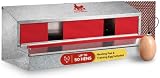
- Cleaner Eggs With Full Pad Coverage: Our chicken nesting box includes a full size nest chicken nesting pads that extends into the rollout tray, helping eggs stay cleaner and easier to collect. The gentle angle supports smooth egg movement into the protected tray, reducing mess and simplifying daily chores for busy chicken keepers
- Flexible Front or Rear Collection: Designed with a reversible rollout system, this nest box lets you collect eggs from inside or outside the coop. The hinged back provides access for lifting the roost bar or excluding hens when needed, creating an adaptable setup that fits your coop layout and routine
- Durable G90 Galvanized Steel Build: Constructed from precision cut G90 galvanized steel, this nesting box offers long lasting use in outdoor environments. The smooth surfaces, sloped roof, and open bottom promote airflow and drainage, supporting a clean, dry interior that hens feel comfortable entering
- Community Style Space For Natural Laying: Instead of tight compartments, this nest box features an open interior that allows hens to settle naturally. The design reduces crowding and gives the flock a calm space to lay, supporting reliable nesting habits for flocks of various sizes and breeds
- Easy Assembly With Included Manual and Video: Each nesting boxes ships flat with a clear step by step manual and access to a full assembly video. Panels are pre cut and pre punched for alignment, allowing a smoother setup experience for chicken owners who want dependable equipment without complicated tools or instructions
How many trap nests do I need?
Lee’s USDA bulletin (1915) advised one trap nest for every four to five hens in flocks of 50 or more, with more nests per hen in smaller flocks. Those figures describe historical practice, not a current universal standard or legal requirement.
| Flock situation | Historical guidance | How to interpret it today |
|---|---|---|
| 50 or more hens | One nest for 4–5 hens | Use only as dated historical context; adjust for housing, laying concentration, and the time available for checks. |
| Fewer than 50 hens | More nests per hen than the ratio above | No current standardized ratio was established; smaller flocks may need additional access to prevent crowding and missed entries. |
Layout matters as much as arithmetic. If several hens queue for one nest, some eggs may be laid elsewhere and the record will be incomplete.
Rank #3

- Nesting Boxes – Provide a natural, comfortable, and safe environment for the poultry during egg laying
- Nesting Boxes for Chicken – Measuring 14 1/4 ’’ in length x 12 1/2 ’’ in width x 12 1/4 ’’ in height, suitable for all breeds of chicken and also for some poultry; 0.2 ’’ thickness protects chickens and poultry laying eggs inside
- Durable and Soft Material – Made from durable pp plate sheet, the nesting boxes is soft, comfortable, and easy to clean, ensuring the safety and well-being of chickens and poultry; The bright orange color stimulates egg production
- Easy Use – It is incredibly easy to use with no extra tools required; Simply attach the corresponding Velcro and you will get a durable chicken nesting box in just one minutes
- Package Included – 3 Chicken nesting boxes; Please contact us with any questions you may have
How often do I check a trap nest?
Lee’s 1915 instructions said nests should be visited at least three times daily, preferably four or five, with especially frequent visits when hens were laying freely and during hot weather. This is historical guidance, not a modern prescribed schedule. The practical rule is to check often enough to identify and release every trapped hen promptly, given your flock’s laying pattern and weather.
That schedule is the method’s central cost. The USDA material notes that substantial labor limited adoption of trap nests. A keeper who cannot make repeated checks should not rely on trap-nest records as complete production data.
Rank #4

- [Roll Away Nesting Box] No more searching all over for eggs. This chicken nesting box gives hens a comfortable place to lay, protects eggs from dirt and damage, and makes collecting them easier.
- [Rollaway Egg Collection Box] With a gently sloped design, the eggs automatically roll into the front drawer, keeping them safely away from the hens.
- [Infinitely Stackable] This set includes 2 nest boxes that can be freely combined horizontally or vertically and stacked infinitely for expanded capacity.
- [for Medium to Large Chickens] With built-in airflow vents and base drainage holes, the interior of the chicken nest box stays dry and fresh, creating a cozy and healthy space for your hens.
- [Freely Assemble] With pre-drilled holes on the back, you can either wall-mounted or floor-standing placement, whatever works best for your chicken coop!
Trap nests versus ordinary nest boxes
| Feature | Ordinary nest box | Trap nest |
|---|---|---|
| Primary purpose | Provide a suitable shared place to lay and simplify egg collection | Identify the individual hen that laid each egg |
| Attendant time | Routine collection and cleaning | Repeated checks, identification, recording, and release |
| Record precision | Usually flock-level unless birds are separated | Individual records when every entry is checked and logged |
| Best fit | Most household and general laying flocks | Breeding and performance-record programs |
| Capacity planning | Choose enough boxes for the flock’s use | Historical ratios exist, but no current universal ratio was established |
What records should I keep?
At minimum, record the hen’s identification number and the date for each egg. Breeders may also track breaks in laying, broody periods, health notes, and the identity of offspring, but the trap nest itself only establishes the hen-egg link when the check and identification are reliable.
A numbered leg-band system and a dedicated poultry-breeding record book support the workflow described by USDA and Kentucky Extension. Current product quality, prices, and availability vary, so choose equipment that remains legible and does not impede the bird.
Recommended Free Tools
When is trap nesting practical?
It can make sense when
- You are selecting breeders and need evidence from individual hens.
- You can visit the nests several times every day.
- Your housing lets you identify birds quickly and keep accurate records.
It is usually a poor fit when
- You only need a reliable supply of flock eggs.
- No one can perform repeated checks, especially during peak laying or hot weather.
- Bird identification or recordkeeping will be inconsistent.
What are the limitations and welfare considerations?
Every trapped hen depends on a person for identification, recording, and release. Delayed checks reduce record accuracy and prolong confinement. The historical sources document the labor burden but do not provide a modern maximum confinement time, welfare protocol, or validated automated alternative. Keep the mechanism functioning, provide appropriate ventilation and space, inspect birds regularly, and consult a contemporary poultry-extension specialist for current welfare and housing guidance.
How long should hens be trap-nested?
The 1915 bulletin describes some breeders trap-nesting pullets during their first six months of laying to help select breeders. That is a historical example, not a universal program length. The appropriate period depends on the breeding question, the completeness of your records, and the labor you can sustain.
Quick Recap
Product prices and availability are accurate as of the date/time indicated and are subject to change. Any price and availability information displayed on Amazon at the time of purchase will apply.




