Do these 3 things before closing this tab:
1Scan for outdated or missing drivers - takes under a minute2Clear out junk files and repair common Windows errors3Fix the driver behind crashes, sound loss and screen glitchesResearchers who put laboratory mice “in nature” do not simply release them and walk away. In a 2024 rewilding study, mice lived in secured outdoor enclosures and were later recovered for sampling. The central finding: their environment changed how immune measurements related to mouse strain and infection, so results from standard laboratory housing do not tell the whole biological story.
What does “putting lab mice in nature” actually mean?
In the 2024 study, rewilding meant moving laboratory-bred mice into managed outdoor enclosures, not abandoning them in an open habitat. The researchers reported 89 rewilded mice across two experimental blocks. Enclosure wedges covered about 180 m², and animals were recovered at intervals for sampling. The study used female mice and had animal-care approvals. The Nature Immunology paper describes the methods.
The researchers compared three strains—C57BL/6, 129S1 and PWK/PhJ—under standard laboratory housing and outdoor-enclosure conditions. Some mice were also challenged with the intestinal helminth Trichuris muris. The challenge groups received approximately 200 embryonated eggs by oral gavage; that figure describes this experiment’s protocol, not a general or recommended exposure dose.
What changed in the mice?
Immune-cell composition reflected interactions between the mice’s genetic background and their environment. Infection also affected some outcomes. In other words, “strain,” “housing” and “infection” did not act as interchangeable variables: what researchers observed depended in part on the combination being measured.
#1 Best Overall

- Secure & Escape-Proof Wire Lid: Features a dedicated holder to keep water bottles firmly in place and includes a foldable partition to separate food areas. With narrow 1/4" (6.3 mm) wire spacing, the lid effectively prevents rodents from escaping while ensuring proper ventilation.
- Product Size: 11.42" L x 5.9" W x 6.69" H. This mouse cage can be used as a breeding cage (male and female), a pregnancy/maternity cage, a mouse weaning cage, or as a cage to temporarily separate an adult mouse.
- Leak-Proof & Silent Water Bottle: The 250ml water bottle is designed for easy refilling and cleaning. Its watertight stopper and stainless steel nozzle provide a silent drinking experience without a ball bearing. After flipping, the bottle quickly stabilizes to prevent dripping, keeping the habitat dry.
- Smooth & Easy-to-Clean Design: Made from sturdy yet lightweight material, these breeding tubs feature smooth inner walls, a flat base, and rounded corners to prevent waste buildup. Hassle-free cleaning helps maintain a hygienic environment for your mice.
- Space-Saving & Stackable: Both the tubs and steel lids are designed to stack securely, optimizing vertical storage in limited spaces. Ideal for breeders and reptile keepers managing multiple cages efficiently.
Some differences between strains that appeared under laboratory conditions became smaller after rewilding. The authors put it this way: “Notably, genetic differences under laboratory conditions were decreased following rewilding.” That does not mean every strain became alike. Other features remained dependent on genotype or varied by tissue and infection status. The study’s result is context-dependent change, not a single uniform “rewilded mouse” profile.
Another study focused on B cells reported signs of greater maturation among circulating B cells, stronger germinal-center responses, expansion of gut B cells, and increased microbiota-reactive IgG and IgM after rewilding. Those findings concern that separate study, not the 89-mouse sample or protocol described above. The B-cell study offers a further example of how outdoor exposure can affect specific immune measurements.
Rank #2
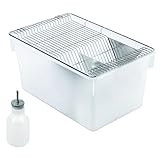
- Versatile Size for Multiple Uses:Perfectly suited as a breeding cage (for male-female pairs), pregnancy/maternity enclosure, mouse weaning habitat, or temporary separation cage for adult mice. Its compact dimensions adapt to various rearing needs.
- Secure Escape-Proof Wire Lid:Ventilation & Protection in One. Boasts a built-in water bottle holder for stable placement and a foldable divider to separate feeding zones. With ultra-narrow 1/4" (6.3 mm) wire spacing, it reliably stops rodent escapes while promoting optimal airflow to keep habitats fresh.
- Leak-Proof Silent Water Bottle (250ml):Designed for effortless refills and cleaning, the bottle features a watertight stopper and stainless steel spout – no ball bearing required for quiet sipping. It stabilizes quickly after flipping to prevent drips, maintaining a dry living space.
- Smooth Easy-Clean Construction:Crafted from durable yet lightweight materials, the breeding tubs feature smooth inner walls, a flat base, and rounded corners to avoid waste accumulation. Hassle-free cleaning ensures a hygienic environment for your mice.
- Stackable Design for Space Optimization:Both the tubs and steel lids are engineered for secure stacking, maximizing vertical storage in tight spaces. An ideal solution for breeders and reptile enthusiasts managing multiple cages efficiently.
How does outdoor rewilding compare with laboratory housing?
| Context | Environmental exposure | What the studies show |
|---|---|---|
| Standard laboratory housing | Specific-pathogen-free housing limits exposure to environmental microbes. | Provides a controlled setting, but immune measurements reflect that setting and should not automatically be treated as a complete picture of biology in more complex environments. |
| Outdoor-enclosure rewilding | Laboratory-bred mice experience a managed outdoor environment and are later recovered for study. | Immune-cell composition can vary with environment, strain, tissue and infection; some laboratory strain differences may become smaller. |
Earlier work helps explain why this comparison matters. A 2016 study reported that changed living conditions altered immune-cell composition, blood-cell gene-expression patterns, resistance to infection and T-cell differentiation. It also found that some immune features seen in feral barn mice and pet-store mice could be induced in laboratory mice after co-housing with pet-store mice. Those results show that environmental context can matter; they do not make all findings from laboratory mice invalid. The 2016 study describes those experiments.
Rewilding is a research strategy for adding ecological realism while retaining some control over the experiment. A 2023 review discusses the trade-off: field-like complexity can make a model more realistic in certain respects, but it also makes conditions less controlled than conventional laboratory housing. It is a tool for questions that need it, not a universal replacement for standard husbandry. The review explains this approach.
What’s actually slowing this PC down?
Pick the symptom - the matching free tool is one click away.
Rank #3

- Versatile Size for Multiple Uses:Perfectly suited as a breeding cage (for male-female pairs), pregnancy/maternity enclosure, mouse weaning habitat, or temporary separation cage for adult mice. Its compact dimensions adapt to various rearing needs.
- Secure Escape-Proof Wire Lid:Ventilation & Protection in One. Boasts a built-in water bottle holder for stable placement and a foldable divider to separate feeding zones. With ultra-narrow 1/4" (6.3 mm) wire spacing, it reliably stops rodent escapes while promoting optimal airflow to keep habitats fresh.
- Leak-Proof Silent Water Bottle (250ml):Designed for effortless refills and cleaning, the bottle features a watertight stopper and stainless steel spout – no ball bearing required for quiet sipping. It stabilizes quickly after flipping to prevent drips, maintaining a dry living space.
- Smooth Easy-Clean Construction:Crafted from durable yet lightweight materials, the breeding tubs feature smooth inner walls, a flat base, and rounded corners to avoid waste accumulation. Hassle-free cleaning ensures a hygienic environment for your mice.
- Stackable Design for Space Optimization:Both the tubs and steel lids are engineered for secure stacking, maximizing vertical storage in tight spaces. An ideal solution for breeders and reptile enthusiasts managing multiple cages efficiently.
Does “rewilding” mean the mice were free of infection?
No. The 2024 study reports that pathogen-screening panels tested for over 30 pathogens and found no other detectable infections in the mice. That is a finding from this experiment’s screening protocol; it is not proof that outdoor rewilding is generally risk-free or that every possible infection was excluded. The researchers also deliberately challenged some animals with T. muris, so infection status was part of the experimental design.
Are “wildling” mice the same as rewilded mice?
No. In the outdoor-enclosure approach, already-born laboratory mice are exposed to an outdoor environment. In the separate “wildling” method described by the NIH, laboratory-mouse embryos are transferred into wild mothers, and the offspring acquire microbial and pathogen communities resembling those of wild mice. The approaches change the animals’ biology in different ways and should not be treated as one experiment or one type of mouse.
Rank #4

- Optimal Size for Housing Small Rodents: with dimensions of 11.81 x 7.17 x 5.79 inches/ 30 x 18.21 x 14.71 cm, this cage comfortably accommodates 4-5 mice; The spacious yet compact design ensures proper ventilation and movement while optimizing lab space efficiency
- Durable PP Material: the lab mouse rat cage is made of quality polypropylene (PP), ensuring durability and resistance to wear; This material is lightweight yet sturdy, suitable for long-term laboratory use; The PP construction allows for high-temperature sterilization, maintaining hygiene standards in research environments
- 304 Stainless Steel Removable Mesh Cover: the rat mouse breeding cage features a 304 stainless steel mesh cover, providing excellent rust; Its sturdy structure prevents deformation even under frequent handling
- Water Bottle Design: included with the cage is a 250ml PP water bottle with visible measurement lines, enabling accurate tracking of water consumption; The detachable design ensures easy cleaning and sterilization, supporting precise data collection in laboratory studies
- Semi-transparent Design for Easy Monitoring: the semi-transparent PP cage allows researchers to observe rodent activity without frequent disturbance; This feature is particularly useful for behavioral studies and health monitoring in laboratory settings
In the NIH account, Barbara Rehermann, M.D., described the aim as creating “a mouse model that better resembles a mouse you’d find in the wild.” That quote concerns the wildling method, not the 2024 enclosure study. The NIH account explains the method.
Independent reader supportYour contribution helps us test, update, and keep practical guides available for everyone.What should a reader take away from this?
The useful surprise is about interpretation: an immune result measured in a specific-pathogen-free laboratory environment may not look the same in a more complex outdoor setting. The rewilding studies show that environmental exposure can shift biological measurements and interact with genotype, tissue and infection. They do not show that nature simply makes every laboratory mouse healthier, or that laboratory results are worthless.
Free tools Windows power users keep installed
One-click scans. No signup required.
Best Value

- Secure & Escape-Proof Wire Lid: Features a dedicated holder to keep water bottles firmly in place and includes a foldable partition to separate food areas. With narrow 1/4" (6.3 mm) wire spacing, the lid effectively prevents rodents from escaping while ensuring proper ventilation.
- Product Size: 11.8" L x 18.11" W x 6.3" H. This mouse cage can be used as a breeding cage (male and female), a pregnancy/maternity cage, a mouse weaning cage, or as a cage to temporarily separate an adult mouse.
- Leak-Proof & Silent Water Bottle: The 250ml water bottle is designed for easy refilling and cleaning. Its watertight stopper and stainless steel nozzle provide a silent drinking experience without a ball bearing. After flipping, the bottle quickly stabilizes to prevent dripping, keeping the habitat dry.
- Smooth & Easy-to-Clean Design: Made from sturdy yet lightweight material, these breeding tubs feature smooth inner walls, a flat base, and rounded corners to prevent waste buildup. Hassle-free cleaning helps maintain a hygienic environment for your mice.
- Space-Saving & Stackable: Both the tubs and steel lids are designed to stack securely, optimizing vertical storage in limited spaces. Ideal for breeders and reptile keepers managing multiple cages efficiently.
These experiments measured mouse biology. They did not establish that rewilded mice were happier, and they do not experimentally demonstrate that people should change their lives. Any life-advice reading is a metaphor, not a conclusion of the studies.
Quick Recap
Product prices and availability are accurate as of the date/time indicated and are subject to change. Any price and availability information displayed on Amazon at the time of purchase will apply.