Air-breathing fish are the best general survivors of low dissolved oxygen (DO). The strongest example in the available evidence is the striped snakehead (Channa striata), which can take oxygen through its gills, skin and a suprabranchial chamber. Air-breathing catfish, lungfish and labyrinth fish such as paradise fish are also unusually tolerant. No species is a universal winner: reported limits depend on population, temperature, acclimation, water chemistry, access to the surface and the way oxygen was measured.
What “low oxygen” means for fish
Low oxygen refers to low dissolved oxygen in the water, not simply whether an aquarium looks stagnant. Fish that breathe air can supplement or replace oxygen extracted through their gills, while other species may slow their activity, breathe at the surface or change metabolism. These responses buy time, but they do not make polluted, overheated or chronically stagnant water safe.
Oxygen results from different studies cannot be compared as if they were one universal scale. A threshold reported in milligrams per litre (mg/L), a water partial pressure in kilopascals (kPa), and survival during a forced-submergence experiment describe different conditions.
The best-documented low-oxygen survivors
| Fish or group | How it obtains oxygen | Evidence and conditions | Important limitation |
|---|---|---|---|
| Striped snakehead (Channa striata) | Gills, skin and a suprabranchial air-breathing chamber | A 2025 review reports more than 70% aerial oxygen uptake under controlled hypoxia in Vietnamese populations. One Indian population had a critical oxygen tolerance near 0.15 mg/L. | Those are population- and experiment-specific findings, not a safe aquarium target or a universal species limit. |
| Air-breathing catfish (including Clarias and Pangasius) | Species-specific accessory organs and air breathing; dependence ranges from facultative to very strong | Armoured catfish began air breathing at a water PO2 of 2.5 kPa in a 2016 Journal of Experimental Biology study. In one 27 °C experiment, striped catfish (Pangasius hypophthalmus) showed 100% survival after seven days of forced submergence. | The tests did not establish a husbandry minimum. Species differ greatly in size, behavior and need for surface access. |
| Lungfish | Lungs supplement or replace gill respiration | Lungfish are classic air breathers and are adapted to oxygen-poor environments. | Adult size, enclosure requirements and local legal rules can make them unsuitable for ordinary home aquariums. |
| Labyrinth fish, such as paradise fish | A labyrinth organ allows atmospheric oxygen uptake | Paradise fish increase air-breathing respiration during hypoxia. | Air breathing does not remove their need for clean water, appropriate temperature or adequate surface access. |
| Black mudfish | Behavioral and physiological hypoxia responses; field observations include surface or aerial strategies | New Zealand field observations recorded near-bottom DO below 1.0 mg/L during hypoxia. | Field observations are not a controlled survival threshold and should not be used as a stocking guideline. |
Why air-breathing fish cope better
A 2020 Fish Physiology review estimates 656 air-breathing teleost species. It reports that air breathing evolved independently more than 80 times across 22 orders and 41 families. The broad pattern is consistent with the ecological problem these fish face: warm, shallow, muddy, crowded or seasonally drying water can lose oxygen faster than gills can extract it.
Free tools Windows power users keep installed
One-click scans. No signup required.
#1 Best Overall

- Steady Output: Max Air Flow Rate: 50 GPH; Pressure: 0.013 MPa; Power: 1.25 W. The pump supplies steady air flow with low power consumption. Work great for fish tanks or buckets up to 60 gallons.
- Adjustable Air Flow: There is a rotatable knob on the top to manually adjust the air volume. Greatly meet your desired air flow to keep fish or roots healthy.
- Quiet Operation: With 4 shockproof rubber feet to minimize vibration, the pump greatly reduces noise to less than 30 dB like a soft speaking voice. No disturbance to your daily life.
- Reliable Construction: The fish tank pump is well constructed with a sturdy ABS shell and a heavy-duty inner structure. Really lightweight and space-saving.
- Pump Accessories: Contain 6.5-foot 3/16" airline tubing (ID: 4 mm), 2 small air stone cylinders, 2 connectors (straight & T-shape) and 2 check valves. All build the basic aeration setup in your fish tank.
Air breathing may be facultative (used when water oxygen falls) or more nearly obligate (required for normal survival). A facultative air breather can still be harmed by being denied the surface, while an aquatic species without an air-breathing organ may die even when the water appears clear.
Striped snakehead
Striped snakehead is the clearest documented candidate when the question is extreme hypoxia tolerance. Its gills handle aquatic exchange, while skin and the suprabranchial chamber contribute to aerial uptake. The reported values above show why it ranks highly, but they come from particular populations and controlled conditions. Snakeheads can also be aggressive, grow substantially and be restricted or prohibited in some jurisdictions.
Rank #2
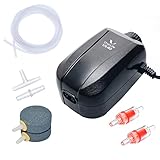
- Steady Output: Max Air Flow Rate: 64 GPH; Pressure: 0.016 MPa; Power: 4 W. Perfect for aeration in 10 - 100 gallon fresh water and marine aquariums.(The data is measured with experimental equipment and may deviate slightly from the actual data. The air volume may be insufficient due to the blocked air intake cotton. Please replace the cotton yourself if the air volume is insufficient.)
- Adjustable Air Flow: Feature a rotary knob to control the amount of air for dual outputs, allowing for your desired air flow to fully oxygenate your fish tank.
- Quiet Operation: The pump emits 25 dB sound under the “Low” mode and maximum 45 dB noise like the hum of a refrigerator under the highest air flow.
- 2 Air Stone Discs: Produce lots of dense medium bubbles bursting into the surface of water steadily. A great way to aerate your tanks and enliven the aquatic life.
- Pump Accessories: Include 2 air stones, 6.5-foot airline tubing, 2 check valves and 2 connectors. Complete accessories to build the basic aeration setup in your tank.
Air-breathing catfish
Catfish are not one uniform category. Armoured catfish can initiate air breathing at a measured water PO2 of 2.5 kPa, and Pangasius hypophthalmus survived a seven-day forced-submergence trial at 27 °C. Neither result says that a home aquarium can safely run at those conditions. Surface access, temperature, body size, illness and water chemistry still change the outcome.
Labyrinth fish and paradise fish
Paradise fish and related labyrinth fish routinely use atmospheric oxygen, and paradise fish increase that respiratory contribution as hypoxia develops. They are generally more practical for many hobbyists than large snakeheads or lungfish, but compatibility, territorial behavior and access to a calm air–water interface matter.
PC Slower Than It Used to Be?
A free scan shows the junk files, broken settings and background clutter dragging Windows down - then fixes them in one click.Free scan · Windows 10 & 11Outdated Drivers Are Slowing You Down
One free scan finds every outdated or missing driver and matches the right update for your exact hardware.Free scan · exact hardware matchRank #3

- POWERFUL AERATOR PUMP & ENERGY CONSERVATION - AQQA fish tank air pump 3 watt equipped with a high-quality pump, the pump delivers stable output while conserving energy for optimal performance. Air volume for up to 80 gallon tank, the max pressure is 18Kpa and max air volume is 100GPH, can be easily connected to different type air stones, can be used for larger fish tanks, aquariums.
- NOISE REDUCTION ULTRA QUIET FUNCTION - The aquarium air pump features a sturdy double-layer structure with a built-in air pump and thickened casing, the bottom of the pump is designed with four soft rubber pads, which not only reduce noise, the max noise does not exceed 35dB but also prevent the pump from moving excessively during operation.
- DURABLE STAINLESS STEEL DUAL OUTLET DESIGN - The fish air pump designed with 2 stainless steel outlets, long service life, that can be used in multiple fish tanks or aquariums, making it suitable for both freshwater and seawater setups.
- ADJUSTABLE AIR FLOW SWITCH - The air pump aquarium is equipped with a knob on top, allowing you to easily adjust the air volume or switch without the need for frequent unplugging and plugging, making it more user-friendly.
- PACKAGE INCLUDED - 1 × Aquarium air pump with 5.91ft power cord; 2 × Air stones; 2 × 4.92ft Air tubes; 2 × Check Valves; 1 × User Manual. And you will get a 1-year after-sale product service and 7*24H lifetime customer service.
How to compare a candidate for your setup
- Identify the breathing strategy. Prefer a species with documented air breathing if the risk is occasional oxygen depletion. Determine whether it is facultative or dependent on regular surface access.
- Read the oxygen result in context. Record the unit, temperature, salinity, population, acclimation period and whether fish could reach air. Do not convert one study’s threshold into another species’ safe limit.
- Check adult size and aggression. A fish that tolerates hypoxia may still outgrow a tank, eat companions or injure them.
- Match water chemistry and temperature. Hypoxia tolerance does not guarantee tolerance of unsuitable pH, ammonia, salinity or temperature. Warm water holds less oxygen, and disease or transport stress can sharply reduce resilience.
- Provide surface access. Cover, turbulence, floating plants or a sealed lid can prevent an air-breathing fish from using its adaptation. Leave an appropriate, unobstructed air–water interface.
- Confirm legality and availability. Snakeheads and some other air-breathing fish are regulated differently by jurisdiction. Check local wildlife and aquarium rules before purchase.
What to do in an aquarium
An air-breathing species should be a safety margin, not an aeration substitute. Use a dissolved-oxygen test to find out what is happening rather than relying on a species label.
- Install an appropriately sized air pump and air stone, or increase filter return agitation.
- Maintain circulation so oxygen-poor pockets do not form, especially near the bottom.
- Avoid overstocking and remove decaying food or organic waste that drives oxygen demand.
- Watch for piping at the surface, lethargy, rapid gill movement, clustering near a return outlet or sudden nighttime distress.
- If oxygen falls, restore aeration immediately, reduce feeding and investigate power, temperature, biomass and water-quality problems. Do not make a large emergency water change with untreated or temperature-mismatched water.
Mechanical aeration is identified in USDA aquaculture guidance as a major oxygen source in ponds. In a home tank, an air stone or strong surface movement is usually a more reliable intervention than replacing fish with a supposedly “hardy” species.
Rank #4

- Ultra Quiet: Made of ABS thickening engineering plastics, super silent aquarium air pump. Soft rubber foot pads, further palliation for noise.
- Long Service Life: Manually adjustable air volume, won’t cause shakes and electric field fluctuation, much safer than electronic adjustment, lower failure rate.
- Aquarium Air Pump with 2 outlets, dual hose fish tank air pump, 3W air pump fit for fish tanks from 10 to 100 gallon.
- Unique Design: The air intake cotton is replaceable, it can filter the impurities in the air and extend the service life of the air pump, also come with 1 more replacement.
- Complete Accessories: Comes with everything you need, includes: Return Valve*2, Air Stone*2,Air Tube (2 x 4.9ft)*2, Suction Cup*2, Air Regulating Valve*2, T-Connector*1, Air Intake Cotton*1. Original quality, professional manufacturer.
What to do in a pond or aquaculture system
Pond oxygen commonly falls overnight and before dawn because photosynthesis stops while fish, plants and microbes continue consuming oxygen. Heat, algal crashes, heavy stocking, muddy water and decomposing material increase the risk. Use a pond aerator or other mechanical aeration sized for the system, keep an emergency power plan, and measure DO at the time of greatest risk.
Air-breathing fish can survive episodes that kill strictly aquatic species, but they can still suffer chronic stress, poor growth, disease and toxic ammonia exposure. A tolerant fish is not evidence that the pond is healthy.
Recommended Free Tools
Best Value

- 【DaToo 3W 40GPH AIR PUMP】: Don't let oxygen supply become a concern in your happy aquarium career. How can we easily solve the problem of oxygen supply? DaToo offers you a complete solution. DaToo 3W air pump is small body with big power, whisper-quiet operation mode, rugged and durable, comprehensive all-in-one package, making it easy for you to have an enjoyable and fun-filled aquarium journey!
- 【SMALL BODY BIG POWER】: DaToo 3W air pump has a small body of 3.5*1*1inch, which can be easily hidden in any corner, perfect for aquarium hobbyists with compact space. At the same time, it also has a strong power of 40GPH, 0.018Mpa, which can provide sufficient and fresh oxygen to your aquarium 24 hours a day, so that your pet fish always live in a comfortable water environment!
- 【WHISPER-SILENT MODE】: As we all know that vibration noise is the key to the noise level of an aquarium system, DaToo 3W air pump adopts the sharp corner silent technology, which ensures sufficient support while minimizing the contact area between pump and desktop, and the level of silence is increased by 7% compared to similar air pumps. Made of soft rubber material, which can effectively absorb the vibration noise, so that your just-started aquarium adventure won't be stopped by the noise!
- 【STRONG AND DURABLE】: DaToo 3W aquarium air pump is made of thickened ABS shell, which is strong and solidly constructed, fearless of damage and external impact, giving you a long-lasting experience. Professional all-copper motor, stable performance, low noise, corrosion and abrasion resistance, longer service life, is your ultimate aquarium companion!
- 【COMPREHENSIVE ALL-IN-ONE PACKAGE & ONE YEAR WARRANTY】: Completing the setup of your aquarium aeration system is a breeze thanks to DaToo's all-in-one package, which includes a DaToo 3W air pump, 6.5ft air hose, and an air stone. Additionally, you'll find a check valve in the package, which keeps your unit safe. We provide one year warranty and 24 hours professional customer service. Buy With Confidence!
Are any fish truly safe without an air pump?
No. Some fish can survive a temporary pump failure by breathing atmospheric air, but “survive” is not the same as thrive indefinitely. A pump failure can also create ammonia, carbon-dioxide and temperature problems that air breathing does not solve. For any aquarium or pond, provide aeration and circulation sized to the bioload, and verify DO with a test.
Bottom line for choosing a fish
For documented extreme hypoxia tolerance, striped snakehead is the standout in the available evidence, followed by air-breathing catfish, lungfish and labyrinth fish. For a typical pet setup, choose only a legal species whose adult size, temperament and water requirements fit the enclosure—and fix oxygen management with aeration rather than treating air breathing as permission for stagnant or polluted water.
Quick Recap
Product prices and availability are accurate as of the date/time indicated and are subject to change. Any price and availability information displayed on Amazon at the time of purchase will apply.




