Not exactly. The famous Canadian “dinosaur mummy” is Borealopelta markmitchelli, an armored nodosaur found near Fort McMurray, Alberta, in 2011. It preserves an unusually complete, three-dimensional body outline, extensive fossilized skin-like scales and armor coverings, and a mass of plant material from its last meal. The published evidence does not show intact internal organs or living skin.
What dinosaur was found in Canada?
The specimen is the holotype of Borealopelta markmitchelli, a nodosaurid ankylosaur from the Early Cretaceous of Alberta. It is catalogued as Royal Tyrrell Museum specimen TMP 2011.033.0001.
On March 25, 2011, employees working for Suncor near Fort McMurray noticed an oddly textured object with a distinctive diamond pattern. They photographed it and contacted the Royal Tyrrell Museum. Because the region had once been seabed, museum staff initially expected a marine reptile. The fossil turned out to be an ankylosaur, a heavily armored plant-eating dinosaur.
The Government of Alberta described the fossil as about 110 million years old. Its formal scientific description appeared in 2017. Museum preparator Mark Mitchell spent more than 7,000 hours exposing and stabilizing the specimen; his name became part of the species name.
Recommended Free Tools
#1 Best Overall

- Resin Cast Replica
- 5.5 inches
Why do people call it a “dinosaur mummy”?
“Dinosaur mummy” is an informal paleontological term for a fossil that retains an unusually detailed external body covering or body outline. It does not mean a fresh carcass remains, and it does not guarantee that original soft organs survived.
In Borealopelta, researchers documented:
- A largely three-dimensional body form rather than a flattened skeleton alone
- Broad, continuous fields of fossilized scales and other skin-like integument
- Armor plates and horn sheaths that retained their original positions and shapes
- The head, neck, most of the trunk and sacrum, and parts of the limbs
These are mineralized or otherwise fossil-preserved structures and evidence of their original arrangement. Calling them “intact skin” in the ordinary modern sense would be misleading.
Did it really have intact organs?
No intact internal organs have been reported for this specimen in the cited studies. The strongest internal evidence is a distinct fossilized mass of stomach contents.
Rank #2
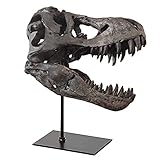
- 【Home Office Desktop Shelf Decor 】Dinosaur head sculptures skull model is hand cast from high-quality solid resin. The surface is made of antique craftsmanship, and the convincing colours and details make it look very realistic and eye-catching. Add some aesthetic to your room
- 【Supplement Your Collection】T-Rex is one of the most popular dinosaurs in the world. For dinosaur lovers or palaeontology lovers, the tyrannosaurus rex skull is a fantastic replica. It will also be a fun teaching tool for any child or teen
- 【Home Decor and Conversation Starter】A lifelike dinosaur skeleton decor. This impressive sculpture looks great on a table or bookshelf. It will be a great conversation starter and conversation piece for any family
- 【Suitable for Many Occasions】This Tyrannosaurus Rex skull replica comes with a metal base. There are 4 non-slip pads on the bottom of the stand to protect the surface of your furniture. It can be placed on various occasions such as office, hallway, TV cabinet, wine rack, living room, etc
- 【Perfect Christmas/Birthday Gift】10.2x 5.9x 11.8 inches.It only takes 2 minutes to complete the installation.Give it as a gift to children, adults, husbands, and friends, no one will refuse it
A 2020 peer-reviewed study examined the plant remains in that mass. Those remains represent material in the animal’s digestive tract at death or shortly before it died, allowing scientists to investigate its diet and the vegetation available in its environment. They do not demonstrate that the stomach wall, intestines, liver or other organs remained intact.
What did the nodosaur eat?
The preserved stomach mass contained fossilized plant material. Its analysis provided a direct snapshot of the animal’s final meal rather than a dietary guess based only on teeth or body shape.
That evidence can illuminate which plants were available and how this nodosaur fed within its Early Cretaceous ecosystem. It should still be described as a preserved last meal: the study does not turn the fossil into a dinosaur with surviving functional digestive organs.
Rank #3

- Utahraptor was a large theropod dinosaur that lived during the Early Cretaceous period, known for its sharp claws and hunting abilities
- This replica is based on a real Utahraptor fossil discovered in Utah, accurately capturing the shape and detail of the original claw
- The Utahraptor’s curved claw was used for gripping and slashing, making it a key tool for hunting prey
- Cast in durable resin, this 5.5-inch replica offers museum-quality detail and texture
- Made in the USA, this fossil reproduction is perfect for collectors, educators, and dinosaur enthusiasts
What exactly is preserved?
| Feature | What the evidence supports |
|---|---|
| Age | About 110 million years, according to Alberta’s 2011 discovery announcement |
| Identity | Borealopelta markmitchelli, a nodosaurid ankylosaur |
| Body preservation | Highly detailed, largely three-dimensional external form with scales and armor |
| Color | Scientific chemical and microscopic analyses support interpretations of original coloration; this is an inference from fossil evidence, not a direct observation of a living animal |
| Digestive evidence | A fossilized mass of plant remains from the last meal |
| Intact organs | Not reported in the cited studies |
How scientists studied its appearance and ecology
Researchers used chemical and microscopic signals in the preserved integument to investigate coloration. Those results also informed hypotheses about how the animal’s appearance may have affected predator-prey interactions.
Such conclusions are reconstructions: they combine measurable chemical and structural evidence with biological interpretation. They are not photographs of Borealopelta alive, and they should not be presented as certain details of its behavior.
Is its preservation mechanism known?
The fossil’s exceptional external detail is clear, but a preservation process demonstrated for another “mummy” should not automatically be assigned to Borealopelta.
Rank #4

- IT FROM XUQCAH MATERIAL AND FOIMOJSK PAR ENT AND Thurder LOVER
- Museum Quality Replica
- Please thoroughly read discription
A 2026 study of two different Edmontosaurus annectens specimens found that their integumentary outlines were preserved as a clay template less than 1 millimeter thick, formed during decay before soft tissues and organic compounds were lost. Those findings help explain how a fossil can retain a detailed external impression while original tissues disappear. They do not establish that the same mechanism produced the Canadian nodosaur’s preservation.
Where was it found, and where is it studied?
The fossil was discovered during work near Fort McMurray in Alberta, Canada, and was transported to the Royal Tyrrell Museum for preparation and study. The museum’s preparation work made the extensive armor and integument visible over thousands of hours.
This is not a newly discovered 2025 or 2026 dinosaur. The discovery occurred in 2011, the species was named in 2017, and subsequent studies—including the 2020 stomach-content analysis—expanded what scientists could learn from it.
Windows Errors? Fix Them Before They Spread
Repair common Windows errors and clear accumulated junk for a smoother, more stable PC - no reinstall needed.Free scan · no reinstallCrashes, No Sound, or Screen Glitches?
Random freezes, missing sound and display glitches usually trace back to one bad driver. Find and replace yours safely.Free scan · under a minuteHow to describe the find accurately
- Say “exceptionally preserved armored dinosaur fossil” or “dinosaur mummy” with an explanation of the informal term.
- Specify that the fossil preserves skin-like integument, scales, armor and horn sheaths.
- Describe the internal discovery as fossilized stomach contents or a preserved last meal.
- Do not claim that intact organs or living skin survived.
- Keep evidence from Borealopelta separate from preservation studies of North Dakota or Wyoming Edmontosaurus specimens.
The Bottom Line
Bottom line: Canada’s 110-million-year-old “dinosaur mummy” is Borealopelta markmitchelli, an extraordinary fossil with detailed external integument, armor and a preserved plant-filled stomach mass—not a dinosaur with intact organs.
Quick Recap
Product prices and availability are accurate as of the date/time indicated and are subject to change. Any price and availability information displayed on Amazon at the time of purchase will apply.




