What’s actually slowing this PC down?
Pick the symptom - the matching free tool is one click away.
The sand cat (Felis margarita) is a small wild felid specialized for life in true deserts. Fur-covered feet, unusually sensitive hearing, digging ability and an efficient way of obtaining moisture from prey all help it survive where temperatures swing sharply and free water may be scarce. Here are eight evidence-based facts, followed by what is—and is not—known about its conservation status.
1. It is the only felid found primarily in true deserts
The IUCN SSC Cat Specialist Group describes the sand cat as the only cat species found primarily in true deserts. Its range extends through desert regions of northern Africa and southwestern and central Asia, but the species is distributed patchily rather than continuously across that vast area. The IUCN account and assessment both caution that records are sparse, so an empty spot on a map is not proof that sand cats are absent.
Sand cats are wild animals, not domesticated pets. Their specialized behavior and habitat needs make them unsuitable for ordinary household care.
IUCN SSC Cat Specialist Group species account · IUCN Red List assessment
#1 Best Overall
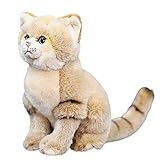
- MATERIAL: This Cat plush is made of soft plush fabric, comfortable and delicate feel is unforgettable
- HUG SIZE:The cute Dune Cat plush toy has a head width of 12cm/4.72in, a head to butt length of 29cm/11.42in, a head to foot height of 25cm/9.84in and a weight of 0.23kg, the size for hugs
- DECORATION:Realistic, delicate and beautiful, this stuffed cat will make a difference in your bedroom, children's room, living room, office, nursery, car and anywhere else you want to go
- EARLY EDUCATION TOY: The design of this Cat plush is inspired by animals in nature. Our designers have restored its appearance.You can use it to introduce to children and improve children's understanding cognition of nature
- BEAUTIFUL GIFTS:This plush cat is well designed . So whether it's Easter or Children's Day or other anniversaries, this cat is a beautiful gift for your children, friends or family, and you will see them smile when you receive the toy
2. Fur extends across the soles of its feet
Dense, dark fur covers the sand cat’s foot pads. This layer helps insulate the feet from temperature extremes in desert ground—both intense daytime heat and cold surfaces after dark. It is an important physical adaptation, but it should not be exaggerated into a claim that the cat is impervious to heat.
The fur also conceals the pads, making tracks harder to detect in loose sand, although the principal documented benefit is insulation.
IUCN SSC Cat Specialist Group species account
3. Its ears are built for locating prey in open country
Sand cats have enlarged auditory passages and associated bony structures. In open desert, where there may be little vegetation to hide sound or prey, this hearing equipment helps the cat detect animals around it. The adaptation works with the cat’s low-profile hunting style: it can listen carefully, then move toward prey that may be difficult to see.
Rank #2

- Hailing from stony deserts, this realistic stuffed animal sand cat features a striped tail, perky ears and a cute button nose.
- Bring more wildlife adventures to daily play with this sand cat plush toy with a white underbelly and big eyes begging for fun.
- Cat lovers can’t resist the look and feel of this sand cat stuffed animal that makes a great birthday gift for boys and girls.
- With durable stitching and lifelike detailing, this soft sand cat animal plush is great as a Christmas gift for kids.
- Combining play with Earth-sustaining practices, The Petting Zoo is committed to providing little ones with cute and cuddly plush toys that are made from recycled water bottles.
The evidence supports enhanced sound detection; it does not justify assigning the cat a precise hearing range that has not been established in the cited sources.
Recommended Free Tools
IUCN SSC Cat Specialist Group species account
4. It can dig rapidly for a meal
A sand cat does not rely only on prey found in the open. It can quickly dig animals out of sand, an ability that broadens its options when small creatures shelter below the surface.
What it eats
- Small mammals
- Birds
- Reptiles
- Insects, listed in the Royal Commission for AlUla’s regional guide
Diet records can differ by location, so a list from AlUla should be read as regional information rather than a complete menu for every sand cat population.
Rank #3

- This plush is approx. 3" x 8" x 4" in size
- Made from deluxe materials for a cloud-like softness!
- This light and fluffy Cat plush makes for a great cuddling partner
- Mini Flopsies are designed to lay resting on its belly for easy, fun play
- To ensure stability and quality, this plush contains bean pellets suitable for all ages
IUCN SSC Cat Specialist Group species account · Royal Commission for AlUla, Mammals of AlUla
5. Prey can supply much of its moisture
Sand cats can meet their moisture requirements from the animals they eat and can live far from dependable water sources. That does not mean they never drink: the Cat Specialist Group says they drink readily when water is available. Their strategy is flexibility—use prey as a regular source of moisture, while taking advantage of free water when desert conditions provide it.
The Tool Desk
Outbyte PC Repair FREERepair Windows errors before they cause bigger problemsFix Now →Outbyte Driver Updater FREEScan for outdated or missing drivers - takes under a minuteDriver Scan →IUCN SSC Cat Specialist Group species account · Smithsonian National Zoo: Can Sand Cats Survive Without Water?
Rank #4

- Plush Cat Toy: A cozy companion for kittens and cats—offers comfort during stressful transitions and helps ease separation anxiety
- Touch-Activated Purr: Gently squeeze or cuddle the cat pillow toy to trigger a calming purring sound that lasts 2 minutes
- Soft & Snuggly: Cozy fabric makes this interactive cat toy perfect for naps, kneading, and quiet snuggle time
- Easy to Clean: Simply remove the purr mechanism and machine wash the plush fabric shell; air dry fully before reassembling
- Play It Safe: No toy is indestructible. Do not leave toys with unsupervised pets. Remove and replace toy if worn or damaged. Contains 3 LR44 Alkaline replaceable button cell batteries
6. A secretive lifestyle makes the species hard to study
Sand cats are difficult to see and monitor. Their desert camouflage, nocturnal or crepuscular activity and use of burrows or sheltered sites all reduce the chance of straightforward observation. The result is a science problem as well as a wildlife-watching challenge: across the broad range, the IUCN assessment reports few recent confirmed records and limited ecological research.
Movement estimates illustrate why local context matters. The Cat Specialist Group reports substantially different home-range figures from Israel, Saudi Arabia and Morocco; those studies should not be treated as one universal measurement for the species.
IUCN SSC Cat Specialist Group species account · IUCN Red List assessment
Best Value
- Ultimate Play Satisfaction: This toy is perfectly sized for kicking, wrestling, and cuddling. The under-stuffed floppy body is ideal to withstands your cat’s instinctual “bunny kicks.”
- Prevents Boredom: The hidden crinkle sounds and multi-textured feel spark the hunting instinct, encouraging active kneading and pouncing to provide essential mental and physical stimulation.
- Smartly Crafted: Kicker toys are an outlet for one of your cat’s first playful behaviors. This Llama is made with soft fleece and long, dangly legs that encourage healthy wrestling play.
- Clever Details: This multi-textured toy contains catnip, works great as a solo toy for wrestling or can be tossed and dangled for rewarding interactive fun for two.
- SmartyKat Promise: We know cats—so we design with their instincts (and your peace of mind) in mind. Each SmartyKat product is tested for safety and crafted to spark joy, satisfy curiosity, and keep playtime smart and stylish.
7. Breeding season changes with location
There is no single breeding calendar that applies identically across the entire range. The Smithsonian’s National Zoo reports that Sahara sand cats begin breeding in January and finish by April. That January–April period is a regional example, and timing can vary with location and local conditions.
Smithsonian’s National Zoo sand cat profile
8. “Least Concern” comes with important qualifications
The IUCN Red List assessment published in 2016 lists the sand cat as Least Concern. The assessment’s last-assessed date was 20 April 2014, and its authors describe the population trend, distribution details and effects of threats as difficult to determine because confirmed records and ecological studies are limited.
What the assessment’s numbers mean
| Figure | What it represents | Qualification |
|---|---|---|
| 27,264 mature individuals | Conservative population estimate used in the assessment’s justification | From the 2016 publication; not a current census |
| 15,414,561 km² | Estimated extent of occurrence | The broad geographic envelope, not continuously occupied habitat |
| 940,163 km² | Estimated area of occupancy | Does not imply that cats occupy this area continuously |
A global category should not be transferred automatically to every local population. For example, the Royal Commission for AlUla guide distinguishes the global Least Concern assessment from a regional Vulnerable assessment.
New tracking work does not equal a new Red List assessment
On 24 February 2026, the Prince Mohammed bin Salman Royal Reserve announced that researchers had successfully deployed and retrieved GPS collars on six sand cats. The project, conducted with the Royal Zoological Society of Scotland’s WildGenes laboratory, also supported development of a high-quality reference genome. The announcement discusses publications proposing two subspecies rather than four; that interpretation should be attributed to the reserve and related publications, not presented as settled taxonomic consensus. The project signals active research, but it does not itself change the cited IUCN category.
IUCN Red List assessment · Prince Mohammed bin Salman Royal Reserve, 24 February 2026 announcement · Royal Commission for AlUla regional guide
Quick Recap
Product prices and availability are accurate as of the date/time indicated and are subject to change. Any price and availability information displayed on Amazon at the time of purchase will apply.




