That pale, round “shell” on the beach is not a shell at all. It is the hardened internal skeleton of a marine animal related to sea urchins and starfish. Sand dollars spend their lives crawling through sandy seafloors, filtering edible particles from the sediment, and using a surprisingly sophisticated body plan to survive waves, predators, and changing currents.
Here are nine facts that explain what sand dollars are, how they live, and why a living one should be left in the water.
1. A sand dollar is a flattened sea urchin
Sand dollars belong to the class Echinoidea, the same broad group as sea urchins. More specifically, they are “irregular” sea urchins: animals adapted for life lying on or burrowing into soft sediment rather than clinging to rocks.
The rigid disk found on beaches is called a test. It is the animal’s internal skeleton, made from calcium carbonate plates. After the soft tissues and tiny spines decay, the test may wash ashore and eventually become the familiar white, smooth object associated with sand dollars.
#1 Best Overall

- Floating Framed Inspirational Canvas Wall Art: This framed painting measures 8x10 inches and comes with a non-stick adhesive backing for easy hanging, perfectly decorating your space
- Time Is Money Finance Artwork: Black monochrome design features an hourglass filled with US dollar bills flowing down, conveying the classic "Time Is Money" concept, a bold visual metaphor for wealth, investment and financial growth
- Applicable Scenarios: Ideal for finance office, entrepreneur workspace, study, business room, investment studio and bedroom. It matches modern, minimalist, luxury and business-style interior decor perfectly
- Gift Benefits: A unique inspiring gift for investors, entrepreneurs, businessmen, graduates and financial practitioners for promotions, birthdays and housewarmings, reminding people to value time and wealth creation
- After-Sales Service: We care about your shopping experience. If you have any questions, reach us via email, our support team will reply to you promptly
Calling it a seashell is understandable, but technically inaccurate. A shell is generally an external protective covering; a sand dollar test is the internal framework that supported the living animal.
2. Living sand dollars are usually dark and fuzzy
A healthy sand dollar does not usually look white. Living animals may be gray, brown, reddish, or purple, and their tests are covered by thousands of short, movable spines. Those spines give the animal a soft, fuzzy appearance and help it move through sand.
The white specimens commonly collected on beaches have died. Sunlight, water, and weather gradually remove or bleach the remaining organic material from the test. A useful rule when beachcombing is simple: if it is dark, flexible-looking, or covered in moving fuzz, it is not an empty keepsake.
3. The five-petal pattern helps the animal breathe
The flower-like design on a sand dollar is not a collection of tiny starfish and it is not merely decoration. The five petal-shaped regions are called petaloid ambulacra. They contain specialized tube feet that help with gas exchange, functioning in a role similar to gills.
Do these 3 things before closing this tab:
1Fix the driver behind crashes, sound loss and screen glitches2Clear out junk files and repair common Windows errors3Scan for outdated or missing drivers - takes under a minuteThe five-part arrangement is a hallmark of echinoderms. Sea stars, sea urchins, and their relatives share this basic five-part body symmetry, even when it becomes less obvious in a flattened animal such as a sand dollar.
The petals therefore reveal something important about the animal’s anatomy: they are connected to its water-vascular system and respiratory structures.
4. Sand dollars have a five-part jaw
The mouth is on the underside of the animal. Inside it is a complex feeding structure known as Aristotle’s lantern, a five-part jaw with toothlike sections.
Rank #2
- Floating Framed Inspirational Canvas Wall Art: This framed painting measures 12x16 inches and comes with a non-stick adhesive backing for easy hanging, perfectly decorating your space
- Time Is Money Finance Artwork: Black monochrome design features an hourglass filled with US dollar bills flowing down, conveying the classic "Time Is Money" concept, a bold visual metaphor for wealth, investment and financial growth
- Applicable Scenarios: Ideal for finance office, entrepreneur workspace, study, business room, investment studio and bedroom. It matches modern, minimalist, luxury and business-style interior decor perfectly
- Gift Benefits: A unique inspiring gift for investors, entrepreneurs, businessmen, graduates and financial practitioners for promotions, birthdays and housewarmings, reminding people to value time and wealth creation
- After-Sales Service: We care about your shopping experience. If you have any questions, reach us via email, our support team will reply to you promptly
Sand dollars use this apparatus to grind and process tiny food items, including algae, organic detritus, microscopic animals, and other particles mixed into the sand. Food processing can take considerable time as material moves through the animal’s digestive system.
Quick wins for a faster PC:
Fix the driver behind crashes, sound loss and screen glitchesFind Drivers →Repair Windows errors before they cause bigger problemsFix Now →Scan for outdated or missing drivers - takes under a minuteDriver Scan →The name is shared with the jaw apparatus of regular sea urchins, although its shape and use are adapted to the sand dollar’s low, sediment-dwelling lifestyle.
5. They move and eat with spines, tube feet, and cilia
Sand dollars do not have legs, fins, or claws. Instead, their many small spines work together to propel them across the seafloor and help them burrow into loose sand.
Hairlike structures called cilia and tiny tube feet move food particles across the animal’s body toward the mouth. A sand dollar may collect diatoms, algae, detritus, and small crustacean larvae from the surrounding sediment. Rather than chasing prey, it acts more like a slow-moving sediment processor, sorting usable particles from the sand.
This is one reason turning over or removing a sand dollar from its habitat can be harmful even if the animal appears motionless. Its feeding and respiratory structures are delicate, and its normal life depends on remaining in the sediment.
Free tools Windows power users keep installed
One-click scans. No signup required.
6. Some sand dollars have holes called lunules
Many people recognize sand dollars by the slots or holes running through their tests. These openings are called lunules, but not every sand dollar has them.
Lunules can help reduce the force of moving water and may help an animal remain in sandy sediment instead of being rolled away. Their exact role differs among species, and research has also associated them with food gathering. So the popular explanation that lunules exist solely to stop sand dollars from washing away is too simple.
Rank #3

- Sea Shell Sand Dollar Painting, Size: 16x16Inchx2pcs, Copyright Licensed by PI Creative Art.
- High Definition Canvas Print: This coastal wall art is printing artwork on high quality canvas. Vivid color create the feel of the original nature. Eco-Ink print makes it safe for your family.
- Gallery Wrapped and Easy to Hang: This modern abstract gold and neutral wall decor is wrapped around a solid wood stretchers for a gallery-worthy look, fixed with a D-ring bracket hanger, ready to hang as soon as it arrives.
- Perfect Wall Decor and Gift Idea: This ocean theme artwork is a perfect decor for your living room, dining room, bedroom, bathroom, office, or as a focal point at the end if a long hallway.
- After-Sales Service: Your satisfaction is our priority. If you have any questions or concerns, feel free to contact us anytime. Buy with confidence!
Species without lunules are still sand dollars. The presence, number, and shape of the openings can vary depending on the species and its habitat.
7. Young sand dollars can swallow sand for ballast
Small sand dollars face a special problem: their light bodies can be moved easily by waves and currents. Juveniles may ingest heavy sand grains to increase their effective weight. This ballast helps them stay in place when water becomes rough or fast-moving.
Adults use other strategies as well. They may lie flat against the seafloor or burrow into the sediment during turbulent conditions. Their flattened shape is useful in this environment, allowing them to shelter within the sand instead of presenting a tall profile to waves.
8. They begin life as drifting larvae
Sand dollars do not hatch as miniature disks. They begin as eggs and pass through planktonic larval stages, drifting in the water column before transforming into juvenile animals that settle on the seafloor.
Some species show an unusual defensive behavior during this early stage. When larvae detect chemical signals associated with predators, they may clone themselves. This can produce additional larvae that are also likely to carry the traits suited to surviving that particular threat.
Once settled, the juvenile gradually develops the flattened body and hard test associated with adult sand dollars.
What’s actually slowing this PC down?
Pick the symptom - the matching free tool is one click away.
9. Sand dollars can live for years in dense beds
The Pacific sand dollar, Dendraster excentricus, can grow to about 3.5 inches across and commonly lives for six to ten years. In favorable habitat, sand dollars may occur in dense beds, with hundreds occupying a single square yard.
Rank #4
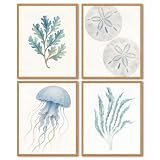
- Watercolor Coastal Marine Aesthetic – Blends soft ocean life motifs with a serene blue palette for a tranquil, beachy vibe.
- Versatile for Coastal Spaces – Ideal for bedrooms, bathrooms, living rooms, or beach house decor.
- Standard 8x10 Size for Easy Framing - Each print measures 8 x 10 inches and comes unframed, allowing you to place them in frames that match your room decor. Perfect for gallery walls, desks, shelves, or bedside decor.
- Perfect Decor for Any Spaces - The unframed design offers great flexibility. It can be used to decorate various spaces like bedrooms, bathrooms, living rooms, or even coastal - style cafes. Whether you want to create a relaxing bathroom ambiance or a dreamy bedroom with an ocean theme, these prints can perfectly match your needs.
- Thoughtful Gift for Ocean Lovers – Perfect for housewarmings, beach house gifts, birthdays, or coastal-themed occasions.
These concentrations are not necessarily piles of dead beach finds. They can be active communities of living animals feeding and moving through the sediment. A crowded patch of sand dollars is therefore a habitat worth observing without disturbing.
Independent reader supportYour contribution helps us test, update, and keep practical guides available for everyone.How to tell whether a sand dollar is alive
| What you see | Likely meaning | What to do |
|---|---|---|
| Dark gray, brown, reddish, or purple color | Likely alive | Leave it in shallow water or return it gently to the seafloor. |
| Tiny spines moving or a fuzzy surface | Alive | Do not collect, dry, bleach, or carry it away. |
| White, brittle, smooth test with no soft tissue | Dead and weathered | Check local beach-collecting rules before taking it. |
Color alone is not a perfect test, but a living sand dollar is generally darker and covered in spines. Never use bleach to “clean” a specimen while it may still be alive.
Common sand dollar myths, corrected
- “They are seashells.” The beach-found structure is a test, or internal skeleton, not technically a shell.
- “Living sand dollars are white.” Usually not. White tests are typically dead specimens that have weathered and bleached.
- “The petals are five baby starfish.” That is a popular legend. The petals are associated with respiratory and water-vascular structures.
- “Every sand dollar has holes.” No. Lunules occur in some species and are absent in others.
- “You can always collect one if you find it.” Collection rules vary by location. Some areas prohibit removing living sand dollars, while other regulations distinguish between shells or tests with living organisms and empty tests.
Before collecting even an empty test, check the rules for the beach, state, marine reserve, or national park. For example, North Carolina prohibits removing live sand dollars in the cited coastal-reserve context, and Florida regulations distinguish between shells containing living organisms and empty tests.
Recommended Free Tools
FAQ
Are sand dollars alive when they are white?
Usually not. A living sand dollar is generally gray, brown, reddish, or purple and covered with tiny moving spines. The white, brittle objects found on beaches are usually dead tests that have been bleached by sunlight and weather.
What do sand dollars eat?
They collect and process small particles from the sediment, including diatoms, algae, detritus, and small crustacean larvae. Cilia, tube feet, and spines move food toward the mouth on the underside.
Can I keep a sand dollar I find on the beach?
Only if local rules allow it and the specimen is clearly an empty test. Never take a dark or fuzzy sand dollar, because it may be alive. Beach, state, federal, and park regulations differ.
Why do some sand dollars have holes?
The holes, called lunules, occur in some species. They can reduce water forces and help the animal stay in sandy sediment, although their function may also relate to feeding. Not every sand dollar has them.
Windows Errors? Fix Them Before They Spread
Repair common Windows errors and clear accumulated junk for a smoother, more stable PC - no reinstall needed.Free scan · no reinstallCrashes, No Sound, or Screen Glitches?
Random freezes, missing sound and display glitches usually trace back to one bad driver. Find and replace yours safely.Free scan · under a minuteThe Bottom Line
Sand dollars are living, flattened sea urchins—not shells, flowers, or five-star-shaped souvenirs. Their spines help them move and feed, their petal pattern supports gas exchange, and some juveniles even swallow sand to resist strong currents. If you find one that is dark or fuzzy, return it to the water and leave it undisturbed. For empty tests, check local collection laws before taking one home.
Quick Recap
Product prices and availability are accurate as of the date/time indicated and are subject to change. Any price and availability information displayed on Amazon at the time of purchase will apply.




