PC Slower Than It Used to Be?
A free scan shows the junk files, broken settings and background clutter dragging Windows down - then fixes them in one click.Free scan · Windows 10 & 11Outdated Drivers Are Slowing You Down
One free scan finds every outdated or missing driver and matches the right update for your exact hardware.Free scan · exact hardware matchAfrican grey parrots and many Amazon parrots are strong candidates if human-speech mimicry is your priority, while budgies can learn to talk and may suit some homes better. No species or individual bird is guaranteed to speak. Choose for the bird’s full care needs—including daily attention, noise, space, cost, lifespan, and access to a veterinarian familiar with birds—not for a promised vocabulary.
Important: A bird should be chosen because you can provide a good home even if it never says a word. Speech is a possible outcome, not a benefit to be forced through isolation or punishment.
Quick answer: the best talking bird depends on your priorities
There is no universal winner. Merck Veterinary Manual’s species descriptions identify different strengths and trade-offs, but they do not provide a comparable word-count ranking or a probability that an individual bird will talk. Use this shortlist to compare likely speech ability with the commitment of caring for each bird.
| Bird | Speech potential | Noise and owner fit | Key consideration |
|---|---|---|---|
| African grey | Excellent mimic; potentially among the most extensive vocabularies | Needs substantial time and attention | May not talk in front of strangers |
| Amazon parrot | Most are strong talkers and singers | Can be loud and closely bonded to one person | Consider noise and individual temperament |
| Budgie | Can learn words and sounds | Not usually loud; may suit some apartments | Small size does not eliminate care needs |
| Cockatiel | Speech is not its main strength | Relatively quiet compared with macaws or cockatoos | Consider it for companionship, not assured words |
| Myna | Excellent talker | Not typically very affectionate; droppings can be messy | Different care and interaction expectations from parrots |
| Eclectus | Talking ability varies | Less prone to screaming than cockatoos and macaws | Do not assume every individual will talk |
| Psittacula parakeet, such as an Indian ringneck | Many are good talkers | Can have a piercing scream | Plan for noise as well as speech potential |
| Quaker, or monk parakeet | Can be a talker | May be loud and is known for chewing | Check current ownership rules where you live |
Life expectancy figures require care in interpretation. The Association of Avian Veterinarians’ brochure gives median life expectancy in captivity—not a guaranteed lifespan—of 5.5 years for budgerigars, 9 years for cockatiels and African greys, and 20 years for blue-fronted Amazons. Merck’s April 2025 table gives broader average-lifespan ranges for some species, including 5–10 years for budgies, 30–50 years for African greys, and 40–50 years for Amazons. These sources use different measures; neither figure predicts how long a particular bird will live. See the Merck Veterinary Manual’s bird-selection guidance and the Association of Avian Veterinarians’ care guide.
#1 Best Overall

- Four-Door Safety Design: This spacious bird cage features 0.4-inch bar spacing to ensure your pet's safety. The 4 front access doors allow easy feeding and cleaning, while 2 side doors enable close interaction. Bird-safe materials and secure latches prevent escapes while maintaining ventilation
- Convenient Detachable Components: The removable tray and detachable mesh grate make cleaning effortless. The top carry handle provides portability for travel or outdoor use. Easy assembly with no tools required - simply snap the parts together in minutes
- Entertainment-Focused Interior: Includes 3 wooden perches, 3 hanging accessories, and a play bridge to keep your birds active. The spacious interior (17.3×13.8×62.2 inches) provides ample room for 2-3 small/medium birds like parakeets, cockatiels, or lovebirds to play and rest comfortably
- Mobility & Storage Solution: 4 smooth-rolling 360° wheels with locks allow easy relocation. The bottom storage shelf offers organized space for bird supplies. Sturdy construction with reinforced corners ensures stability during movement
- Ideal Living Space: The open-top design promotes air circulation while the powder-coated finish resists rust. Gives your feathered friends a safe, comfortable habitat that's simple to maintain daily
What does it mean for a bird to talk?
When people say a bird talks, they usually mean vocal mimicry: repeating human words or other sounds. A bird that repeats a word is not necessarily demonstrating human-like understanding. Avoid claims that a species will speak on command, understand ordinary conversation, or learn a particular number of words.
Speech varies between individuals and settings. Merck notes that African greys may not talk in front of strangers. Consider talking a possible behavior, not a reliable measure of intelligence, affection, or a bird’s value as a companion.
The 8 best talking birds to keep as pets
1. African grey parrot: a strong mimic for a prepared owner
Best for: A person prepared to provide substantial daily time and attention, and to care for an intelligent bird even if it does not speak around visitors.
Merck describes African greys as excellent mimics that potentially know the most words. That is a species tendency, not a promise for an individual bird. The same guidance emphasizes their need for considerable time and attention.
Do these 3 things before closing this tab:
1Repair Windows errors before they cause bigger problems2Scan for outdated or missing drivers - takes under a minute3Clear out junk files and repair common Windows errorsDo not choose an African grey as a low-maintenance route to a talking pet. Assess your schedule, home, resources, and access to a veterinarian familiar with birds before acquiring one.
2. Amazon parrot: a talker and singer with a loud side
Best for: Someone prepared for a vocal, demanding companion and the possibility that it will bond closely with one person.
Merck says most Amazons are great talkers and singers. They can also be loud and moody, and often form a close bond with one person. Speech ability should be weighed alongside those household and interaction considerations.
Rank #2

- Spacious Bird Cage for Small/Medium Birds: With dimensions of 24"L x 12"W x 46"H and 1/2″ bar spacing, this upgraded encrypted parakeet cage is expertly crafted from sturdy powder-coated metal with hammered paint finish, ensuring enhanced strength, durability and excellent water resistance, making this bird cages a secure and cozy home for parakeets, parrot, lovebirds, cockatiels, cockatoo, conure, canary, budgerigar, finches, myna, pigeon and other feathered friend.
- Detachable Design For Easy Cleaning:VISCOO bird cage is equipped with a plastic slide-out tray at the bottom of this parrot cage that can be removed for easy cleaning, and with removable panels for better convenience, so as to keep a clean and tidy environment. Our birdcage can also be easily assembled with our hammer but no other tools required. Spend less time scrubbing or assemble, but more time interacting with your pets.
- Easy to Move as a Whole Smoothly: 6pcs universal 360-degree caster wheels with locks are equipped, so you can effortlessly relocate the cockatiel cage quickly and safely, it provides portability for outdoor use for fresh air and sunshine.
- Thoughtful Accessories Included: Our bird cage includes 4 wooden perches, 1 plastic food box and 1 water bottle which can be fixed outside the parakeet cage, so you can add the food without disturbing your bird friends, especially for shy or sensitive birds. Provide a cozy home where your birds can perch, snack, and play.
- Ideal for Bird Lovers: Designed for small to medium-sized birds, the flight cage with 2 doors enable close interaction and door locks prevent escapign while maintaining ventilation. Its spacious design and convenient features make it an ideal choice for home, pet stores and pet hospitals. This bird cages for parakeets provides a comfortable and secure living environment.
3. Budgerigar, or budgie: a small bird with speech potential
Best for: A prepared owner who wants a small bird that can learn to talk and has considered its daily care needs.
Merck notes that budgies can learn to talk and are not usually loud, which may make them a possible fit for some apartment homes. Neither trait is guaranteed for an individual bird, and a small bird still needs suitable housing, attention, veterinary care, and a plan for its needs.
4. Cockatiel: a companion whose speech is a bonus
Best for: Someone who values a lively, vocal companion and will not be disappointed if it never learns human words.
Merck describes cockatiels as lively and vocal, but relatively quiet compared with macaws or cockatoos. Its species guidance does not identify cockatiels as top speech performers, so consider talking a possibility rather than their main strength.
5. Myna: a non-parrot mimic with different needs
Best for: Someone interested in a strong talker who is prepared for a different kind of relationship and care routine from that of a companion parrot.
Merck describes mynas as excellent talkers, but notes they are not typically very affectionate and can have messy droppings. Those differences matter when deciding whether a myna fits your expectations for interaction and household care.
6. Eclectus parrot: speech varies by individual
Best for: Someone prepared to assess an individual bird rather than relying on a species-wide promise about speech.
Rank #3

- 2 Extra Birdcage Covers -Keep Clean & Protect Birds: Black birdcage cover blocks 90% sunlight & UV rays, creating a dark, cozy rest space for parakeets, cockatiels, and parrots
- Parrot-Proof Lock-No Escape, Even for Smart Birds: Glossy secure lock specially designed for parakeets, cockatiels, and parrots - smarter than traditional latches! No way to open it, ensuring your feathered friends stay safe inside
- Slide-Out Tray & Wrought Iron Wire-1-Minute Cleanup: Large slide-out tray catches bird droppings and food scraps - just pull, dump, and wipe! Durable wrought iron wire resists rust and stains, no more scrubbing hard-to-reach corners.
- For 2-3 Birds: Extra-large flight space for budgies, parakeets, lovebirds, cockatiels, or small parrots to stretch wings! Ample room for perches, and feeders-happy birds-quieter, less destructive pets
- 360° Swivel Wheels + Storage Rack-Move & Organize Effortlessly: 4 universal wheels glide smoothly on any floor-relocate your bird cage in seconds! Built-in storage rack holds bird food, and supplies-no more cluttered pet space
Merck says talking ability varies among Eclectus parrots. It also notes that they are less prone to screaming than cockatoos and macaws. That comparison is not a guarantee of quietness or a prediction that a particular bird will talk.
7. Psittacula parakeet, including the Indian ringneck
Best for: Someone interested in a parakeet with speech potential who can also accommodate a potentially piercing call.
Free tools Windows power users keep installed
One-click scans. No signup required.
Merck describes many Psittacula parakeets, including Indian ringnecks, as good, quiet talkers, while warning that their screaming voice can be piercing. Consider both traits before choosing one for a shared-wall home.
8. Quaker, monk, or monk parakeet: check the rules first
Best for: Someone who has confirmed current ownership rules for their location and is prepared for a bird that may be loud and likes to chew.
Merck notes that Quakers can be loud and are known for chewing. Ownership restrictions apply in some U.S. states, and rules may vary by locality or change over time. Check current state and local requirements before acquiring or transporting one; an old list is not a substitute for current legal advice.
Best talking bird by lifestyle
| Your situation | Candidates to investigate | Consider carefully |
|---|---|---|
| Speech is a priority | African grey or Amazon; also consider budgie, myna, and Psittacula parakeets | No species guarantees speech |
| Apartment or shared walls | Budgie may be worth considering; Merck describes cockatiels as relatively quiet compared with macaws and cockatoos | Amazons can be loud; Psittacula parakeets can scream piercingly; Quakers may be loud |
| Limited time for interaction | Do not choose based on speech potential alone | African greys especially need substantial time and attention |
| Want a bird that is not a parrot | Myna | It may not fit expectations for affection and can be messy |
| Considering a Quaker | First verify current state and local rules | Restrictions vary; chewing and noise may matter at home |
This is a decision aid, not a temperament guarantee. Merck’s selection guidance emphasizes that birds have different personalities and that owners should consider time, cost, veterinary care, cage requirements, noise, and the needs of the home.
The Tool Desk
Outbyte Driver Updater FREEFix the driver behind crashes, sound loss and screen glitchesFind Drivers →Outbyte PC Repair FREEClear out junk files and repair common Windows errorsFree Scan →Can a talking bird live in an apartment?
Some birds may be more practical in an apartment than others, but no species description can guarantee that an individual bird will be quiet. Merck describes budgies as not usually loud and cockatiels as relatively quiet compared with macaws or cockatoos. It also notes that Amazons can be loud and that Psittacula parakeets can have a piercing scream.
Rank #4

- Open-Top Design for Extra Freedom: This parakeet cage's roof can be opened and securely locked, creating an additional perch for your birds to enjoy an open-air experience. When it's time to rest, simply close the roof to provide a safe enclosed home
- Spacious Home for Small to Medium Birds: The 18"L × 14"W × 36.5"H cage interior plus 0.4'' bar spacing provides a safe and comfortable living environment for small to medium-sized birds such as parakeets, lovebirds, finches and canaries. The overall dimension including the stand and open top is 18"L × 14"W × 64"H
- Easy Clean Design with Slide Out Tray: Constructed with waterproof metal framing, this cockatiel cage features a slide-out bottom tray for simple cleaning. A bottom grate separates birds from the tray to maintain a tidy cage interior
- Detachable Rolling Stand with Storage Shelf: This budgie cage comes with a 27'' tall detachable rolling stand with 360-degree swivel casters, supporting smooth movement indoors and outdoors. The upper cage can be removed from the stand for tabletop placement or transport
- Smart Storage & Feeding Convenience: The four feeding doors of this cockatiel cage allow for quick seed and water refills, while the extra storage shelf on the stand keeps bird seeds, toys, and cleaning tools neatly organized and within reach
Before acquiring a bird, check your lease and building rules, consider neighbors, and spend time around birds of the species you are considering. Do not rely on a quiet visit or a species reputation to predict an individual bird’s behavior at home.
How to encourage talking without compromising welfare
Speech should be treated as a possible outcome of a good relationship, not a requirement. Keep interactions calm and positive, and stop if the bird appears uncomfortable. Never punish, frighten, or isolate a bird to try to make it talk.
- Learn about the species first. Consider its need for attention, noise, space, care costs, and veterinary access.
- Give a new bird time to settle. Provide a calm, suitable home and watch its behavior and health.
- Build trust through calm interaction. Let the bird approach at its own pace rather than forcing contact.
- Use familiar words naturally. Speak to the bird during ordinary routines without demanding a response.
- Keep the bird’s welfare first. A bird that never mimics speech still needs companionship, appropriate care, and veterinary attention.
The daily-care reality behind a talking bird
Time, space, and cost
Before acquiring any bird, consider the time and expense involved in appropriate housing, daily care, veterinary visits, and the bird’s needs throughout its life. Merck specifically recommends weighing time, costs, vet visits, bird size and cage requirements, and noise. Choose a cage and setup appropriate to the bird rather than assuming one size or product fits every species.
What’s actually slowing this PC down?
Pick the symptom - the matching free tool is one click away.
Veterinary care and choosing a bird
Locate a veterinarian familiar with birds before bringing one home. Merck advises prospective owners to assess a bird’s condition and living environment, ask for written health information, and arrange an examination by a veterinarian familiar with birds. Its guidance also identifies shelters or rescue groups, reliable breeders, and specialist pet stores as possible sources, and advises confirming captive origin.
The Association of Avian Veterinarians recommends regular checkups in its bird care guide. Ask the veterinarian about appropriate care for the species and individual bird.
Independent reader supportYour contribution helps us test, update, and keep practical guides available for everyone.How to buy or adopt a talking bird responsibly
Choose a source carefully, ask questions, and evaluate the bird’s health and living conditions before making a decision.
- Check current rules. Verify state and local ownership requirements, especially for Quakers. USDA’s pet-bird categories relate to specified Animal Welfare Regulations licensing thresholds; they are not a comprehensive guide to whether ownership is legal in a location.
- Consider a rescue or reliable breeder. Merck identifies shelters or rescue groups, reliable breeders, and specialist pet stores as possible sources.
- Ask for written health information. Ask about the bird’s history and condition, and arrange an examination with a veterinarian familiar with birds.
- Confirm captive origin. Ask the source to document the bird’s origin rather than relying on an unsupported claim.
- Make a long-term plan. Choose only if you can meet the bird’s needs and provide care even if it never talks.
See Merck’s guidance on choosing a pet bird. The USDA APHIS pet-bird list explains its regulatory categories and licensing context; it should not be used as a general ownership-permission checklist.
Best Value
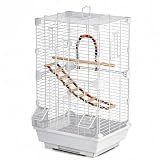
- This Bird cage is equipped with a ladder, a horizontal bar, two feeders, and a swing that can be freely suspended inside the cage. It can serve as both a cozy home for your adorable bird and a fun playground.
- Crafted with a blend of painted metal (rugged, chew-resistant for birds that love to gnaw), PP plastic (lightweight, easy to wipe clean, and BPA-free), and wood (natural texture for perching comfort), this cage combines durability with pet-safe materials. All edges are smoothly polished, and paint is non-toxic, ensuring no harm to your bird’s beak or claws.
- The cage features a removable tray (under the wire floor) for quick waste cleanup—simply slide it out, dispose of debris, and wipe clean. The metal wires are spaced ≤0.5” to prevent escapes (especially for tiny birds like finches) while allowing proper airflow. The elevated hanging design keeps your pet safe from floor drafts and other pets (like cats).
- Blending functionality with aesthetics, the cage’s clean metal frame, warm wood accents, and neutral tones fit seamlessly into living rooms, bedrooms, or aviaries. Whether you’re a first-time bird owner or a seasoned enthusiast, this cage balances practicality (easy to assemble, maintain) with charm, making it the perfect “happy home” for your small bird—and a lovely decor piece for your space!
- Measuring 24.8”L x 14.6”W x 11”H, this cage offers ample space for small birds like Zebra Finches, Canaries, Pacific Parakeets, Java Finches, Lovebirds, and more to stretch, hop, and play comfortably. The balanced length-width ratio ensures natural movement, avoiding cramped “skinny” designs, so your feathered friends thrive in a roomy home.
The most honest way to choose
Before choosing a species, answer these questions:
- Can I provide the time, attention, space, and care this bird needs?
- Can I accommodate its likely noise and behavior in my home?
- Can I afford appropriate housing and veterinary care?
- Can I find a veterinarian familiar with birds?
- Have I checked current ownership rules where I live?
- Would I still want this bird if it never learned a human word?
If speech is your priority, investigate African greys and Amazons, while taking their attention needs, noise, and individual variation seriously. A budgie may be a smaller option with speech potential, while a cockatiel may better suit someone who values companionship over words. A myna offers a different kind of mimicry and care experience. The right choice is the bird whose needs you can meet—not the species with the biggest reputation for talking.
FAQ
Which pet bird is the best talker?
Merck describes African greys as excellent mimics that potentially know the most words, and most Amazons as great talkers and singers. Mynas are also described as excellent talkers. These are species tendencies, not guarantees for individual birds.
Will my bird definitely learn to talk?
No. The research does not establish a reliable probability that a pet bird will speak, and no species guarantees speech. Choose a bird you can care for and value even if it never mimics a word.
What is a quieter bird to consider for an apartment?
Merck says budgies are not usually loud and describes cockatiels as relatively quiet compared with macaws or cockatoos. Individual birds vary, so check housing rules and consider the bird’s actual behavior rather than relying on a guarantee.
Quick wins for a faster PC:
Clear out junk files and repair common Windows errorsFree Scan →Fix the driver behind crashes, sound loss and screen glitchesFind Drivers →Repair Windows errors before they cause bigger problemsFix Now →Are Quaker parakeets legal everywhere?
No. Merck notes that some U.S. states restrict ownership. Rules can vary by state and locality, so check current requirements where you live before acquiring or transporting a Quaker.
How long do talking birds live?
Life expectancy varies by species, individual, and source. The Association of Avian Veterinarians’ brochure reports median captive life expectancy figures, while Merck gives broader average-lifespan ranges for some species. A median or range is not a promise of how long an individual bird will live.
The Bottom Line
Choose a bird you will care for even if it never speaks. African greys and many Amazons are strong candidates for mimicry, budgies can learn words and may suit some homes, and mynas are another excellent-talker option with different care expectations. Compare each bird’s attention needs, noise, space, cost, lifespan, and access to veterinary care before deciding.
Quick Recap
Product prices and availability are accurate as of the date/time indicated and are subject to change. Any price and availability information displayed on Amazon at the time of purchase will apply.
Recommended Free Tools




