The world’s most imperiled cetaceans include the vaquita, North Atlantic right whale, baiji, Atlantic humpback dolphin, and several river-dwelling dolphins and isolated populations. But there is no official scientific ranking called the “14 most endangered” cetaceans. This is an updated editorial list of 14 especially threatened whales, dolphins, porpoises, subspecies, and populations, using the earlier list as its framework.
The conservation picture is urgent but not hopeless. Some populations are showing modest increases, including North Atlantic right whales and Yangtze finless porpoises. Preventing extinction will depend largely on stopping avoidable deaths in fishing gear, reducing ship strikes, protecting rivers and coastal habitat, and enforcing rules that already exist.
What does “endangered” mean?
In ordinary language, people often use endangered to mean any animal at serious risk of extinction. The International Union for Conservation of Nature (IUCN) uses more specific categories. Critically Endangered, Endangered, and Vulnerable are all considered threatened with extinction, with Critically Endangered representing the highest risk category before extinction in the wild.
#1 Best Overall
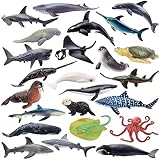
- ✔ MINI SEA ANIMALS BIG PARTY - Includes 1 Great White Shark,1 Whale Shark,1 Blue Shark,1 Blacktip Reef Shark,1 Hammerhead Shark,1 Basking Shark,1 Dolphin,1 Blue Whale,1 Humpback Whale,1 Sperm Whale,1 North Pacific Right Whale,1 Killer Whale,1 Beluga Whale,1 Narwhal,1 Walrus,1 Seal,1 Sea Otter,1 Sea turtle,1 Swordfish,1 Manta Ray,1 Blue Spotted Ray,1 Sawfish,1 Manatee,1 Octopus. Totally 24 ocean animals figurines. Kids would like to have a party with different varieties of ocean animal figurines.
- ✔ REALISTIC EMULATIONAL DETAILS - This sea animal figures set was made by hand painted with high realistically detailed appearance, cute face and childish eyes. Their uniquely molded textures and richly painted details make the animals vivid. Children would like to spend more time to observe and play with them.
- ✔ AWESOME OCEAN ANIMAL CAKE TOPPER - There are many mini sea animals, it would be a good idea to use them as the cake toppers and make a sea animals-themed cake for your kids. Such cute & different varieties of animal figures are worth to be collected, decorating children's bookcase, desk and room. It's an awesome birthday gift or prize for kids, they would love that so much.
- ✔ SMALL SCHOOL PROJECT PLAYSET - These were great for education purposes, creative play, party favors, diorama school projects, baby shower and crafts. It will help to improve children's concentration and outsight, develop and train their imagination and creativity. Parents can tell the children stories about the information of the animals or the happy life of the animal family, it will improve the parent-child relationship.
- ✔ SAFETY MATERIAL - TOYMANY Animal Figures Playset made by high quality durable PVC plastic, Non-Toxic Paint and Odorless. All by safety meterials for kids, all farm figures are solid. TOYMANY aims to produce more realistic animal figurines and provide customers with the better quality.
IUCN status is a global scientific assessment, not necessarily a country’s legal classification. National laws can use different categories and may protect a species, subspecies, or geographically distinct population separately. A species can also be Least Concern globally while one of its populations is in grave danger. That is the situation for gray whales: the species is globally Least Concern, but the western North Pacific population is Endangered.
The 14 at a glance
| No. | Cetacean and scientific name | Conservation unit | Current status | Latest useful population information | Main threat |
|---|---|---|---|---|---|
| 1 | North Atlantic right whale Eubalaena glacialis |
Whole species | Critically Endangered | About 384 animals estimated alive in 2024; approximately 70 reproductively active females in the latest NOAA assessment | Fishing-gear entanglement and vessel strikes |
| 2 | North Pacific right whale Eubalaena japonica |
Whole species; eastern stock is especially imperiled | Endangered globally; Northeast Pacific population Critically Endangered | Fewer than 500 likely remain globally; about 28 in the Bering Sea population | Small population, entanglement, shipping, and prey changes |
| 3 | Sei whale Balaenoptera borealis |
Whole species | Endangered | No reliable current global total; some regional populations are recovering from whaling | Historical depletion, whaling, entanglement, strikes, and changing prey |
| 4 | Blue whale Balaenoptera musculus |
Whole species | Endangered | Regional populations are recovering unevenly; a precise current global census is unavailable | Ship strikes, entanglement, prey changes, noise, and climate change |
| 5 | Western gray whale population Eschrichtius robustus |
Western North Pacific population | Endangered; gray whales globally are Least Concern | About 200 regularly feed near Sakhalin Island, Russia | Entanglement and oil-and-gas activity |
| 6 | Vaquita Phocoena sinus |
Whole species | Critically Endangered | About 10, or possibly fewer, observed or estimated in recent assessments | Illegal totoaba gillnets |
| 7 | Narrow-ridged finless porpoise Neophocaena asiaeorientalis |
Whole species; Yangtze subspecies is a separate conservation emergency | Endangered; Yangtze subspecies Critically Endangered | 1,426 Yangtze finless porpoises reported in a 2025 survey | Fishing gear, habitat degradation, shipping, and altered river flows |
| 8 | Baiji Lipotes vexillifer |
Whole species | Critically Endangered, Possibly Extinct | Last verified records in 2001 and 2002; no survivors found during a comprehensive 2006 survey | Bycatch, river traffic, pollution, and habitat alteration |
| 9 | Atlantic humpback dolphin Sousa teuszii |
Whole species | Critically Endangered | Fewer than 3,000 are believed to remain, in fragmented coastal groups | Artisanal gillnet bycatch |
| 10 | Hector’s dolphin Cephalorhynchus hectori |
Whole species; Māui dolphin is a Critically Endangered subspecies | Endangered; Māui subspecies Critically Endangered | Old broad estimates should not be treated as a current species-wide census | Gillnet and trawl bycatch |
| 11 | Irrawaddy dolphin Orcaella brevirostris |
Whole species; six isolated populations are Critically Endangered | Endangered | No dependable current global total; several local populations number only in the dozens | Gillnets, dams, altered flows, and habitat fragmentation |
| 12 | Ganges and Indus river dolphins Platanista gangetica and Platanista minor |
Two species formerly grouped as the South Asian river dolphin | Both Endangered | Indian survey: 6,324 Ganges and three Indus dolphins within the surveyed Indian range | Dams, water diversion, fishing gear, pollution, and reduced flows |
| 13 | Indian Ocean humpback dolphin Sousa plumbea |
Whole species | Endangered | Global abundance is poorly known; many groups are small and fragmented | Coastal fishing, development, ports, shipping, and pollution |
| 14 | Amazon river dolphin Inia geoffrensis |
Whole species | Endangered | No reliable global total; serious regional declines have been documented | Mercury contamination, fishing, dams, drought, and habitat degradation |
The IUCN Cetacean Specialist Group’s latest summary reports that 93 of 94 recognized cetacean species had been assessed. It classifies 26% of assessed species as threatened. Five are Critically Endangered: Rice’s whale, North Atlantic right whale, vaquita, Atlantic humpback dolphin, and baiji. Twelve are Endangered, including many of the species and populations discussed here. See the IUCN Cetacean Specialist Group status summary for the current assessment context.
1. North Atlantic right whale
Scientific name: Eubalaena glacialis
IUCN status: Critically Endangered.
About 384 North Atlantic right whales were estimated to be alive in 2024, up from 376 in 2023, according to the North Atlantic Right Whale Consortium. NOAA’s 2026 update describes a third consecutive year showing signs of increase, but estimates only about 70 reproductively active females. That is a fragile improvement, not a recovery: the species remains extremely small and is still experiencing an ongoing unusual mortality event.
What’s actually slowing this PC down?
Pick the symptom - the matching free tool is one click away.
North Atlantic right whales migrate between calving grounds off the southeastern United States and feeding areas in the North Atlantic, including waters off New England and Atlantic Canada. Their feeding habitat has shifted as warming ocean conditions redistribute the copepods they eat, bringing whales into areas with dense fishing and shipping activity.
- Fishing-gear entanglement: Lobster, crab, and other fixed fishing gear can cause drowning, severe injury, chronic pain, or loss of feeding ability.
- Vessel strikes: Large ships can kill or seriously injure whales that surface in busy routes.
- Climate and prey changes: Warming seas can alter where and when the whales find adequate food.
- Noise and reproductive stress: Underwater noise can interfere with communication, while poor body condition and injury contribute to long calving intervals.
Conservation must reduce the risk from both fishing gear and ships at the same time. Seasonal speed restrictions, rerouted shipping lanes, real-time whale alerts, stronger reporting, and fishing gear that reduces entanglement are all important. The recent increase matters, but a population with only around 70 reproductively active females cannot withstand many years of avoidable deaths.
Current references: NOAA conservation and management, the 2025 Consortium report card, and the North Atlantic right whale unusual mortality event.
2. North Pacific right whale
Scientific name: Eubalaena japonica
IUCN status: Endangered globally; the Northeast Pacific population is Critically Endangered.
The North Pacific right whale is one of the rarest large whales. NOAA estimates that fewer than 500 probably remain across the species, while fewer than 50 are thought to survive in the eastern stock. A more specific estimate places the Bering Sea population at approximately 28 animals, including only about eight females. The western North Pacific population may number in the hundreds, but its abundance is poorly known. These numbers describe different geographic units and must not be added together as though they were equivalent surveys.
Commercial whaling removed most North Pacific right whales, and illegal Soviet whaling in the twentieth century caused additional losses. The remaining whales face fishing-gear entanglement, ship strikes, marine debris, underwater noise, oil and gas activity, and changes in the distribution of their prey. Increasing Arctic shipping could add further disturbance as sea ice retreats.
For the eastern population, even a few deaths can have an outsized demographic effect. Conservation requires protecting feeding areas, locating and avoiding whales, reducing entanglement risk, managing shipping, and maintaining long-term acoustic and visual monitoring. Because sightings are rare, a lack of observations does not prove that a particular area is unoccupied.
Sources: NOAA species overview, NOAA eastern-population information, and the International Whaling Commission right-whale overview.
Do these 3 things before closing this tab:
1Repair Windows errors before they cause bigger problems2Fix the driver behind crashes, sound loss and screen glitches3Clear out junk files and repair common Windows errors3. Sei whale
Scientific name: Balaenoptera borealis
IUCN status: Endangered.
Sei whales live in deep offshore waters of the world’s oceans and are known for rapid movements and seasonal migrations. Industrial whaling greatly reduced their numbers, especially in the Southern Hemisphere. The IUCN Cetacean Specialist Group identifies sei whales as one of two cetacean species showing recovery from severe historical depletion, but recovery remains incomplete and uneven.
There is no dependable current global population total. Regional surveys, such as recent North Pacific estimates of more than 30,000 animals, cannot simply be combined into a precise worldwide census because survey areas, dates, methods, and stock boundaries differ.
Today’s risks include continuing whaling in Japan, entanglement, vessel strikes, underwater noise, and climate-related changes in prey and ocean conditions. A recovering population can still be Endangered when it remains far below historical abundance or when its recovery is uncertain. Protecting feeding grounds, maintaining reliable monitoring, reducing ship and gear interactions, and ending commercial exploitation are the central requirements.
Quick wins for a faster PC:
Clear out junk files and repair common Windows errorsFree Scan →Scan for outdated or missing drivers - takes under a minuteDriver Scan →Repair Windows errors before they cause bigger problemsFix Now →See NOAA’s sei whale information, its five-year review, and the IWC population-status summaries.
4. Blue whale
Scientific name: Balaenoptera musculus
IUCN status: Endangered.
The blue whale is the largest animal known to have lived, but size did not protect it from industrial whaling. Some populations are now recovering, while others remain severely depleted or poorly monitored. Older figures such as 10,000 to 25,000 blue whales worldwide should not be presented as a precise current census.
Regional information illustrates why a global number is difficult. The IWC cites roughly 2,000 blue whales in the eastern North Pacific and more than 2,000 Antarctic blue whales based on older regional estimates. These figures do not establish a definitive total for all oceans, subspecies, or populations.
Windows Errors? Fix Them Before They Spread
Repair common Windows errors and clear accumulated junk for a smoother, more stable PC - no reinstall needed.Free scan · no reinstallCrashes, No Sound, or Screen Glitches?
Random freezes, missing sound and display glitches usually trace back to one bad driver. Find and replace yours safely.Free scan · under a minuteBlue whales concentrate where krill and other prey are abundant. That makes them vulnerable to ship strikes and entanglement in productive coastal waters. Ocean noise can interfere with communication, while warming seas and changing currents can alter the location and reliability of prey. Climate change may therefore affect both feeding success and the timing of migration.
Recovery plans focus on protecting important feeding areas, reducing collisions and entanglements, improving population surveys, and maintaining healthy prey ecosystems. A population can be increasing and still remain Endangered for decades after historical depletion.
References include NOAA’s blue whale recovery plan, its information on blue whale hot spots, and the IWC status summaries.
5. Western gray whale population
Scientific name: Eschrichtius robustus
Conservation unit: Western North Pacific population.
Status: Endangered population; gray whales globally are Least Concern.
Free tools Windows power users keep installed
One-click scans. No signup required.
This is a population-level conservation case, not an Endangered-species classification for every gray whale. The eastern North Pacific gray whale population is a notable recovery from historical whaling, although its abundance has fluctuated and it has experienced unusual mortality events. The western North Pacific population remains in danger.
Approximately 200 gray whales regularly feed near Sakhalin Island, Russia. Their feeding habitat overlaps with oil-and-gas operations, vessels, and industrial infrastructure. Entanglement, underwater noise, pollution, and disturbance can reduce feeding success or injure animals in a population that has little demographic room for losses.
Effective conservation requires protecting the Sakhalin feeding grounds, limiting industrial activity during sensitive periods, reducing entanglement, and coordinating monitoring across the whales’ migration route. The heading should always retain the word population; calling the entire species Endangered would be inaccurate.
Sources: the IWC gray whale summary, NOAA’s gray whale abundance information, and NOAA’s review of the western North Pacific population.
6. Vaquita
Scientific name: Phocoena sinus
IUCN status: Critically Endangered.
The vaquita is the most immediate extinction emergency on this list. It lives only in the northern Gulf of California in Mexico. About 10 animals have been observed in recent years, and NOAA says as few as 10 may remain. Because surveys use both visual sightings and acoustic detections, the figure should be reported as an estimate rather than an exact census.
The decisive threat is gillnet entanglement. Illegal gillnets set to catch totoaba, whose swim bladders are illegally traded, also trap vaquitas. The porpoises drown when they cannot reach the surface. A legal gillnet ban exists in the vaquita’s range, but illegal fishing and inadequate enforcement have continued.
For vaquitas, conservation has a very clear test: gillnets must be removed from the remaining animals’ habitat. Captive breeding cannot substitute for protecting the wild population, and a written prohibition is not enough if illegal nets remain in the water. Enforcement, net detection and removal, alternative fishing methods, and sustainable livelihoods for local fishers must operate together.
Recommended Free Tools
Rank #2

- 12-Piece Ocean Animal Set – Includes dolphin, sea turtle, seahorse, octopus, penguin, seal, whale, shark, clownfish, killer whale, crab, and whale shark for full undersea adventure.
- Realistic & Durable Designs – Hand-painted details bring each marine creature to life; crafted from non-toxic, BPA-free plastic, safe for kids ages 3+.
- Educational STEM Learning Toy – Boosts creativity and knowledge of marine biology; great for homeschooling, classrooms, or exploring ocean ecosystems.
- Versatile Play & Decor –These small ocean animal figures perfect as bath toys, cake toppers, party favors, or sensory bin fillers; also ideal for dioramas and aquarium displays.
- Gift-Ready Eco Box Packaging – Beetots ocean animal toys come in sturdy, eco-friendly packaging — easy to store, wrap, and gift for birthdays, holidays, and classroom rewards.
Follow the latest NOAA vaquita information, NOAA’s abundance and conservation page, and the IUCN Cetacean Specialist Group vaquita page.
7. Narrow-ridged finless porpoise
Scientific name: Neophocaena asiaeorientalis
Status: Endangered species; Yangtze subspecies Critically Endangered.
The original common-name entry needs a taxonomic qualification. The narrow-ridged finless porpoise is a species that includes coastal and freshwater forms. Its Yangtze subspecies, Neophocaena asiaeorientalis asiaeorientalis, is a separate and more severe conservation concern.
A 2025 survey reported 1,426 Yangtze finless porpoises, an increase of 177 from the previous assessment. That is encouraging, but it is a count for the Yangtze freshwater population or subspecies, not for every narrow-ridged finless porpoise in Asia. The increase also does not remove the subspecies from the Critically Endangered category.
Threats include entanglement in fishing gear, shipping, sand mining, industrial pollution, loss of fish prey, habitat degradation, dams, and altered river flows. Fishing restrictions and protected areas may be helping, but recovery from a small population remains vulnerable to a single severe mortality event or a weakening of enforcement.
Conservation must preserve connected river habitat, reduce gear mortality, maintain water quality and ecological flows, and continue standardized surveys. The 2025 Yangtze survey report and the relevant IUCN species assessment provide the necessary scope distinction.
8. Baiji
Scientific name: Lipotes vexillifer
IUCN status: Critically Endangered, Possibly Extinct.
The baiji should not be described as an ordinary surviving species with a known population. The last verified records were a pregnant female found stranded in November 2001 and an individual photographed in May 2002. A comprehensive six-week visual and acoustic survey in 2006 found no evidence of surviving baiji.
The Tool Desk
Outbyte Driver Updater FREEFix the driver behind crashes, sound loss and screen glitchesFind Drivers →Outbyte PC Repair FREERepair Windows errors before they cause bigger problemsFix Now →The International Whaling Commission describes the baiji as extinct, and it was widely declared extinct in 2007. The IUCN-linked treatment remains Critically Endangered, Possibly Extinct because proving that the very last individual has died is difficult. In practical terms, the baiji is generally regarded as functionally extinct: there is no confirmed viable population.
Its decline followed decades of bycatch, vessel collisions, intense river traffic, industrial pollution, prey depletion, and major habitat changes in the Yangtze. The baiji is a warning that a species can disappear before conservation agencies have enough information to measure the final collapse. The lesson for other river dolphins is to protect habitat and reduce mortality before populations become too small to recover.
See the IUCN Cetacean Specialist Group baiji account and the IWC discussion of cetaceans and extinction.
9. Atlantic humpback dolphin
Scientific name: Sousa teuszii
IUCN status: Critically Endangered.
Atlantic humpback dolphins inhabit shallow coastal waters along the Atlantic coast of Central and West Africa. Fewer than 3,000 individuals are believed to remain, probably divided among small, fragmented groups. In some locations, a group may number only in the tens or low hundreds.
The primary threat is bycatch in artisanal gillnets. Because the dolphins live close to shore, they overlap with fishing communities, ports, shipping routes, and coastal development. Additional pressures include prey depletion, direct hunting for aquatic bushmeat, pollution, port construction, habitat degradation, and underwater noise.
Data are uneven across the range. Failure to find dolphins in a country does not necessarily prove local extinction if surveys have been limited; it may instead reflect a lack of monitoring. That uncertainty is itself a conservation problem.
Recovery would require reliable country-by-country surveys, safer fishing practices, effective bycatch reporting, protection of shallow-water habitat, and practical alternatives for fishing communities. The IUCN specialist account and NOAA’s Atlantic humpback dolphin information summarize the species’ risk.
PC Slower Than It Used to Be?
A free scan shows the junk files, broken settings and background clutter dragging Windows down - then fixes them in one click.Free scan · Windows 10 & 11Outdated Drivers Are Slowing You Down
One free scan finds every outdated or missing driver and matches the right update for your exact hardware.Free scan · exact hardware match10. Hector’s dolphin
Scientific name: Cephalorhynchus hectori
Status: Endangered species; Māui dolphin subspecies Critically Endangered.
Hector’s dolphins are found only around New Zealand and include two recognized subspecies with different conservation situations. The South Island form is more widespread, while the Māui dolphin, found off the North Island’s west coast, is much rarer and is Critically Endangered in the IUCN subspecies assessment.
The often-repeated broad estimate of 15,000 should not be used without a date and geographic qualification. It is not a dependable current census of the species and its subspecies. Conservation attention focuses particularly on the tiny Māui population, where the loss of even a few breeding animals matters.
Gillnet and trawl bycatch is the principal threat. The dolphins’ coastal range overlaps with commercial and recreational fishing. Disease, habitat pressures, disturbance, and gaps in monitoring also complicate recovery. A fishing restriction helps only if it covers the places where dolphins occur, is enforced, and is paired with gear or livelihood alternatives that fishers can actually use.
Recommended Free Tools
Current references include NOAA’s Hector’s dolphin management information and its 2024 five-year review.
11. Irrawaddy dolphin
Scientific name: Orcaella brevirostris
Status: Endangered species; several isolated subpopulations Critically Endangered.
Irrawaddy dolphins live in coastal, brackish, and freshwater environments across parts of South and Southeast Asia. The species-wide Endangered label hides much more severe local crises. Six isolated populations are listed as Critically Endangered:
- Mekong River
- Mahakam River
- Ayeyarwady River
- Songkhla Lake
- Malampaya Sound
- Iloilo–Guimaras
Gillnets are a central threat, particularly in the Mekong. Dams and hydropower projects alter river flows and divide habitat, while embankments, mining, pollution, and declining fish stocks further reduce the dolphins’ options. Formal gillnet bans and river-guard programs can reduce mortality, but their success depends on enforcement and on whether fishing communities have workable alternatives.
Do not repeat an old global estimate such as 5,800 as though it were a current, precise total. Irrawaddy dolphins are scattered among very different habitats, and survey methods and years vary substantially. The meaningful conservation question is often whether each isolated population can remain viable, not merely how many animals exist across the whole species.
See the IUCN Mekong dolphin account, its recent Mekong field update, and the IUCN cetacean status summary.
12. Ganges and Indus river dolphins
Scientific names: Platanista gangetica and Platanista minor
Status: Both species are Endangered.
The original phrase “South Asian river dolphin” is no longer the best current taxonomic treatment for this list. It refers to two species: the Ganges river dolphin, found mainly in the Ganges-Brahmaputra-Meghna and related river systems, and the Indus river dolphin, found mainly in the Indus basin.
Do these 3 things before closing this tab:
1Clear out junk files and repair common Windows errors2Fix the driver behind crashes, sound loss and screen glitches3Repair Windows errors before they cause bigger problemsAn Indian survey covering 2021 to 2023 estimated 6,324 Ganges river dolphins and three Indus river dolphins within the surveyed Indian range. These figures are not a global census. Ganges river dolphins also occur beyond the surveyed areas, and the Indus species has its main population in Pakistan.
Both species depend on connected rivers with adequate flow and prey. Dams, barrages, irrigation diversions, pollution, pesticides, fishing-gear entanglement, prey depletion, and occasional deliberate killing all contribute to their decline. River management that maximizes water extraction while leaving too little ecological flow can degrade habitat even when the river itself has not been physically destroyed.
Conservation requires maintaining flows, improving fish passage or protecting accessible habitat where appropriate, reducing gear mortality, controlling pollution, and coordinating water policy across borders. The Wildlife Institute of India survey information and the Indus river dolphin review explain the geographic limits of the available numbers.
13. Indian Ocean humpback dolphin
Scientific name: Sousa plumbea
IUCN status: Endangered.
Quick wins for a faster PC:
Fix the driver behind crashes, sound loss and screen glitchesFind Drivers →Clear out junk files and repair common Windows errorsFree Scan →Rank #3
- SO REALISTIC, THEY MIGHT JUST MOVE - From feathers to fur, claws to paws - every schleich WILD LIFE figurine is crafted with precise details to spark curiosity and inspire play
- BIG ADVENTURES THROUGH FREE PLAY The world is your kid's playground! Free play sparks creativity, boosts problem-solving, and fuels imagination, so they can learn through endless fun!
- TRUSTED BY EXPERTS, LOVED BY KIDS - “Schleich playsets and figurines inspire kids to play imaginatively: an essential part of healthy childhood development so often overlooked in today’s fast-paced world.” - Dr. Sandra Stone, open-ended play expert
- STEP INTO THE WILD SIDE OF WILD LIFE - Adventure awaits! Swing through the jungle with the monkeys, spot the lions on safari, hear the howl of the wolf through the trees. Our Wild Life play sets include grassland, woodland, forest creatures and more.
- IMAGINATION WITHOUT LIMITATION - Schleich toys come in all shapes and sizes to bring every story to life. We value sustainability which is why we have created diverse worlds of durable toys built-to-last that can be treasured for generations to come.
The Indian Ocean humpback dolphin occupies shallow coastal waters from eastern Africa through the Arabian Sea and parts of South Asia. Its nearshore habitat brings it into particularly close contact with people. Fishing gear, ports, shipping, dredging, pollution, urban expansion, and coastal construction can all affect the same narrow strip of habitat on which the dolphins depend.
Current abundance is poorly known, so the old description of a population in the low tens of thousands should not be repeated as a precise global estimate. Many groups are small and fragmented, and a lack of sightings may indicate either a real decline or inadequate survey effort.
Conservation priorities include coordinated regional monitoring, bycatch reduction, protection of shallow coastal habitat, pollution control, and action plans that cover more than one country. The Indian Ocean Humpback Dolphin Network action plan and the IWC humpback dolphin resources provide additional context.
Independent reader supportYour contribution helps us test, update, and keep practical guides available for everyone.14. Amazon river dolphin
Scientific name: Inia geoffrensis
IUCN status: Endangered.
The Tool Desk
Outbyte PC Repair FREERepair Windows errors before they cause bigger problemsFix Now →Outbyte Driver Updater FREEFix the driver behind crashes, sound loss and screen glitchesFind Drivers →The Amazon river dolphin, sometimes called the pink river dolphin, inhabits the Amazon and Orinoco river systems and connected waterways. There is no sufficiently reliable global population number for a definitive species-wide total. Local surveys instead show that some river systems are undergoing serious declines.
A 2025 report citing long-term monitoring in one part of the Amazon described a 52% decline in pink river dolphins in the monitored area and a 34% decline in gray river dolphins. Those figures are regional and cannot be presented as a 52% decline across the entire Amazon basin.
Major threats include illegal gold mining and mercury contamination, direct killing for fishing bait in some areas, bycatch, dams, river fragmentation, drought, extreme low-water events, pollution, reduced fish availability, and habitat degradation. Mercury is especially concerning because it can accumulate in long-lived aquatic predators and enter the food web through mining pollution.
Protecting free-flowing river habitat, reducing mercury pollution, managing drought and dam impacts, stopping the use of dolphin body parts as bait, and improving bycatch monitoring are all necessary. The IWC recommendation on Amazon river dolphins is a stable status reference; NOAA’s species directory and the IUCN Red List assessment provide additional information.
Why are these cetaceans declining?
Although the 14 entries live in very different places, the same human pressures appear repeatedly. Their biology makes the consequences particularly severe: cetaceans mature slowly, produce few calves, and cannot quickly replace animals killed by fishing gear, ships, pollution, or hunting.
1. Bycatch and entanglement
Bycatch is the unintentional capture or killing of animals in fishing operations. Gillnets are especially dangerous because they form nearly invisible walls underwater. Echolocating dolphins and porpoises can still become trapped, while large whales can become wrapped in ropes and buoy lines connected to crab, lobster, or other fixed gear. Trawl nets and longlines can also kill cetaceans.
Bycatch is the dominant immediate threat for vaquitas, Hector’s and Māui dolphins, Atlantic humpback dolphins, many Irrawaddy dolphin populations, and several other coastal species. It is exceptionally damaging when a population has only a few dozen animals or a small number of reproductive females.
Solutions can include removing gillnets from critical habitat, using alternative fishing gear, modifying trawls, developing on-demand or ropeless systems where appropriate, marking and recovering gear, placing observers or electronic monitoring on vessels, and compensating fishers during closures. A ban on paper is not the same as a reduction in deaths. Conservation programs must measure whether animals are still being caught and whether alternative livelihoods are viable.
2. Vessel strikes and underwater noise
Fast-moving ships can kill large whales, particularly North Atlantic right whales and blue whales, when feeding or migrating routes overlap with shipping lanes. Speed restrictions, rerouting, seasonal management, real-time alerts, and better reporting can reduce this risk.
Noise from ships, construction, oil and gas work, and other industrial activity can interfere with communication and foraging. For animals that depend on sound in murky rivers or dark oceans, a noisier habitat can be functionally smaller even when its physical boundaries have not changed.
3. Habitat loss and fragmentation
River dolphins face dams, barrages, irrigation diversions, embankments, sand mining, and reduced freshwater flows. These changes can isolate populations, block movement, alter fish communities, and turn connected river habitat into a series of small patches.
Coastal dolphins face ports, dredging, shrimp farms, urban expansion, oil and gas infrastructure, vessel traffic, and the loss of shallow feeding areas. Western gray whales are especially vulnerable to disturbance in their restricted Sakhalin feeding grounds.
Free tools Windows power users keep installed
One-click scans. No signup required.
4. Pollution
Pollutants include mercury from gold mining, pesticides, industrial chemicals, oil, plastics, and other marine debris. Some contaminants accumulate in tissues and prey, while debris can cause entanglement or ingestion. Pollution also damages the fish and invertebrate communities on which cetaceans depend.
5. Climate change
Climate change affects cetaceans through changing prey distributions, ocean temperatures, currents, sea-ice conditions, drought, and extreme low-water events. It can move whales into new shipping or fishing areas and intensify competition for already limited river habitat. Increasing Arctic access may also expose North Pacific right whales to more shipping noise and disturbance.
6. Historical whaling
Commercial whaling remains relevant long after hunting has stopped. Large whales reproduce slowly, and some populations still have not returned to historical abundance. Genetic and demographic bottlenecks can persist, while modern ship strikes, entanglement, and climate pressures can prevent a depleted population from recovering.
Are any of these animals showing signs of hope?
Yes, but none of these positive signs should be confused with security.
What’s actually slowing this PC down?
Pick the symptom - the matching free tool is one click away.
- North Atlantic right whales: The estimated population has increased modestly for three consecutive years, reaching about 384 in the 2024 estimate. The population remains Critically Endangered, with only about 70 reproductively active females and continuing human-caused mortality.
- Yangtze finless porpoises: The 2025 survey reported 1,426 animals, 177 more than the previous assessment. The Yangtze subspecies remains Critically Endangered.
- Sei and blue whales: The IUCN Cetacean Specialist Group identifies both as recovering from severe historical whaling depletion, though their recovery is incomplete and uneven.
- Eastern North Pacific gray whales: This population is a major recovery example after commercial whaling. Recent abundance fluctuations and unusual mortality events show that recovery can still be reversed, while the western North Pacific population remains Endangered.
A numerical increase from a very small base may indicate that conservation is helping, but it does not erase inbreeding risk, habitat loss, low reproductive output, or the possibility of a sudden mortality event.
What conservation would prevent extinction?
- Stop avoidable deaths in fishing gear. Protect critical habitat from gillnets, improve gear design, expand electronic monitoring, and make safer equipment affordable for fishing communities.
- Make vessel management work in practice. Use speed limits, route changes, seasonal closures, real-time alerts, and enforcement in areas where whales feed or migrate.
- Protect connected rivers and coastal habitat. Maintain ecological river flows, limit destructive construction, protect feeding and calving grounds, and prevent further fragmentation of isolated populations.
- Control pollution at its source. Reduce mercury from mining, pesticides, industrial discharges, oil pollution, plastics, and marine debris rather than relying only on wildlife rescue.
- Keep monitoring populations. Visual surveys, acoustic monitoring, photo-identification, strandings, and bycatch records measure different things. Trends need consistent methods and geographic boundaries.
- Support local communities. Fishing restrictions are more likely to succeed when alternative gear, compensation, enforcement partnerships, and sustainable income are available.
- Maintain international cooperation. Whales and dolphins cross national borders, while rivers and marine pollution do not follow political boundaries. Recovery plans must cover the full range of a population.
- Address climate change. Protecting prey, refuges, and migration routes can reduce climate pressure, but long-term cetacean conservation also depends on limiting greenhouse-gas emissions.
What changed from older versions of this list?
The earlier title-matching article was useful as a starting point, but it was updated in December 2022 and relied in places on older IUCN information. Several important corrections are now necessary:
- The number 14 is an editorial selection, not an official IUCN ranking.
- The old reference to 14 of 89 cetacean species should not be retained without a date. Current IUCN summary information uses revised taxonomy and reports 93 of 94 species assessed, with 26% threatened.
- The South Asian river dolphin is now treated as two species: the Endangered Ganges river dolphin and Endangered Indus river dolphin.
- The western gray whale is an Endangered population within a globally Least Concern species.
- The Yangtze finless porpoise is a Critically Endangered subspecies within an Endangered finless porpoise species.
- The Māui dolphin is a Critically Endangered subspecies of Hector’s dolphin, not merely an undifferentiated local group.
- The baiji is a possible-extinction case, not a normally extant species with a current population estimate.
- Rice’s whale, now listed as Critically Endangered, is an important omission from any current discussion of cetaceans at greatest risk. It is not included in this retained 14-entry framework because the list updates the earlier selection rather than pretending to be a new formal ranking.
Why whales, dolphins, and porpoises belong in one article
Whales, dolphins, and porpoises are all cetaceans, a group of aquatic mammals adapted to life in the ocean or, in a few lineages, freshwater.
- Baleen whales, including blue, sei, right, and gray whales, filter prey through baleen plates rather than using teeth.
- Toothed whales include dolphins, porpoises, sperm whales, and beaked whales.
- River dolphins are toothed cetaceans adapted to often murky freshwater or coastal systems.
Dolphins and porpoises are not simply small whales. They belong to different families and have distinct evolutionary histories, body forms, and conservation needs. They are grouped here because the same broad conservation issues—bycatch, habitat degradation, pollution, noise, climate change, and slow reproduction—affect many members of the cetacean order.
How to read population numbers responsibly
A population figure is meaningful only when its scope is clear. The following are not interchangeable:
- A direct visual count during one survey.
- A minimum population estimate.
- A modeled abundance estimate.
- A count of mature or reproductive animals.
- A number of acoustic detections.
- A regional estimate.
- A range-wide species estimate.
For example, “about 10 vaquitas,” 384 North Atlantic right whales, 28 North Pacific right whales in the Bering Sea, and three Indus dolphins counted in surveyed Indian waters describe different kinds of evidence. None should be placed in a simple league table and treated as a direct measure of which animal is closest to extinction.
Bottom line
The most endangered cetaceans are not necessarily the species with the smallest number printed beside their names. Extinction risk also depends on how many populations remain, how isolated they are, how many breeding females exist, how quickly animals reproduce, and whether the main threat can be stopped.
For most of these whales, dolphins, and porpoises, the conservation problem is not mysterious. It is preventing avoidable deaths—especially in fishing gear and vessel collisions—while protecting the rivers, coastal waters, prey, and migration routes on which the animals depend. The vaquita may be the clearest emergency, but every entry on this list demonstrates the same principle: legal protection matters only when it changes what happens in the water.
Free tools Windows power users keep installed
One-click scans. No signup required.
Frequently Asked Questions
Is there an official list of the 14 most endangered cetaceans?
No. The number 14 is an editorial selection, not an IUCN ranking. Extinction risk cannot be ranked reliably by population size alone because estimates differ in date, method, geographic scope, and confidence.
Is the baiji extinct?
The last verified baiji records were in 2001 and 2002, and a comprehensive 2006 survey found no evidence of survivors. The International Whaling Commission describes it as extinct, while IUCN-linked assessments retain the classification Critically Endangered, Possibly Extinct because absolute extinction is difficult to prove.
How many vaquitas are left?
Only about 10 vaquitas have been observed in recent years, and NOAA says as few as 10 may remain. This is an estimate rather than an exact census. Illegal gillnets, particularly those used to catch totoaba, are the decisive threat.
What is the biggest threat to endangered dolphins and porpoises?
For many small coastal and river cetaceans, the biggest immediate threat is bycatch in gillnets or other fishing gear. Dams, reduced river flows, pollution, coastal development, ship traffic, and prey loss are also major threats, depending on the species.
Quick wins for a faster PC:
Repair Windows errors before they cause bigger problemsFix Now →Fix the driver behind crashes, sound loss and screen glitchesFind Drivers →The Bottom Line
The practical conservation priority is clear: reduce deaths in fishing gear and vessel strikes, protect connected rivers and coastal habitat, control pollution, and enforce protections with workable alternatives for local communities. Recent increases in a few populations are encouraging, but none justify calling these cetaceans safe.
Quick Recap
Product prices and availability are accurate as of the date/time indicated and are subject to change. Any price and availability information displayed on Amazon at the time of purchase will apply.




