Recommended Free Tools
Bottom-feeder fish are fish that forage or feed near the aquarium substrate. Corydoras and some other catfish are familiar examples, but diet, adult size, water conditions, social needs, and compatibility depend on the species. They do not automatically clean an aquarium or live on leftovers.
The exact species matters. A small Corydoras, a potentially large pleco, and a predatory catfish may all feed near the bottom, but their diets and care requirements differ.
What does “bottom feeder” mean?
The phrase usually describes where a fish feeds rather than what kind of fish it is. Bottom-feeding fish obtain at least some of their food on, in, or close to the bottom substrate. That substrate might be sand, mud, gravel, rocks, plants, leaf litter, or the seafloor.
Scientists use more specific terms:
- Benthic means relating to or occupying the bottom of a body of water.
- Benthivore means an animal—such as a fish—that feeds on benthic, or bottom-dwelling, organisms.
- Demersal generally describes fish that live and feed near the bottom.
- Benthopelagic describes fish associated with the bottom but usually swimming above it rather than remaining in direct contact with the substrate.
These categories overlap, but they are not identical. A flatfish may rest directly on the seafloor, while another bottom-associated fish may patrol just above it. A catfish may search the bottom with its barbels, whereas a bottom-associated predator may actively chase prey. The NOAA Fisheries glossary, NOAA research materials, and FishBase use these distinctions to describe bottom habitats and feeding strategies.
#1 Best Overall

- NOTHING LIKE OLD SCHOOL: The Clear-Free Premium Under Gravel Filter is air driven and utilizes an Air Pump (not included) to cycle crystal clear water throughout your aquarium, while keeping a crisp and neat look inside. This means there’s less “moving parts, making for simplistic and easy maintenance. This filter is suitable for most 10 gallon aquariums.
- BIOLOGICAL, CHEMICAL, AND PHYSICAL FILTRATION: As air is pushed through the Air Stones and rises through the Lift Tubes, water is gently suctioned through gravel and the filter plates, allowing both air and water to pass through the Filt-a-Carb Activated Carbon Cartridges. When water continues to be drawn through, anaerobic bacteria collects and colonizes within the gravel and filter plates.
- ALSO AERATES YOUR TANK: Since the Clear-Free Premium Under Gravel Filter is air driven through the use of Air Stones and an Air Pump (not included), it also aerates your tank. In essence, your aquarium is being filtered and aerated at the same time, though the same system. It’s a filter and bubbler in 1.
- ITEMS INCLUDED: The Clear-Free Premium Under Gravel Filter includes 2 Filter Plates (color of plates may vary), 2 Adjustable Lift Tubes, 2 Straight Airline Tubes, 3 Filter Plate Connecters, and 2 Replaceable Filt-a-Carb Activated Carbon Media Cartridges.
- MEASUREMENTS: Each Filter Plate Separately = 9.5 (W) x 9.5 (D) / Filter Plates Together = 19 (W) x 9.5 (D) / Each Lift Tube at Filter Plate Base = 9.75 – 12.75
What do bottom-feeder fish eat?
There is no single bottom-feeder diet. Depending on the species, a bottom-feeding fish may eat:
- worms and insect larvae
- crustaceans such as shrimp or crayfish
- snails, clams, and other mollusks
- small fish
- algae and aquatic plants
- detritus, including decomposing organic material
- carrion
- organisms living in or on bottom sediments
Some browse across the substrate, some sift sediment, and others graze, ambush prey, or hunt actively. “Bottom feeder” tells you something about a fish’s feeding location, but not whether it is an herbivore, omnivore, scavenger, or predator.
Examples of different diets
- Corydoras catfish are foraging omnivores that search the bottom for food. Depending on the species, they may accept quality sinking foods and small live or frozen foods.
- Plecos and other suckermouth armored catfish include herbivorous species, but the trade name “pleco” covers many fish with different diets and adult sizes.
- Predatory catfish may eat live prey, including fish or crustaceans. They show why bottom feeder does not automatically mean scavenger.
- Flatfishes, soles, sculpins, eelpouts, haddock, and related marine fish may eat worms, snails, clams, crustaceans, and other animals on or in the seabed.
How are bottom feeders adapted to their habitat?
Bottom-feeding fish have evolved different ways to locate and capture food where visibility may be poor and food may be hidden in sediment or among rocks.
- Downward-facing or subterminal mouths: A mouth positioned underneath the head can help a fish pick up food from the substrate.
- Barbels and other sensory projections: Catfish such as Corydoras use their whisker-like barbels to investigate the bottom.
- Suction mouths: Some suckermouth catfish can hold onto surfaces and collect food.
- Flattened bodies: Flatfishes and some other bottom dwellers are shaped to remain close to the substrate.
- Digging and sediment-sifting behavior: Some species search below the surface for buried prey.
- Specialized teeth and jaws: Predatory bottom fish may have jaws suited to gripping prey or ambushing fish rather than grazing algae.
These adaptations are not a checklist that every bottom feeder shares. Consider a fish’s actual species, habitat, and diet.
Common bottom-feeder fish
Freshwater aquarium fish
In home aquariums, the label commonly includes Corydoras, plecos, Synodontis, Otocinclus, loaches, and other catfish. They are not interchangeable community-cleanup tools.
| Fish commonly called a bottom feeder | Typical distinction | Care consideration |
|---|---|---|
| Corydoras catfish | Foraging omnivores that search the substrate | Need suitable sinking foods, appropriate substrate, and species-specific group and water conditions |
| Small plecos | Some species are smaller and herbivorous | Confirm the species, adult size, diet, shelter, and tank requirements |
| Common or sailfin plecos | Can grow very large | Do not choose one for a small tank based on its juvenile size |
| Loaches | Bottom-associated fish with varied needs | Care differs substantially among species; some need specialized conditions |
| Predatory catfish | May hunt fish or other animals near the bottom | May outgrow a community aquarium or eat tankmates |
OATA recommends at least an 80-litre aquarium for a shoal of smaller Corydoras or smaller plecos, with larger aquariums for larger species. That is group-level guidance, not a universal tank-size rule. Check the adult size and requirements of the particular fish before buying.
Bottom feeders in the wild
Catfish, carp, and many other freshwater fish feed on or near the bottom of rivers, lakes, and ponds. Their feeding position can change with age, water temperature, time of day, habitat, and available prey. Wild bottom feeding does not necessarily mean a fish remains on the bottom at all times; some species move into the water column to pursue prey or respond to changing conditions.
Marine bottom feeders
Marine examples include many flatfishes, soles, sculpins, eelpouts, haddock, cod relatives, and other demersal fish. Some lie on the seafloor, some burrow into sediment, and some swim just above it while searching for prey.
Rank #2

- 【Upgraded 6-in-1 Multi-Functional Aquarium Gravel Cleaner】This upgraded gravel vacuum integrates six essential functions: water changing, sand washing, debris removal, water filtration, water showering, and flow control. Designed for use in both freshwater and saltwater aquariums, it is compatible with tanks of various depths and water volumes.
- 【High-Efficiency 28W Pump with 1700L/H Flow Rate】Equipped with a 110V/28W high-torque motor, the pump delivers a maximum flow rate of 1700 liters per hour (L/H). It can drain a 180-gallon (681L) tank in approximately 30 minutes under optimal conditions. The adjustable flow valve allows precise control of suction strength for gentle or deep cleaning.
- 【Powerful Cleaning Performance】The strong suction effectively removes fish waste, uneaten food, algae, and fine debris from gravel and substrate without disturbing beneficial bacteria. Ideal for routine maintenance and deep cleaning, it ensures efficient water changes and a healthier tank environment.
- 【Adjustable Telescopic Tube for Universal Fit】The telescopic cleaning tube extends from 23.6 inches (60 cm) to 37.7 inches (96 cm), accommodating water depths from 13.7 inches (35 cm) to 47.2 inches (120 cm). The ergonomic design allows comfortable operation in shallow or deep tanks, with secure locking mechanisms to prevent accidental retraction.
- 【3-Year Warranty & 24/7 Customer Support】We stand behind our product with a 3-year warranty covering manufacturing defects. Our professional technical team provides round-the-clock support. If you have any questions or encounter issues, please contact us directly—we respond within 24 hours and are committed to your satisfaction.
NOAA’s deep-sea feeding review distinguishes benthic fish, which spend most of their time directly on the seafloor, from benthopelagic fish, which are associated with the seafloor but spend relatively little time in direct contact with it.
Are bottom-feeder fish cleaner fish?
No. A bottom-feeder fish is not a replacement for aquarium maintenance.
Some bottom-associated fish eat algae, leftover food, detritus, or dead material, but they also produce waste. Corydoras may eat morsels that reach the substrate, but OATA advises against relying on leftovers to feed them. Adding a fish to “clean” an aquarium increases its biological load and cannot replace regular maintenance.
Healthy aquarium care still requires:
- appropriate mechanical and biological filtration
- regular partial water changes
- controlled feeding
- reasonable stocking levels
- substrate cleaning when appropriate
- regular water testing and management
- species-compatible tankmates
Think of a bottom feeder as a fish with a particular ecological role—not as a piece of cleaning equipment.
Quick wins for a faster PC:
Scan for outdated or missing drivers - takes under a minuteDriver Scan →Repair Windows errors before they cause bigger problemsFix Now →Fix the driver behind crashes, sound loss and screen glitchesFind Drivers →How to feed bottom-feeder fish in an aquarium
Bottom feeders often need food that reaches the substrate before faster midwater fish consume it. Catfish diets vary: OATA describes Corydoras as omnivores, plecos as herbivores in its examples, and some more predatory catfish as carnivores. Choose sinking foods suited to the exact fish rather than relying on scraps.
For Corydoras, suitable choices may include quality sinking prepared foods and small live or frozen foods, depending on the species. OATA advises asking for species-specific feeding guidance. Its general catfish advice is to feed what fish can eat within a few minutes once daily, allowing longer for some grazing species, and to avoid excess food that can decompose and add waste.
For example, sinking wafers for bottom feeder fish are one food format to consider, but check that the ingredients and nutritional profile fit the species. Tetra describes Tetra CoryWafers as a complete food for omnivorous bottom feeders such as Corydoras and loaches; a vegetable-oriented food such as pleco wafers may fit some herbivorous plecos. These are examples, not universal prescriptions.
A practical feeding routine
- Identify the exact fish. “Pleco,” “catfish,” and “loach” are broad common names, and species determines diet and care.
- Choose species-appropriate food. An omnivorous Corydoras does not have the same nutritional needs as a herbivorous pleco or predatory catfish.
- Offer sinking food where the fish can reach it. Do not assume scraps will make it to the substrate.
- Observe feeding. Make sure shy or slow-moving fish get access to food.
- Remove uneaten food. Excess food can decay and degrade water quality.
Do not assume aquarium algae is enough for a pleco, or that a Corydoras can thrive on whatever falls from the surface. OATA advises feeding catfish appropriately rather than relying on leftovers.
Rank #3

- Comprehensive Package Contents: this under gravel aquarium filter set includes 16 black undergravel filter plates, 4 adjustable lift tubes, 4 straight air tubes, and 1 customizable activated carbon filter sponge; All components are designed to work together for efficient filtration in various aquarium setups
- Customizable Sizing Options: the fish tank filter plates measure about 5.7 x 5.7 inches each, and these uplift tubes can be adjusted from about 12.6 to 20.08 inches; With large tubes at about 0.87 inches and small tubes at about 0.79 inches in diameter, and the size of filter cotton is 4 x 4 inches, this undergravel filter offers flexibility for different tank depths and layouts
- Dependable Material Composition: these bottom sand filter plates are made of PVC, slightly submerged, with good toughness, ensuring long-term use in the aquarium, the filter cotton is an activated carbon sponge, which can effectively help you filter impurities
- Modular Design for Adaptability: the plastic grid plates allow users to separate and combine filter media types, optimizing water flow and substrate stability; The 16 pieces can be freely combined into any size you want, and assembled into two rows of 8 pieces, suitable for most 40 to 55 gallon aquariums
- Ideal for Large Aquatic Species: this under gravel aquarium filter is well-suited for large fish such as Arowanas and marine species; Its design supports a healthier habitat by enhancing water circulation and maintaining a clean substrate environment
Bottom feeders versus scavengers
The terms are related but not synonymous.
A bottom feeder is defined primarily by feeding location or use of bottom-associated food. A scavenger feeds on available dead, discarded, or decomposing material. Some bottom feeders scavenge, but others actively graze algae, sift sediment, hunt live crustaceans, or ambush fish.
Calling every bottom feeder a scavenger can lead to poor feeding decisions and inappropriate tank combinations.
Why are bottom-feeder fish important in ecosystems?
The bottom of a water body is not an empty waste zone. It supports communities of animals, plants, and microbes that process organic matter, recycle nutrients, and provide food for larger animals.
NOAA describes benthic animals as contributors to sediment processing and notes that fish including haddock, catfish, and many flatfishes eat benthos. Depending on the species and habitat, bottom-feeding and burrowing can disturb sediment. A fish may therefore function as an algae grazer, detritivore, predator, prey species, or sediment disturber.
Free tools Windows power users keep installed
One-click scans. No signup required.
The ecological role cannot be inferred from the label alone. A small substrate-sifting catfish and a large predatory catfish may both be called bottom feeders while having very different effects on their environments.
How to choose a bottom feeder for an aquarium
If you are considering one for a home tank, use this checklist before purchase:
- Find the scientific name. Avoid making a decision based only on a vague store label.
- Check the adult size and tank footprint. Do not choose a fish based on its size at the shop.
- Match the diet. Determine whether the species needs plant-based foods, insect-based foods, live or frozen foods, meat, or a varied omnivorous diet.
- Check social requirements. OATA recommends groups of at least five for shoaling Corydoras, but group needs vary by species.
- Choose suitable substrate. OATA recommends aquarium sand or fine gravel for catfish with sensitive barbels to help prevent injury.
- Provide shelter and space. Use plants, wood, pots, or caves where appropriate while leaving enough room for active fish.
- Check water requirements and filtration. OATA gives general catfish guidance of 22–27°C, pH 6.0–8.0, ammonia and nitrite at zero mg/L, and nitrate no more than 20 mg/L above normal tap-water levels. These figures are group-level guidance, not requirements for every bottom-dwelling fish; confirm species-specific needs.
- Plan for water testing and maintenance. OATA recommends regular testing, once a week, and an essential filter; a heater may be needed to maintain suitable temperature year-round.
- Check compatibility. Some catfish are predatory, and some prefer to live alone. Match tankmates and group size to the exact species.
Common misconceptions
“All bottom feeders eat algae.”
False. Some graze algae, but others eat worms, insect larvae, crustaceans, mollusks, detritus, or fish. Even herbivorous fish may need an appropriate supplemental diet.
“All bottom feeders eat waste.”
False. Fish waste is not a proper diet, and a fish that consumes some leftover material does not eliminate the need to remove waste or control feeding.
The Tool Desk
Outbyte Driver Updater FREEScan for outdated or missing drivers - takes under a minuteDriver Scan →Outbyte PC Repair FREEClear out junk files and repair common Windows errorsFree Scan →Rank #4
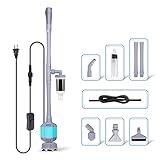
- CLEANING FUNCTION: Our sand cleaner have four spliced rigid tubes, which can be extended from 11.4 inches to 40.5 inches according to the tank. With brush heads, each corner of the fish tank can be cleaned. Aquarium gravel cleaner can also be used with the duckbill suction port to suck dirt from the corner of the fish tank, and the dung can be easily sucked away
- WATER CHANGE FUNCTION: 4.92 ft super high head, and the water changer pump can provide a strong flow of up to 360GPH, the power of sand washer is sufficient to quickly change the water, saving half the time compared to manual. The starting water level can be as low as 2 inches, no water accumulation, and pumping as low as 0.3 inches
- FILTRATION FUNCTION: The filter housing can filter the garbage in the water and make the clean water return to the tank. The fish tank can be filtered without changing water, such as washing sand, and the dirt is directly passed through the filter box. Filter sponge can be repeatedly cleaned and reused and can be replaced with other filter media
- 5 IN 1 MULTI-FUNCTION PUMP: Electric fish tank vacuum cleaner has high-density new plastic, detachable design, wear-resistant, lightweight, anti-fall. The adapter is AC 110V 60HZ, and the power supply has passed UL certification that is good to use. Independent switch control, easy to operate, no longer need to worry about unplugging the socket with wet hands
- ACCESSORIES INCLUDE: functional accessories include 45 ° corner suction inlet(Sand washing head), duckbill suction inlet(Debris vacuum), brush head, gravel washer(sand vacuum), 360 ° water intake strainer, filter housing; other accessories include: adapter ×1, independent switch ×1, water pump motor ×1, extension tube ×4, small connector ×1, Three-way valve ×1, handle ×1, wire slot ×4, outlet ×1, 2m water pipe ×1. 1x improved manual (with detailed use steps)
“Every pleco stays small.”
False. “Pleco” includes many species. Confirm the exact fish and its adult size before buying.
“A bottom feeder can live on whatever other fish miss.”
Usually not. Faster fish may consume most of the food, leaving the bottom feeder underfed. Offer an appropriate diet deliberately and monitor feeding behavior.
“Bottom feeder” is a scientific classification.
Not exactly. It is a broad descriptive label. Terms such as benthic, demersal, benthopelagic, and benthivore are more precise, but even those describe habitat or feeding relationships rather than making all included fish interchangeable.
FAQ
Is a bottom-feeder fish a scavenger?
Not necessarily. Some bottom feeders consume dead or discarded material, but others graze algae, sift sediment, hunt live crustaceans, or prey on fish. Bottom feeder describes feeding location more than diet.
Do these 3 things before closing this tab:
1Scan for outdated or missing drivers - takes under a minute2Repair Windows errors before they cause bigger problems3Fix the driver behind crashes, sound loss and screen glitchesDo bottom-feeder fish clean an aquarium?
No. They may eat some algae or leftover food, but they also produce waste and cannot replace filtration, water changes, substrate maintenance, or sensible feeding.
What is the best food for a bottom-feeder fish?
The best food depends on the species. Corydoras are foraging omnivores, plecos may be herbivorous, and some catfish are predatory. Choose suitable sinking food and follow species-specific guidance.
Can I keep any bottom feeder in a small aquarium?
No. Adult size, behavior, social needs, water requirements, and compatibility all matter. OATA recommends at least 80 litres for a shoal of smaller Corydoras or smaller plecos, but larger species need larger aquariums. Check the exact species before buying.
The Bottom Line
Bottom line: A bottom-feeder fish is one that obtains food from the bottom zone or substrate. It may be a grazer, omnivore, scavenger, sediment sifter, or predator. For aquarium care, identify the exact species, plan for its adult size, diet, group and water needs, provide suitable substrate and food, and maintain the tank independently of the fish.
Quick Recap
Product prices and availability are accurate as of the date/time indicated and are subject to change. Any price and availability information displayed on Amazon at the time of purchase will apply.




