Free tools Windows power users keep installed
One-click scans. No signup required.
Tuna live mainly in open-ocean waters, but their ranges and depth use differ by species. Yellowfin and skipjack favor warm surface waters, while albacore and Pacific bluefin also use temperate waters; bigeye can dive below the surface to feed. Tuna are highly migratory, and some species or life stages may also use nearshore waters.
Which oceans do tuna live in?
Tuna species occur across tropical, subtropical, and temperate parts of the Atlantic, Pacific, and Indian Oceans. Their exact range depends on the species and population. For example, NOAA describes yellowfin near the surface of tropical and subtropical oceans worldwide, while albacore are found in open waters of tropical and temperate oceans.
Pacific bluefin inhabit mainly temperate Pacific waters, as well as tropical waters and cooler coastal regions. Some remain in the western Pacific; others migrate to the eastern Pacific off North America. NOAA’s Pacific bluefin overview describes this movement.
Bigeye occur in tropical and warm-temperate waters of the Atlantic, Pacific, and Indian Oceans. Keep these broad ranges distinct from fishery catch locations, which do not necessarily show a species’ full biological range.
#1 Best Overall
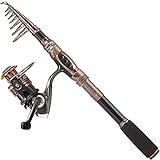
- 🎣 Warm Prompt: Fishing rod + reel (No Lures & Line) include Only Include 1 Fishing Rod +1 Fishing Reel.
- 🎣 Perfect elasticity, high density Carbon fiber mixed with fiberglass makes your fishing pole hard & durable.
- 🎣 Stainless Steel Hooded Reel Seat is anti-seawater corrosion; EVA Fore Grip for comfort. The telescopic fishing rod is portable, and closed length design is convenient carrying around. Power: Medium.
- 🎣 Instant anti-reverse; Power drive gears equipped for high strength. Deep aluminium spool with double color and one line hole; More short body with large spool and large line capacity. Line capacity: mm/M 0.20/240 0.25/200 0.30/140. Model: HA 3000; Gear ratio: 5.2:1.
- 🎣 It's the best gift to send father, son, husband,fiance, boyfriend for the upcoming Christmas. Want to buy single rod or single reel? Please search the ASIN: B07FT29RJS or B07YFP8KV3.
Do tuna live in the open ocean or near the coast?
Most tuna are pelagic: they occupy the water column and are mainly associated with open-ocean habitat, rather than the seafloor. That does not mean they never approach land. Skipjack, for example, may spend part of their lives in nearshore waters. NOAA’s skipjack profile describes their open-ocean and nearshore habitat.
Floating objects, ocean fronts, convergence zones, upwelling areas, and prey concentrations can affect where tuna gather. These associations vary by species: Pacific yellowfin may aggregate around drifting debris, buoys, fish aggregating devices, dolphins, and other large animals; Pacific bigeye schools may associate with floating objects, seamounts, or submarine ridges.
How deep do tuna swim?
Tuna do not share one fixed depth range. Some commonly use surface waters but dive during the day or as they grow, feed, or encounter changing conditions. The figures below come from specific NOAA species accounts and should not be treated as a universal depth range for tuna.
| Species and account | Depth information | Other habitat or movement detail |
|---|---|---|
| Skipjack, Atlantic | Surface waters to 850 feet during the day; generally near the surface at night. | Mostly open ocean, though some life stages may use nearshore waters. |
| Bigeye, Atlantic | At or near the surface, with daytime dives to about 800 feet. | Found in tropical and warm-temperate oceans. |
| Albacore, Pacific | Adults are found at least 1,250 feet deep and may search deeper for prey. | Juveniles are often associated with oceanic fronts or temperate discontinuities. |
| Yellowfin, Pacific | Larvae and juveniles remain in surface waters; older fish are often found deeper. | Favor 64–88°F water, according to NOAA’s Pacific account. |
These are examples from separate species accounts, not measurements made using one uniform method. NOAA’s albacore profile, skipjack profile, and yellowfin profile provide species-specific information.
The Tool Desk
Outbyte PC Repair FREERepair Windows errors before they cause bigger problemsFix Now →Outbyte Driver Updater FREEScan for outdated or missing drivers - takes under a minuteDriver Scan →Rank #2
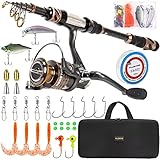
- 🎣 Warm Prompt: Full Kit with Carrier Case Include 1 Fishing Rod + 1 Fishing Reel + Fishing Line + Various Fishing Lures + Fishing Hooks + Some Necessary Accessories + Carrier Bag.
- 🎣 Full Kit with Carrier Case is special made for novice, including nessary accessories for fishing. You can use it without buying any other accessories from anywhere.
- 🎣 PLUSINNO Telescopic Fishing Rod are constructed with High Density 24-Ton Carbon Fiber reinforced with Fiberglass Composite for power,elasticity and durability; The Welded Stainless Steel Guides with Ceramic Inserts for superior casting distance and accuracy while dissipating heat more efficiently which delivers excellent durability with monofilament, fluorocarbon and braided lines; The Exquisite Reel Seat Is Made of Corrosion Resistant CNC Machined Aluminum for a solid base and all-day.
- 🎣 HA 3000 Fishing Reel With CNC Machine Cut Collapsible Handle, Left / Right Interchangeable The Rod Import Adjustable Full Metal Screw Reel Seat,12+1 Corrosion Resistant Smooth Ball Bearings,Line capacity: mm/M 0.20/240 0.25/200 0.30/140, Gear ratio: 5.2:1.
- 🎣 It's the best gift to send father, husband, fiance, boyfriend for the upcoming Christmas Thanksgiving Day.
How does water temperature affect where tuna live?
Temperature is one factor shaping tuna distribution, alongside prey, life stage, and ocean conditions. NOAA’s management appendix groups bigeye, skipjack, and yellowfin as tropical tunas, and Pacific bluefin and albacore as temperate tunas. This is a broad classification, not a claim that each fish stays within one temperature zone.
For example, NOAA gives Pacific yellowfin a preferred temperature range of 64–88°F and Pacific bigeye a preferred range of 55–84°F. These figures belong to the specific NOAA accounts and populations; they are not universal boundaries for every individual. Ocean conditions can also affect the timing and distance of migrations.
Where does each major tuna species live?
| Species | Broad range and habitat | Depth, movement, or habitat associations |
|---|---|---|
| Albacore | Open waters of tropical and temperate oceans. | Adults are found at least 1,250 feet deep. North Pacific juveniles migrate between waters off Japan and the U.S. Pacific coast; timing and distance vary with ocean conditions. |
| Pacific bluefin | Mainly temperate Pacific waters, also tropical waters and cooler coastal regions. | Some remain in the western Pacific, while others migrate to the eastern Pacific. NOAA reports that a trans-Pacific crossing can take as little as 55 days. |
| Bigeye | Tropical and warm-temperate waters of the Atlantic, Pacific, and Indian Oceans. | Atlantic bigeye dive to about 800 feet during the day. Pacific schools may associate with floating objects, large slow-moving animals, seamounts, or submarine ridges. |
| Yellowfin | Near the surface of tropical and subtropical oceans worldwide. | Older fish are often found deeper than larvae and juveniles. Pacific yellowfin favor 64–88°F water and may gather around floating objects and prey-rich areas. |
| Skipjack | Tropical, subtropical, and warm-temperate waters; mostly open ocean. | May reach 850 feet during the day and generally stay near the surface at night. Some life stages may use nearshore waters. |
Albacore tuna
Albacore inhabit open waters of tropical and temperate oceans. Juveniles are often associated with oceanic fronts or temperate discontinuities, while adults are found at least 1,250 feet deep and may search deeper for prey. In the North Pacific, juveniles typically migrate from off Japan toward the U.S. Pacific coast, but timing and distance vary with ocean conditions.
Pacific bluefin tuna
Pacific bluefin live mainly in temperate Pacific waters, but their range also includes tropical waters and cooler coastal regions. NOAA describes them as highly migratory: some remain in the western Pacific, while others migrate east across the Pacific. NOAA’s Pacific bluefin resource has current range and management information.
Rank #3
- 🎣 Warm Prompt: Full Kit with Carrier Case: 1 Fishing Rod + 1 Fishing Reel + Fishing Line + Various Fishing Lures + Fishing Hooks + Some Necessary Accessories + Carrier Bag.
- 🎣 Full Kit with Carrier Case is specially made for novice, including necessary fishing accessories. With this set, there is no need for you to buy any other fishing stuff.
- 🎣 Perfect elasticity, high density Carbon fiber mixed with fiberglass makes your fishing pole hard & durable. Stainless Steel Hooded Reel Seat is anti-seawater corrosion; EVA Fore Grip for comfort. The telescopic fishing rod is portable, and closed length design is convenient carrying around. Power: Medium.
- 🎣 Instant anti-reverse; Power drive gears equipped for high strength. Deep aluminium spool with double color and one line hole; More short body with large spool and large line capacity. Line capacity: mm/M 0.20/240 0.25/200 0.30/140. Model: HA 3000; Gear ratio: 5.2:1.
- 🎣 It's the best gift to send father, husband, fiance, boyfriend for the upcoming Christmas Thanksgiving Day.
Bigeye tuna
Bigeye occur in tropical and warm-temperate waters. In NOAA’s Atlantic account, they live at or near the surface and dive to about 800 feet during the day. Pacific bigeye may school around floating objects, large slow-moving animals, seamounts, and submarine ridges.
Yellowfin tuna
Yellowfin live near the surface of tropical and subtropical oceans worldwide. Pacific yellowfin favor water between 64 and 88°F, according to NOAA, and may travel to higher latitudes as water warms seasonally. Larvae and juveniles remain in surface waters, while older fish are often found deeper.
Skipjack tuna
Skipjack inhabit tropical, subtropical, and warm-temperate waters and are mainly open-ocean fish. NOAA says Atlantic skipjack occur at the surface and to depths of 850 feet during the day, generally staying near the surface at night. Schools can gather around floating objects, convergence zones, water boundaries, and upwelling areas.
Why are tuna able to travel so far?
Tuna migrations reflect changing conditions and needs, including prey availability, temperature, ocean features, and life stage. NOAA documents seasonal North Pacific albacore movement between waters off Japan and the U.S. Pacific coast, as well as Pacific bluefin that migrate between western and eastern Pacific waters.
Quick wins for a faster PC:
Scan for outdated or missing drivers - takes under a minuteDriver Scan →Repair Windows errors before they cause bigger problemsFix Now →Rank #4

- UGLY STIK 7’ COMPLETE SALTWATER SPINNING COMBO: Includes 9 pieces of Saltwater tackle to catch multiple Saltwater Species: 20lb. mono double hook bottom rig (2), 3oz. pyramid sinker (2) and 3/0 circle hooks (5).
- UGLY TECH CONSTRUCTION: Telescopic - 2-piece, Ugly Tech construction combines graphite and fiberglass, for a strong, yet sensitive rod. Telescoping. Includes 7 year rod warranty. Gear ratio of 5.1:1 provides smooth operation and mechanical advantage.
- SIZE 50 SPINNING REEL: 1 ball bearing system for smooth operation. Features 6 Stainless Steel guides to provide durability and eliminate insert pop-outs during rough treatment. Pre-spooled with 14lb line.
- FRONT DRAG: Graphite spinning reel with ball bearing; Multi-Stop system helps keep fighting the fish on your terms. EVA handle balances durability and comfort. Right/Left handle position.
- 12-25LB LINE RATING, MEDIUM HEAVY POWER: Ugly Stik Clear Tip delivers strength where you need it. Mono Capacity yd/lb: 280/12 215/14 195/17 (m/mm: 255/0.33 195/0.36 180/.038).
Floating objects, fronts, upwelling, and seamounts can concentrate prey or influence where particular species gather. These habitat associations are species-specific; they should not be assumed to apply equally to every tuna.
Can tuna live in freshwater?
No. Tuna are marine fish that live in saltwater. Their natural habitats are ocean waters, including open-ocean and, for some species or life stages, nearshore marine waters.
Independent reader supportYour contribution helps us test, update, and keep practical guides available for everyone.What is the simplest accurate answer?
Tuna live mainly in the open waters of the Atlantic, Pacific, and Indian Oceans. Species differ: yellowfin and skipjack favor warm surface waters, while albacore and Pacific bluefin also use temperate waters, and some tuna dive below the surface to feed.
Range and depth change with species, population, life stage, prey, and ocean conditions. A broad species range is not a real-time location report.
Recommended Free Tools
Best Value

- ALL-IN-ONE COMPLETE FISHING KIT – Most new anglers waste time and money buying fishing gear piece by piece, only to struggle with mismatched components. This complete fishing pole setup arrives pre‑assembled with a rod, reel, line, baits, fish gripper, pliers, bag, and 2 step‑by‑step manuals – everything pre‑matched, no guesswork. Even with zero experience, start fishing right out of the tackle box – no costly trial and error, no empty‑handed frustration. Perfect for beginners, kids, seniors
- ULTRA-TOUGH PREMIUM FISHING COMBO – 36-ton graphene-reinforced carbon fiber fishing rod (20% lighter, 50% stronger) with stainless steel ceramic guides for smooth, tangle-free line flow. Precision CNC-machined reel seat ensures a tight, stable fit; soft non-slip EVA grip delivers long-lasting comfort. 12+1 corrosion-resistant bearings and 5.21:1 gear ratio provide ultra-quiet, silky-smooth, jam-free retrieval. Multi-disc drag system up to 17.5 lbs stopping power. Ambidextrous handle
- WATERPROOF PORTABLE FISHING BAG -Skip wet rusty gear and messy rummaging. Our high-density tear-resistant waterproof fabric shields your gear from rain, splashes & moisture, stopping rust & bait damage in any weather. Classified compartments organize your telescopic fishing rod, reel, pliers, baits & other fishing accessories, saving you time digging messy gear Lightweight & compact, it's easy to carry by hand, store in car trunks or take on boats, perfect for travel, daily fishing
- COMPLETE FISHING ACCESSORIES KIT – Say goodbye to pricked fingers and slimy hands! Fluoropolymer-coated fishing pliers and lip gripper both feature non-slip handles for secure wet grip and easy one-hand operation. Sharp cutters slice fishing line, jaws remove fishing hooks and split rings. One-finger gripper locks fish with anti-drop lanyard. Pre-loaded tackle box packed with hard baits, soft lures and rigs, perfectly suited for bass, trout and other common fish in freshwater and saltwater
- IDEAL GIFT FOR ALL ANGLERS – The ultimate fishing gifts for men — perfect for dads, husbands, boyfriends, brothers, and all angling enthusiasts from beginners to pros. Ideal for Father’s Day, Valentine’s Day, birthdays, Christmas, Thanksgiving, anniversaries, graduation, and retirement. Fully equipped, portable, and durable for camping, angling adventures. It’s a long‑lasting collectible gift that creates unforgettable memories—a heartfelt investment, not disposable cheap fishing set
FAQ
Do tuna live near the surface?
Many tuna use surface waters, but some dive to feed or use deeper habitat. NOAA reports that Atlantic skipjack can reach 850 feet during the day and generally stay near the surface at night.
How deep can tuna swim?
It depends on the species and the account. NOAA reports Atlantic bigeye diving to about 800 feet during the day, Atlantic skipjack reaching 850 feet during the day, and adult albacore occurring at least 1,250 feet deep.
Are tuna tropical fish?
Some tuna, including yellowfin and skipjack, are grouped as tropical tunas in NOAA’s management appendix. Albacore and Pacific bluefin are grouped as temperate tunas, so tuna are not all exclusively tropical.
Can tuna be found close to shore?
Yes. Tuna are mainly pelagic and associated with open-ocean habitat, but NOAA notes that skipjack may spend part of their lives nearshore. Coastal proximity does not mean that all tuna are coastal fish.
Do all tuna migrate across oceans?
No. Movement differs among fish and populations. NOAA reports that some Pacific bluefin remain in the western Pacific while others migrate east; North Pacific albacore also make seasonal movements whose timing and distance vary with ocean conditions.
Quick Recap
Product prices and availability are accurate as of the date/time indicated and are subject to change. Any price and availability information displayed on Amazon at the time of purchase will apply.




