The Tool Desk
Outbyte PC Repair FREERepair Windows errors before they cause bigger problemsFix Now →Outbyte Driver Updater FREEFix the driver behind crashes, sound loss and screen glitchesFind Drivers →Coral-reef fish are colorful because several forces overlap: pigments and reflective tissues create visible colors, vivid patterns can camouflage a fish against a complex reef, and some colors communicate identity, mating condition, territory or danger. Water also filters light by wavelength, so a pattern that is conspicuous in shallow water may look different—or disappear—deeper down. No single explanation accounts for every reef fish.
Color can be camouflage on a colorful reef
A coral reef is not a plain background. It contains branching corals, sponges, algae, sand, shadows and moving patches of sunlight. A fish does not always need to match one color; it may need to make its outline difficult to detect or its head and tail difficult to interpret.
Disruptive spots and stripes
Spots and stripes interrupt the continuous shape of a body. This is called disruptive coloration. When the pattern overlaps a similarly varied reef background, a predator may have trouble deciding where the fish begins and ends. The pattern can work even when its colors are bright to a human observer, because concealment depends on contrast, pattern scale, viewing angle and the background behind the fish.
False eyes redirect an attack
The four-eye butterflyfish provides a classic example. A dark band helps hide the true eye, while a prominent spot near the tail can resemble an eye. A predator that aims at the false eye may strike the wrong end of the fish, giving the butterflyfish a chance to escape. The pattern is therefore both conspicuous and protective.
#1 Best Overall
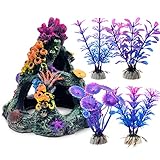
- Size: Great for fish tank decorations, also good for model making and marine aquariums. Packing Included: Coral Mountain x 1, Aquatic Plant x 4.
- Material: Gorgeous colorful aquarium coral reef set is made of high quality resin, no any harmless to humans and your fish. It will not release any harmful substances even if placed in water for long.
- Solid one-piece construction: This resin coral reef designed with one-piece construction, not easy to broke. There are some sea anemones and starfish on that mountain as decorations, it will be a nice scenery for your tanks.
- Good for your fish: There are three holes on our coral rock, which is designed as a toy for your pet betta or other small fishes. They will be happy to swim across the hole when they want to play. And as they tired, the coral reef will be the nice place for their rest.
- Easy to collocate: You can easily use the coral mountain with something else to create a favorite environment for your fishes as your expectation. Such as making an ocean paradise by collocate with an ocean sunken ship and so on.
Countershading reduces contrast
Many fish have a darker back and a lighter underside. Seen from above, the dark back can blend with deeper water or the reef below; seen from below, the pale belly can blend with downwelling light. Countershading does not make a fish invisible from every direction, but it reduces the contrast that would otherwise reveal its three-dimensional body.
How fish color is produced
Reflected wavelengths
Color begins with light. In Michael Lesser’s NOAA Ocean Exploration log from May 24, 2007, he explains that “the color we see is caused by the reflectance of colors not absorbed by the organism when sunlight shines upon them.” Pigments absorb some wavelengths and reflect others toward an observer. The reflected wavelengths determine whether a fish appears blue, yellow, orange, red or another color under the available illumination.
Rank #2

- Package Content: You will receive 1 piece of white aquarium corals decoration, which is 14 cm/5.51 inch long, 5 cm/1.96 inch wide and 12.5 cm/4.92 inch high, which can meet your multi-scene decoration needs.
- Reliable Material: This coral decoration is made of resin with fine workmanship, shatterproof, durable, can withstand humid environment, will not harm fish, and can be used for a long time.
- Realistic Design: The lifelike coral appearance design creates a vibrant underwater landscape, provides fish with a hiding place with a natural ocean atmosphere, and enhances the visual appeal of fish tanks and aquariums.
- Easy Maintenance: This fish tank coral decorations are easy to clean, just wipe or soak in warm water, it can keep its shape permanently and keep your landscape beautiful continuously.
- Wide Applications: This coral ornament is perfect for small to medium aquarium decorations, fish tank landscape decorations, underwater party centerpieces and other glass container decorations, etc.
Fluorescence is a different optical process
Fluorescence occurs when a compound absorbs a shorter wavelength and emits light at a longer wavelength. For example, a pigment or protein can absorb blue light and emit green, orange or red light. That emitted light is not simply the reflection of the original blue illumination.
Fluorescent colors are easiest to see when the shorter-wavelength excitation light is present and the observer can detect the emitted light. Their visibility therefore depends on depth, water clarity, illumination and viewing conditions. A fish that looks ordinary in broad daylight may show bright fluorescent patches under blue-rich light, but fluorescence alone is not a universal explanation for reef-fish color.
Rank #3

- Complete 35-Piece Ocean Reef Decor Set Transform your aquarium with this 35-piece ocean-style decoration set, featuring artificial coral, flowing aquarium plants, seashell accents, anemone-style ornaments, and a starfish detail. The variety of shapes and colors helps create a rich underwater scene with a full coral reef look.
- Ocean Style for Freshwater, Tropical, and Saltwater Tanks Designed with a coral reef theme, this aquarium decor set is ideal for freshwater aquariums, tropical fish tanks, and saltwater displays. It brings an eye-catching marine-inspired look to different tank setups while helping you create a more colorful and layered aquascape.
- Creates Depth, Height, and Visual Impact With tall background plants, a large statement coral centerpiece, and small accent pieces for the foreground, this fish tank decorations set makes it easy to build a balanced layout. Use it to add height, texture, and dimension to small and medium aquarium displays.
- Easy to Arrange for Custom Tank Layouts This aquarium decorations set includes multiple sizes and shapes, making it easy to arrange around gravel, substrate, and other tank accessories. Whether you want a reef-inspired centerpiece or a full ocean-themed display, the pieces can be positioned to fit your preferred layout.
- A Fast and Low-Maintenance Tank Upgrade Refresh the look of your aquarium without the hassle of sourcing separate decorative pieces. This coral reef aquarium decor kit offers a convenient way to build a vibrant underwater display and is a great choice for anyone looking to upgrade fish tank decor with a coordinated ocean theme.
Why the same pattern changes with depth
Water does not transmit every visible wavelength equally. NOAA Ocean Exploration reported in 2015, with an update in 2021, that blue light penetrates best, followed by green, yellow, orange and red. Red light is rapidly filtered as depth increases and effectively does not reach the deep ocean.
As a result, a red fish can appear vivid near the surface yet lose its red appearance with depth. In the right conditions, red coloration becomes dark and difficult to see because the red wavelengths needed to illuminate it are missing. Blue and green patterns remain more available at greater depths, although their apparent visibility still depends on the reef background and the observer’s angle.
Rank #4

- Fish Tank Accessories includes: 2 pieces resin coral aquarium decor and 10 Pieces Aquarium Decorations Plants Plastic (2.2 - 7.9 inch, including green, red, white, purple and orange).
- With different styles and sizes, you can decorate you fish tank according to your creativity.
- All Aquarium plants with pedestal: every fish tank plants in this set has a pedestal at the bottom, heavy and firm, and with the pedestal, those plants will not float around in the aquarium.
- This corals are made of resin, non-toxic and safe. The plastic plants are made of soft and healthy material, no harm to water and fish.It is ideal for both fresh and salt water, do not affect the PH in the tank.
- Please soak the fish tank decorations in water for 10-15 minutes before using. If you receive the broken item, feel free to contact with us please.
Depth is only one part of the visual environment. Shade beneath a coral ledge, cloud cover, suspended particles, water clarity and the direction of sunlight can all change which colors reach a fish and which colors reach a predator or potential mate.
Independent reader supportYour contribution helps us test, update, and keep practical guides available for everyone.Are bright colors camouflage or communication?
They can be either, and a single pattern may serve more than one function. A stripe can break up an outline at a distance while also helping members of the same species recognize one another at close range. A conspicuous patch may signal species identity or reproductive condition, yet make the fish more visible to a predator in another setting.
Quick wins for a faster PC:
Repair Windows errors before they cause bigger problemsFix Now →Fix the driver behind crashes, sound loss and screen glitchesFind Drivers →Clear out junk files and repair common Windows errorsFree Scan →Best Value

- Fish Tank Accessories includes: 2 pieces resin coral aquarium decorations and 6 Pieces aquarium plants (2.2 - 4.9 inch, including green, pink, purple and orange).
- All fish tank plants with pedestal: every fish tank plant in this set has a pedestal at the bottom, heavy and firm, and with the pedestal, those plants will not float around in the aquarium.
- This corals are made of resin, non-toxic and safe. The plastic plants are made of soft and healthy material, no harm to water and fish.It is good for both fresh and salt water, do not affect the PH in the tank.
- Wide range of usage: In order to save your time, we match a variety of styles, sizes and colors of aquarium products which can be placed in different sizes of aquarium Decorations, house, office and other places of Fish Tank, aquarium. Bring your pet fish a beautiful underwater world, more interesting, and happier life. It's an amusement park for them.
- Please soak the fish tank decorations in water for 10-15 minutes before using. If you receive the broken item, feel free to contact with us please.
| Possible role | What the pattern does | When it is most useful |
|---|---|---|
| Disruptive camouflage | Breaks up the body outline with spots, bars or stripes | Against a visually complex reef background |
| False-eye pattern | Hides the real eye or redirects an attack toward a less vulnerable body region | When predators target the head or eye |
| Countershading | Reduces contrast between the fish and overhead light or the darker water below | When the fish is viewed from above or below |
| Species or social signaling | Transmits information to mates, rivals or members of the same species | During courtship, territorial encounters or close-range recognition |
| Warning or deterrence | Makes a fish or an unprofitable feature conspicuous | When predators can learn to avoid the signal |
Why conspicuous signaling may evolve on reefs
A peer-reviewed proposal called the “Hyper-Visible World” hypothesis argues that reef conditions can favor conspicuous signals. Mobile reef fish often cannot reduce visual exposure enough for camouflage to dominate every interaction: they move through open, brightly lit and structurally complex habitats where other animals can see them. Under those conditions, sexual, warning and territorial signals may provide benefits even when they increase visibility.
The hypothesis is not a settled explanation for all reef-fish diversity. The paper states that “No evolutionary explanation for the striking colouration of coral reef fish has been established to date.” That qualification matters: different species occupy different habitats, behave differently and face different predators, so the same color cannot be assigned one universal purpose without studying the species and context.
What reef habitat and human activity change
Color only works relative to the environment in which a fish lives. If coral structure, algal cover, water clarity or the mix of neighboring species changes, a pattern may become more or less effective as camouflage or signaling.
NOAA Fisheries analyzed 5,525 fish surveys conducted at depths of 1–30 meters across 35 U.S.-affiliated Pacific islands. Natural depth-related community patterns were strong at remote reefs but greatly reduced or absent at inhabited islands, where fishing and habitat loss alter the relationship between fish and reef. This finding does not show that a particular color evolved because of human activity; it shows that human pressure can change the ecological and visual context in which reef-fish colors function.
Do these 3 things before closing this tab:
1Repair Windows errors before they cause bigger problems2Scan for outdated or missing drivers - takes under a minute3Clear out junk files and repair common Windows errorsQuick Recap
How to interpret a colorful reef fish
- Look at the pattern, not only the hue. Ask whether spots, bars or bands interrupt the outline, conceal the eye or create countershading.
- Consider the background. A bright pattern may blend into branching coral, sponge texture, algae or broken sunlight even if it looks striking against a plain aquarium wall.
- Note the depth and light. Red wavelengths fade quickly with depth, while blue and green remain more available.
- Separate reflection from fluorescence. Reflected color comes from wavelengths returned by the fish; fluorescence involves absorption of one wavelength and emission of a longer one.
- Avoid one-function conclusions. Camouflage, recognition, courtship, territorial display and warning can overlap, and scientists have not established one explanation for every reef-fish pattern.
Product prices and availability are accurate as of the date/time indicated and are subject to change. Any price and availability information displayed on Amazon at the time of purchase will apply.




