The peacock mantis shrimp (Odontodactylus scyllarus) delivers a remarkably forceful underwater strike with a spring-loaded, hammer-like appendage. A primary study measured peak limb-impact forces of 400 to 1,501 newtons in this species, plus cavitation forces reaching 504 newtons. Those measurements help explain the headline—but they do not establish a standardized ranking proving it has the single most powerful punch of any animal.
Which tiny creature is famous for its powerful punch?
It is the peacock mantis shrimp, a marine crustacean with a brightly patterned body and a pair of specialized raptorial appendages. In this species, the striking part of each appendage ends in a hard, club-shaped segment called a dactyl. The club is used to smash hard-shelled prey.
The animal is often described as having the world’s most powerful punch. That is a memorable shorthand, not a settled scientific leaderboard: comparisons across animals can involve different measurements, body sizes, species and experimental conditions.
How much force does a peacock mantis shrimp’s strike produce?
A 2005 study of peacock mantis shrimp reported peak limb-impact forces from 400 to 1,501 newtons. The researchers also measured peak cavitation forces as high as 504 newtons. These are distinct force peaks, not one combined figure or a universal maximum for all mantis shrimp. The study’s abstract reports the species-specific measurements.
#1 Best Overall

- LIFELIKE REALISM - Meticulously 3D printed to replicate the mantis shrimp's intricate compound eyes, segmented antennae, and gradient blue-purple texture. Each detail captures the enigmatic beauty of deep-sea creatures for an immersive marine life experience.
- ARTICULATED POSEABILITY - Features multi-segmented limbs with sturdy hinges that move smoothly yet hold positions firmly. Perfect for creating dynamic displays on your desk, bookshelf, or as a conversation-starting decor piece.
- PREMIUM PLA CONSTRUCTION - Made from high-quality PLA material with a layered tail fan featuring intricate fin segmentation. Designed for indoor display only to maintain color vibrancy and structural integrity.
- COLLECTOR'S SHOWCASE - Part of ELEFEA's curated line of 3D printed sea animals. This 8.3-inch masterpiece stands out in any marine collectibles collection, celebrating the wonders of deep-sea biology.
- EASY CARE & DISPLAY - Gently wipe with a soft, dry cloth for cleaning. Avoid direct sunlight, rain, or extreme temperatures. Ideal gift for marine biology enthusiasts, 3D printing hobbyists, and executive office decor.
A Smithsonian Channel video description says the strike has force “2,500 times the shrimp’s own weight.” That is the channel’s relative-force description, not the same measurement as the study’s force values in newtons. The two claims should not be treated as interchangeable. The Smithsonian Institution catalog record preserves the channel’s description.
Why can one strike produce two force peaks?
The first peak comes from the club hitting its target. The strike’s rapid motion underwater also creates cavitation: vapor-filled bubbles form and then collapse, producing a later force peak. In the 2005 study, the two peaks were typically separated by 390 to 480 microseconds. High-speed imaging, force measurements and acoustic analysis connected the later peak to bubble collapse. The study describes this sequence.
Rank #2

- Lifelike craftsmanship: the model's intricate detailing ensures a realistic appearance, captivating fascination with marine animals, cognition ,realistic shrimp
- Distinctive appearance: the unique design sets it apart, making it an eyecatching addition to any collection,animals for ,marine animal models
- Realistic detailing: the model's detailed craftsmanship provides a lifelike representation of marine animals, engaging curiosity,simulated marine animals,simulation plastic animals
- Great present: a thoughtful present for or friends, combining fun and learning in one delightful package,small ,simulation animal model
- Authentic appearance: the model's realistic detailing captures the essence of marine life, sparking interest,simulated animal ,artificial
That distinction matters when interpreting claims about “punch force.” A direct impact and the force associated with cavitation are related parts of the strike, but they are not the same event or measurement.
How does the shrimp generate such a fast strike?
The shrimp does not rely on muscle alone to swing its club. It loads elastic structures in its body and releases the stored energy through a spring-and-latch mechanism. This lets the appendage move far faster than direct muscle contraction could achieve by itself. A 2004 Nature report describes the deadly strike mechanism and its biomechanics. Read the report.
Rank #3

- Exquisite carving restores realistic mantis shrimp shape and presents unique artistic charm of marine creatures for visual enjoyment.
- Dual use as a tea pet and desktop ornament fits tea culture scenes and daily home or office decoration needs.
- Sturdy material with fine polishing ensures smooth surface and durable performance for long term display and use.
- Compact size saves space and can be placed on desks tea trays shelves and cabinets to enrich interior decoration layers.
- 2-piece set offers enough quantity for personal use and flexible matching in different decorative scenes.
At impact, the club’s speed and the underwater interaction with the target also set up cavitation. The strike’s effects therefore arise from both the spring-powered limb and what happens in the water around it.
How does the club withstand repeated impacts?
A 2025 report on a study published in Science describes two protective features in the club. Its outer mineralized-fiber region has a herringbone arrangement that resists cracking; inside, fibers form a Bouligand structure, fanning in different directions. The reported experiments found that the inner structure selectively absorbs high-frequency stress waves, helping protect the appendage during repeated strikes. Smithsonian Magazine’s coverage includes comments from study co-leader Horacio Espinosa, an engineer at Northwestern University.
Rank #4
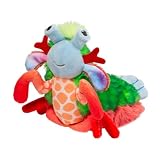
- REALISTIC MANTIS SHRIMP DESIGN – Features vibrant tropical colors, detailed body segments, expressive eyes, and lifelike features inspired by one of the ocean’s most fascinating sea creatures
- SOFT & CUDDLY OCEAN COMPANION – Crafted with premium plush materials and resilient polyester fill for comforting hugs, imaginative play, and everyday adventures
- PERFECT 10 INCH SIZE FOR KIDS – Lightweight and easy to carry for travel, classroom learning, aquarium visits, ocean-themed collections, and cozy cuddle time
- FUN MARINE LIFE FRIEND – Encourages curiosity about sea life, marine ecosystems, underwater exploration, and ocean animals through creative and educational play
- DOUGLAS QUALITY CRAFTSMANSHIP – Designed with child-friendly materials and detailed realistic styling from Douglas Cuddle Toys, trusted for premium animal plush
“To repeatedly execute these high-impact strikes, the mantis shrimp’s dactyl club must have a robust protection mechanism to prevent self-damage,” Espinosa said. The researchers found that it uses “phononic mechanisms—structures that selectively filter stress waves,” helping preserve striking ability over multiple impacts and prevent soft-tissue damage.
This is an explanation for how the club limits damage, not evidence that the shrimp is immune to injury in every circumstance.
The Tool Desk
Outbyte Driver Updater FREEFix the driver behind crashes, sound loss and screen glitchesFind Drivers →Outbyte PC Repair FREERepair Windows errors before they cause bigger problemsFix Now →Best Value

- 14" Length.
- No plastic pellets or bean bag filler.
- Cute, soft and squeezable.
- High quality. Detailed realistic design.
- Designed in the USA by Adore Plush Company.
Is it scientifically proven to have the most powerful punch in the world?
Not by the measurements cited here. The 2005 study provides specific force values for peacock mantis shrimp, while a 2019 review discusses strike power, energy flow and bioinspired materials across the broader subject. The available sources do not define a common test or standardized comparison covering all animals. The review offers broader context, but does not turn unlike measurements into a global ranking.
To compare fast strikes fairly, readers would need to know whether a figure measures direct impact or cavitation, absolute force or force relative to body weight, and strike speed or force. The species and experimental setup matter too. A “bullet-speed” comparison or a force-to-body-weight ratio describes a different axis from a peak force reported in newtons.
Quick Recap
Product prices and availability are accurate as of the date/time indicated and are subject to change. Any price and availability information displayed on Amazon at the time of purchase will apply.




