Three whitefly species preserved as immature-stage remains in Myanmar amber dating to about 100 million years ago give scientists unusually detailed evidence about early whitefly evolution. A 2026 study describes their upper and lower body surfaces and traces of wax—features rarely preserved together in fossil whiteflies. The fossils refine what researchers can infer about the group’s early history; they do not rewrite or settle the whole story.
What did scientists find in Myanmar amber?
Caballero and coauthors described three extinct whitefly species in a 2026 study published in PeerJ. The specimens are puparia preserved in mid-Cretaceous Myanmar amber, dated to approximately 100 million years ago:
- Palaeoaleuroclava grandirostrata and Cretacerifera mranmaense, assigned to the subfamily Aleyrodinae.
- Cenomaleurodicus multiporu, assigned to Aleurodicinae.
The study identifies these as the first known whitefly puparia with visible dorsal and ventral surfaces and wax traces. It also presents the first fossil representative of Aleurodicinae and the only known Mesozoic occurrence represented by whitefly puparia.
What is a whitefly puparium?
Whiteflies belong to the insect family Aleyrodidae. A puparium is the hardened outer covering associated with an immature whitefly stage. These fossils are therefore not adult whiteflies trapped in amber: they preserve immature-stage remains, which can reveal features that adult fossils cannot.
Outdated Drivers Are Slowing You Down
One free scan finds every outdated or missing driver and matches the right update for your exact hardware.Free scan · exact hardware matchPC Slower Than It Used to Be?
A free scan shows the junk files, broken settings and background clutter dragging Windows down - then fixes them in one click.Free scan · Windows 10 & 11#1 Best Overall

- Vivid Insect Fossils: Our artificial natural amber fossils are made from real insects, offering a lifelike depiction of every detail that can be viewed from different angles.
- Versatile Decorative Options: These amber specimens come with removable hooks, allowing you to personalize your choice of necklaces, clothing, keychains, or decoration for your theater room, well, children's room, or living room.
- Multiple Color Options: Our product features various insect specimens in amber and glowing white colors, with the latter having the added feature of glowing in the dark. The more light it absorbs, the stronger the glow in the dark. The 8PCS set contains 4 amber and 4 glow-in-the-dark pieces, The 16PCS set contains 8 amber and 8 glow-in-the-dark pieces
- Quality Material and Size: Our product measures 0.98 inches in diameter and is made of high-quality materials that ensure durability and longevity.
- Perfect Gift Idea: This set of insect fossils is an ideal gift for any nature lover, science enthusiast, or jewelry collector. It is also an excellent educational tool for kids and adults alike, providing a fascinating look into the world of insects and amber.
Why are these fossils unusually informative?
Many described fossil whiteflies are adults, and fossil preservation often leaves too little anatomy to make detailed comparisons. The Myanmar puparia preserve features on both the upper (dorsal) and lower (ventral) body surfaces, along with traces of wax. That combination gives researchers more to examine than a fossil showing only one surface or a less complete outline.
The authors compare structures including claws, compound pores and the proportions of the lingula, a feature of the puparium. These anatomical details help them assess similarities and differences between Aleyrodinae and Aleurodicinae and consider how those lineages relate to living whiteflies.
Rank #2

- Each fossil plate measures 8-14 cm / 3-6" long, with the fish typically ranging from 4-8 cm / 1.8-3.2". Variations in shape, size, and color are natural.
- These fish fossils date back approximately 150 million years, offering a glimpse into the ecological eras of the past. Perfect for fossil enthusiasts and collectors.
- Please note: Natural fossils, each product may be different from the photo, in order to ensure the character of the product, some of the products have been hand-colored and adhesive repair, looking forward to your understanding and cooperation.
- Discover the ancient world with our real fish fossils from western Liaoning, China. Each sample features a unique fish, carefully selected for high quality.
- Explore our extensive collection of FOSSILS AND ROCKS, including REAL BUGS, INSECT SPECIMENS, and more. Perfect for fossil lovers alike.
What do the fossils tell us about whitefly evolution?
The comparisons support the conclusion that several important morphological features found in living whitefly genera were already present by the mid-Cretaceous. In the authors’ words, “Comparative analysis reveals that several key morphological features observed in extant genera evolved by the mid-Cretaceous, providing new insights into the early evolution and diversification of whiteflies during the late Mesozoic.”
This is new anatomical evidence that can refine scenarios for early whitefly diversification. It does not establish every step in the group’s history, identify a complete sequence of ancestors, or show that modern genera themselves existed in their present form at that time.
Free tools Windows power users keep installed
One-click scans. No signup required.
Rank #3

- The overall size of the fossil is 2-3 inches long and 1.5-2.5 inches wide, and the trilobite worm body measures 1.5-2.5 inches long and 1-1.5 inches wide.
- Own a 500 million year old trilobite fossil, perfect for fossil collection enthusiasts .
- A unique birthday or gifts for collectors, featuring a trilobite fossil that is a window into the past.
- Explore the wonders of the past with this real bugs specimen, great for insect collection and enhancing your fossils and rocks display.
- Thank you so much for your purchasing from our store.Any question ,please feel free to contact us.
How does this discovery compare with another fossil whitefly?
A separate 2024 study described Pudrica christianottoi, found in succinite associated with Lower/Middle Miocene lignite deposits in Lower Lusatia, Germany. The authors argued that this find challenges established assumptions about how central and eastern European fossil resins formed and were deposited. It is a different fossil and a different geological question from the Cretaceous Myanmar puparia.
| Find | Age and locality | Preservation and life stage | What it contributes |
|---|---|---|---|
| Three species described by Caballero and coauthors (2026) | Mid-Cretaceous Myanmar amber; approximately 100 million years old | Amber inclusions preserving puparia, with dorsal and ventral surfaces and wax traces visible | First known whitefly puparia with those visible features; first fossil Aleurodicinae representative identified by the study; only known Mesozoic occurrence represented by whitefly puparia |
| Pudrica christianottoi (2024) | Succinite associated with Lower/Middle Miocene lignite deposits in Lower Lusatia, Germany | Whitefly in fossil resin; the 2024 study is a separate fossil record from the Myanmar puparia | Raises a question about established assumptions concerning central and eastern European fossil-resin formation and deposition |
What remains uncertain?
The whitefly fossil record is sparse and incomplete, so each find provides only part of the evidence needed to reconstruct the group’s past. These specimens broaden the anatomical record for immature whiteflies and add a fossil Aleurodicinae representative, but they do not settle the timing or full pattern of whitefly origins and diversification.
Quick Recap
Best Value
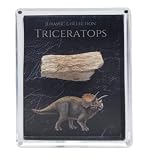
- Genuine Jurassic Gallery Fossil: Contains an authentic Triceratops bone fragment from the late Cretaceous period (approx. 67 million years old), ethically sourced from the Hell Creek Formation, Montana, USA.
- Elegant Lucite Display Case: Housed in a 4 x 3.25 x 1 inch (10.5 x 8.5 x 2.5 cm) transparent Lucite case with a magnetic lid for secure and stylish presentation.
- Unique Natural Specimen: Each bone fragment varies in shape, size, and color, reflecting the natural diversity of Triceratops fossils from the Cretaceous era.
- Distinctive Triceratops Features: Represents the Triceratops, known for its three horns, large frill, and up to 800 teeth, used for defense, foraging, and display.
- Historical Significance: From a herbivore that roamed alongside Tyrannosaurus rex, feeding on prehistoric plants like palms and cycads.
Rank #4

- Experience what it's Like to Own an Authentic Prehistoric Mosasaur Tooth Fossil Dated To Be 90 Million Years Old!
- Trilobites, Meaning "Three-Lobed", First Appeared In Our Oceans About 570 Million Years Ago Before Going Extinct around 240 Million Years Ago.
- These Fossils are Hand-Selected with an Average Size of 2.5 Inches; However, Please Allow for small Variations in Size, Shape, & Color.
- Our Trilobite Fossils are Insured with a Money-back Guarantee. The KALIFANO family has been serving customers in the United States since 1912. If for any reason you are not satisfied, we are happy to offer a full value refund. Order with confidence. We guarantee every item we sell. You will receive the same high quality on Amazon that we offer in our retail stores in Las Vegas at The Grand Canal Shoppes @ The Venetian and The Forum Shops @ Caesars Palace.
- Interested in Fossils and Minerals? 💎 Explore The KALIFANO Store Today!
Product prices and availability are accurate as of the date/time indicated and are subject to change. Any price and availability information displayed on Amazon at the time of purchase will apply.




