What’s actually slowing this PC down?
Pick the symptom - the matching free tool is one click away.
A matching name or alias is a lead, not proof that you have identified the same person—or that the person committed an offense. Verify the jurisdiction, case number, offense, legal outcome and dates against an official court or agency record. If the records still do not establish a match, stop and give the information to animal control or law enforcement. Do not publish someone’s private details or confront them based on a name match.
Why a name or alias match is not enough
Names are not unique, and an alias alone does not establish identity. Nor does an arrest, allegation or charge establish a conviction. There is no universal public procedure or set of identifiers that proves two records refer to the same person. A responsible check relies on the case context and on distinguishing information an official source lawfully makes public.
Animal-abuse registries also have defined, local scopes. They may cover only particular offenses or outcomes, so an entry—or the absence of one—does not resolve every question about a person. Treat the registry as a pointer to the underlying record, not as a substitute for it.
How to check a possible match
- Note the source and jurisdiction. Identify the court, clerk, agency or registry that issued the record, and the jurisdiction it covers. A result from another county or state may concern a different person.
- Capture the case details. Record the case number, offense, relevant filing and disposition dates, and the legal status shown: allegation, charge, plea or conviction. Do not describe an allegation or arrest as a conviction.
- Look for the underlying official record. Where public access is available, use the court, clerk or agency named in the entry. Check that the case number and disposition correspond. An unofficial repost or search-engine result is not confirmation.
- Compare only lawfully public identifiers. If the official record provides additional distinguishing details, compare them carefully. Do not infer identity from a name, an approximate age, rumor or an alias alone. The sources do not establish a universal match threshold or a standard set of public identifiers.
- Stop if details conflict or remain inconclusive. Do not merge records or try to fill gaps through private investigation. Provide the records and explain the uncertainty to animal control or law enforcement, which can use authorized records and investigative processes.
What animal-abuse registries can—and cannot—tell you
Registry rules vary by jurisdiction. Check the registry’s stated inclusion criteria and its own accuracy or update caveats before drawing conclusions.
Recommended Free Tools
#1 Best Overall

- 【Support Multipe Microchip Formats】Universal microchip scanner supports EMID / ISO11784 / ISO11785 / FDX-B(15 digit microchips). Please note, the microchip reader CAN NOT read Avid chips, and the 9-digit ID can not be recognized. Only the 15-digit international standard protocol can be recognized. Please check the format of the microchip before purchasing.
- 【Easy To Operate & Fast Scan】Our pet microchip scanner is easy to operate, one button to read. Our microchip scanner adopt advanced RFID technology, responsive and fast scanning, it can better improve the efficiency of work. Please note, if no label is scanned, the device will automatically turn off after 180 seconds, or you can press and hold the button for 3 seconds to turn off the device.
- 【 Large Data Storage】Our pet microchip scanner can save 128 animal chips. It can be transferred to a computer or mobile phone via a USB cable connection. Our pet chip scanner also features a data-erase function, refer to the user manual for instructions.
- 【Rechargeable Battery】Our pet chip scanner supports USB charging, eliminating the need for frequent battery replacements, it can last for more than one year after being fully charged.
- 【Easy To Carry】Our scanners are lightweight and compact, making them easy to carry and ideal for both indoor and outdoor use. The package includes one scanner, a USB cable, and a user manual.
| Registry or source | What its published information says | How to interpret it |
|---|---|---|
| Miami-Dade County registry | The county says it lists people convicted of felony or misdemeanor animal-abuse and cruelty offenses. It describes the registry as a resource for public awareness and vetting in animal sales and adoption. | Use it within those stated criteria and purposes; it is not a universal list of suspicions or allegations. |
| Tennessee Bureau of Investigation registry | The TBI says county clerks submit information and that the agency does not independently verify convictions. Its disclaimer says the information should be regarded as a resource suggesting the need for further inquiry. | Check the underlying court or clerk record. The agency’s disclaimer means an entry should not be treated as independently verified proof. |
| Florida statewide registry information | Marion County says a searchable statewide registry maintained by FDLE went live January 1, 2026, and covers people convicted of, or entering guilty or no-contest pleas to, specified animal-cruelty offenses. | Confirm current availability and the applicable criteria through the state source before relying on a result. |
| 2025 New York bill | The bill text proposes a registry that would include legal names and aliases. | A proposed bill is not evidence that the registry or requirements are current law. Check its legislative status before describing it as enacted. |
Registry entries are not interchangeable across jurisdictions. Check what conduct and outcomes qualify, who supplies the information, and whether the agency says it independently verifies entries. No match-accuracy rate is established by these sources; do not assign one.
Public records have privacy limits
Not every investigative or law-enforcement record is publicly available. The U.S. Department of Justice explains that records about another living person that could invade that person’s privacy ordinarily will not be disclosed without consent or proof of death; it gives records showing whether someone was the subject of a criminal investigation as an example. That is a limit on access, not a reason to seek restricted material through another route. Read the DOJ Criminal Division’s FOIA and privacy guidance.
Rank #2
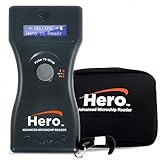
- UNIVERSAL MICROCHIP COMPATIBILITY: Reads all ISO microchips plus 9-, 10-, and 15-digit chips from any brand. Ideal for scanning horses, livestock, pets, and other animals in clinics, shelters, barns, or field settings.
- BLUETOOTH CONNECTIVITY FOR FAST, ACCURATE DATA TRANSFER: Easily sends scanned chip numbers to Bluetooth-enabled devices within a 25-foot range for quick syncing to computers, tablets, or shelter management software. Reduces manual data entry errors and speeds up check-in and intake processes—perfect for busy clinics or multi-pet facilities.
- BACKLIT LCD SCREEN WITH 15-MINUTE DISPLAY HOLD: Features a bright blue backlit LCD screen with bold white text displaying the full chip number on one line for easy reading—day or night. The 15-minute display hold gives ample time to record the scan without rushing, ideal for high-volume or field settings.
- RECHARGEABLE BATTERY WITH AUTO POWER-SAVE MODE: Includes a rechargeable 9V battery and charging unit for long-lasting performance. The auto shut-off function conserves power between uses—great for mobile vets, rescue teams, or animal control officers who need dependable scanning during long sessions.
- LIGHTWEIGHT, DURABLE DESIGN WITH PROTECTIVE CASE: This 7-inch handheld microchip scanner is compact, ergonomic, and easy to carry. Includes a protective carrying case to guard the reader during storage and transport. Built for dependable use in clinics, shelters, barns, or field settings.
Some information about witnesses may also be withheld when disclosure risks harassment, threats or witness tampering. Arizona law, for example, provides for withholding certain witness information in defined circumstances. Keep addresses, phone numbers, social accounts and other private details out of public posts, and do not ask others to identify or locate a suspected person.
Independent reader supportYour contribution helps us test, update, and keep practical guides available for everyone.When and how to report concerns
If you have a credible concern about animal abuse, use the official reporting channel for your location—often animal control, local law enforcement or a relevant animal-welfare agency. Provide what you personally observed and any records you found, clearly distinguishing confirmed facts from uncertainty about identity. Do not confront someone or encourage others to do so.
Rank #3

- Microchip Reader with a 1.44in high-brightness OLED display, You can view scan history, upload data, set formats, Bluetooth wireless connection and more.
- Pet Microchip Scanner Three ways to connect USB connection, wireless 2.4G connection, Bluetooth connection. There is no restriction on location to view data, which saves you more time.
- Microchip Scanner SUPPORT FOR ISO 11784/11785, FDX-B AND ID64 FRID this Portable pet ID Microchip Reader Scanner could read almost all FDX-B (15 digit) microchips for animal identification in compliance with ISO 11784 and ISO 11785 norms. It is widely used for animal management, resource management, railway inspection.
- Save up to 240 tag information, you can upload these information to the computer via wireless 2.4G, Bluetooth 6.1.
- Support for multiple languages. You can set up the language through the software we send you.Improved Recognition Performance:Faster recognition speed and larger recognition range than older scanners. Upgraded the sensitivity of the scanner. It can better improve the efficiency of work.
Reporting duties and protections differ by jurisdiction. Illinois law, for example, requires specified professionals who reasonably believe an animal is abused or neglected to report to the Illinois Department of Agriculture’s Bureau of Animal Health and Welfare; it also provides conditional good-faith immunity and protects reporter identity subject to applicable law. Those provisions are specific to Illinois and do not establish the rules elsewhere. Follow your local agency’s reporting instructions.
Investigative resources are for trained officials, not private surveillance. A Vermont law-enforcement field guide discusses aliases and records such as dog licenses as investigative clues; it does not establish that members of the public should search for or monitor people. View the Vermont law-enforcement field guide.
Quick Recap
Best Value

- Universal Compatibility & Fast Reading: Treamvp rechargeable micro chip reader works at 134.2KHz/125KHz, supports EMID, FDX-B (ISO 11784/11785) microchips; reads in <100ms with 0.5s interval, stable for glass tags and animal ear tags
- OLED Display & Clear Indication: The Pet Microchip Scanner Built-in 0.91-inch high-brightness OLED screen and buzzer; clearly shows data content and status even in strong outdoor/indoor light
- 128 Record Storage & Rechargeable: Save up to 128 tag information; easy data transfer to computer via USB cable for pet/livestock management and traceability. 800mAh rechargeable battery,charging and data uploading, a universal cable
- Portable & Durable Design: Compact size 6.89 x 3.46 x 1.38 inches, lightweight 0.24 lbs/3.99 oz; Easy to carry and ergonomic handle design for comfortable long-time holding and easy to carry; durable for various environments (indoor/outdoor, farms, vet clinics)
- Wide Temperature Range & Stable Performance: Operates from -10°C to 50°C, stores from -30°C to 70°C; reliable for farms, vet clinics, home and outdoor use
Rank #4

- Stores lost pets chip numbers
- Alerts the user that a pet is missing
- Rechargeable by plugging into a pc
- Reads most microchips in pets, dogs, cats
Product prices and availability are accurate as of the date/time indicated and are subject to change. Any price and availability information displayed on Amazon at the time of purchase will apply.




