Do these 3 things before closing this tab:
1Repair Windows errors before they cause bigger problems2Fix the driver behind crashes, sound loss and screen glitches3Clear out junk files and repair common Windows errorsGuppy fin rot is a pattern of worsening fin damage, not a diagnosis of one specific germ. Ragged or receding edges, discoloration, white-edged holes, or red streaks are warning signs—but a clean tear can also come from injury or fin nipping. Start by checking and improving the aquarium environment; consider medication only if the damage continues or infection is likely.
How to tell whether a guppy may have fin rot
Look for damage that progresses rather than a single, clean split. Fin rot may appear as ragged or receding edges, milky or otherwise discolored tissue, holes with pale edges, red streaks, fins that look fused, or gradual fin loss. PetMD identifies receding fin edges, with or without discoloration, as a reason to contact a veterinarian (PetMD); Guppy Aquarium describes additional visible signs, including ragged fins and red streaks (Guppy Aquarium).
Appearance alone cannot establish the exact cause or pathogen. Treat fin rot as a practical suspicion, not a confirmed diagnosis: progression and tissue discoloration after stress or poor conditions are more concerning than a fresh, clean tear that appeared after chasing or contact with décor.
Fin rot, a tear, or fin nipping?
- Possible fin rot: The edge keeps receding or breaking down, discoloration develops, or tissue loss continues over time.
- Possible injury: A clean split or tear appears suddenly after a known collision, chase, or contact with a sharp object.
- Possible fin nipping: Damage coincides with chasing or an aggressive tank mate; inspect the fish and observe the aquarium rather than assuming infection.
These clues overlap. An injury or nipping can expose tissue and stress the fish, so damage can worsen or become infected. Watch whether the fin stabilizes after the suspected cause is removed.
#1 Best Overall
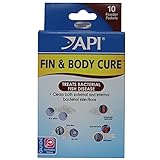
- Contains one (1) API FIN and BODY CURE Freshwater Fish Powder Medication 10-Count Box
- Treats body slime, eye cloud, fin and tail rot, open red sores, gill disease, and hemorrhagic septicemia
- Causes slight discoloration of water that can be fixed by adding activated charcoal
- Use only in freshwater aquariums
- Use daily for four days when symptoms of bacterial diseases appear
Why guppies develop fin damage
Poor water quality, accumulated waste, overcrowding, fin nipping, injury, and other stressors can weaken fin tissue and give opportunistic infections a chance to advance. Aquarium Co-Op notes that fin rot often follows bacterial infection associated with dirty water, fin nipping, or other stress (Aquarium Co-Op). Guppy Aquarium likewise links fin or tail infection with bullying, nipping, overcrowding, and poor water quality.
Fin deterioration can have bacterial, fungal, or injury-related roots. Fritz Aquatics lists Aeromonas, Pseudomonas, and Vibrio among bacteria associated with fin rot, but those possibilities do not identify the cause in an individual fish. Fungal growth is usually secondary to injury or disease that leaves tissue exposed, according to Fritz Aquatics.
Rank #2
- Contains one (1) API BETTAFIX Antibacterial & Antifungal Betta Fish Infection and Fungus Remedy 1.7-Ounce Bottle
- Heals bacterial infections, repairing damaged fins, ulcers, and open wounds and promotes regrowth of fins
- Treats newly introduced fish to reduce risk of disease outbreak and heal wounds and tissue damage
- Contains healing melaleuca, a variety of tea tree
- Use daily for a week when treating infections and for three days as a preventive when adding new fish
What to do first: correct the aquarium conditions
Improving the conditions that may be driving the damage is the first intervention. Medication cannot compensate for ongoing poor water quality, aggression, or injury.
- Test and record the water. Use a freshwater aquarium test kit to check ammonia, nitrite, nitrate, and pH. The results help identify problems and provide a baseline for follow-up checks.
- Change some water and remove waste. Make a partial water change with conditioned water matched to the aquarium’s temperature. Remove uneaten food and visible waste.
- Check the equipment. Verify that filtration and aeration are working. If current is so strong that the guppy cannot rest, reduce it where practical.
- Inspect tank mates and décor. Separate fish that are nipping or bullying the guppy, and remove sharp objects that could be causing repeated injury.
- Reassess the fish and water. Continue monitoring the fin and water readings after these changes. Persistent or worsening damage warrants veterinary advice rather than repeated guesswork.
Petco’s veterinary Q&A and Aquarium Co-Op also emphasize addressing water conditions and stressors before relying on medication (Petco; Aquarium Co-Op).
Quick wins for a faster PC:
Scan for outdated or missing drivers - takes under a minuteDriver Scan →Repair Windows errors before they cause bigger problemsFix Now →Rank #3

- For use in freshwater or marine aquaria.
- Easily absorbed through both skin and gills; ingestion not required.
- Does not adversely affect the filter bed and is easily removed with carbon.
- Safely and effectively treats several fungal, and bacterial fish diseases (dropsy, popeye, fin/tail rot, septicemia).
- When used in a medicated food mix, it is excellent for treating bacterial infections in tanks that contain invertebrates.
When medication may be appropriate
If tissue loss continues despite correcting water and tank conditions, bacterial infection may be more likely. A labeled aquarium antibacterial may then be appropriate, but the visible signs do not prove which organism is involved. Follow the product label exactly and seek advice from an aquatic veterinarian for severe, spreading, or uncertain cases.
Petco’s veterinary answer gives minocycline and erythromycin as examples of broad-spectrum antibiotics. Their availability and prescription status vary by jurisdiction; do not assume either is legal or suitable for every fish or aquarium. A veterinarian can help determine whether medication is warranted and how to use it safely.
Rank #4
- Contains one (1) API MELAFIX Freshwater Fish Bacterial Infection Remedy 16-Ounce Bottle
- Heals bacterial infections and repairs damaged fins, ulcers and open wounds
- Contains natural, botanical tea tree extract to quickly and rapidly help fish
- Helps treat newly-introduced fish to reduce risk of disease outbreak in freshwater aquariums
- Use daily for a week when treating infections and for 3 days as a preventive when adding new fish
Do not treat aquarium salt as a universal cure. The right response depends on the cause, the fish, and the aquarium; indiscriminate treatment can distract from correcting the conditions that triggered the damage.
Independent reader supportYour contribution helps us test, update, and keep practical guides available for everyone.When to contact an aquatic veterinarian
Seek veterinary help promptly if damage is spreading toward the body, red lesions or cottony growth appear, the guppy becomes lethargic, breathing or swimming changes, appetite falls, or multiple fish are affected. Also consult a veterinarian if the fin continues to deteriorate after water and stress problems have been addressed. These signs may indicate a more serious or different condition than uncomplicated fin damage.
Best Value
- Contains one (1) API MELAFIX Freshwater Fish Bacterial Infection Remedy 4-Ounce Bottle
- Heals bacterial infections and repairs damaged fins, ulcers and open wounds
- Contains natural, botanical tea tree extract to quickly and rapidly help fish
- Helps treat newly-introduced fish to reduce risk of disease outbreak in freshwater aquariums
- Use daily for a week when treating infections and for 3 days as a preventive when adding new fish
How to help prevent fin rot from returning
- Test water regularly and keep a maintenance routine suited to the aquarium’s stocking, filtration, and measured water quality.
- Remove uneaten food and waste, and avoid overcrowding.
- Watch for chasing, bullying, or fin nipping; address aggression rather than treating the resulting damage alone.
- Check décor for sharp edges and quarantine new fish when practical.
- Feed appropriately and monitor the guppy’s fins so changes are noticed early.
PetMD recommends routine water changes of 10–25% every two to four weeks as guppy-care guidance (PetMD). That interval is not a universal prescription: adjust the schedule to the aquarium’s conditions and test results.
Quick Recap
Product prices and availability are accurate as of the date/time indicated and are subject to change. Any price and availability information displayed on Amazon at the time of purchase will apply.




