Degenerative myelopathy (DM) should be suspected when an older dog develops slowly progressive, usually painless weakness and incoordination in the hind legs. That pattern is not specific to DM, so a veterinarian must localize the problem and rule out other causes before DM is considered a presumptive diagnosis. A SOD1 DNA test can add supporting evidence, but it measures genetic risk. It does not diagnose the disease on its own.
What the early pattern looks like
The Merck Veterinary Manual describes DM as a slowly progressive, noninflammatory degeneration of axons and myelin in the spinal cord. The features that should raise suspicion are:
- Age: dogs are usually older than 8 years when signs begin.
- Onset: insidious, meaning it creeps in rather than appearing suddenly.
- Location: ataxia (incoordination) and weakness begin in the pelvic limbs.
- Pain: the condition is described as nonpainful.
- Reflexes: spinal reflexes are usually normal or exaggerated in the early stages.
As the disease advances, Merck notes that lower motor neuron signs can appear and the thoracic (front) limbs can become involved. A dog with signs confined to the back legs in its early course is therefore not ruled in or out by location alone; the pattern and the exam over time matter.
Breeds Merck lists as commonly affected
Merck lists German Shepherd Dogs, Pembroke Welsh Corgis, Boxers, Rhodesian Ridgebacks, and Chesapeake Bay Retrievers as commonly affected. Other breeds can also develop DM, so breed raises the index of suspicion without defining it.
Recommended Free Tools
#1 Best Overall

- Harness Object: The Rear Legs support Harness is designed to help your elderly, disabled, or injured dog, who are unable to navigate the stairs, has a difficult time getting up and down, needs help walking and at any risk of falling
- Lifesaver: The dog carrying harness can pick up the rear end of your fur friend,prevent hip pain and injury caused by aging, support them getting in and out of the car,up and down the steps,help them get up from lying down,stabilize both the gait and spine
- Postoperative Rehabilitation : This Hip lifter is a helpful rehabilitation strap to help your furry pug who are post-op surgery of knee,CCL (ACL),TPLO,hip replacement and so on.They all have some trouble with the their back legs
- Soft Durable : Inside contains synthetic fleece material,the dog mobility harness is very fluffy and comfortable for your dog to wear,won't chafe your pups underbelly. The belly sling carrier outer cove with oxford fabric, it is sturdy for large dog
- Easy to Use:The concept of the portable dog lift support harness is great with the padded handles,so its cushion works great for all dog owners can give your dog a assist lifting with easy.The dog body hoist is washable and easy to carry or storage with drawstring bag when not use it
Why foot placement matters: separating DM from orthopedic disease
Merck’s owner-facing guidance notes that DM can be confused with orthopedic disorders such as arthritis. The distinguishing clue it highlights is impaired proprioception, meaning the dog has trouble sensing where its feet are and placing them normally. Hind-limb stiffness or reluctance to move from arthritis does not explain this kind of misplacement, so a neurologic cause should be considered.
This is a reason to book a neurologic examination, not a test to run at home. Owners who notice repeated toe-dragging, unsteadiness, or crossing of the hind feet should describe these observations to their veterinarian with the age of onset and how fast they have changed.
Rank #2
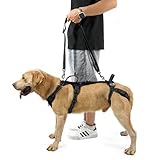
- Veterinary Recommendations - Patented product developed through in-depth communication between our team and veterinarians. Specifically designed for dogs with hip dysplasia, arthritis, anterior cruciate ligament injury, intervertebral disc disease (IVDD), hip problems, unstable standing, and those in need of rehabilitation. It provides assistance in daily life, such as helping dogs climb up and down stairs, use the bathroom, and get in and out of cars.
- Easy to Use - You can put this lift harness on your dog in just 1 minute. The wearing steps are simple and easy to understand, no complicated operations required, so even first-time users can get the hang of it quickly.
- Bathroom Assistance - When your dog needs to defecate or urinate, this support sling provides stable support for the dog's rear legs, allowing the dog to use the bathroom without taking off the harness. Meanwhile, it also provides dual support for both the front and rear legs of the dog, making it easier for the dog to use the bathroom.
- Reflective Material - All the straps of the harness are equipped with reflective strips. In low-light environments or at night, they can effectively improve the visibility of the dog, making the dog's night activities safer and reducing the risk of accidents.
- 24-Hour Wearable - Made of skin-friendly material, it is lightweight, soft and breathable, which won't cause discomfort to the dog. It can be washed with water and dried, making daily cleaning and maintenance convenient, and suitable for the dog to wear all day long.
How the veterinary evaluation works
A DM diagnosis is built from a process of elimination supported by targeted tests, not from one result. The veterinarian typically:
- takes a history, including age at onset, rate of progression, and any pain or changes in bladder or bowel function;
- examines gait, postural reactions, spinal reflexes, and pain response;
- localizes the lesion to a region of the nervous system;
- considers competing causes of progressive hind-limb weakness and incoordination.
Excluding compressive and inflammatory disease
Merck names compressive and inflammatory diseases as the conditions that must be excluded. It states that myelography or MRI and cerebrospinal fluid (CSF) analysis are essential for that purpose. These tests address alternatives such as disc disease compressing the spinal cord or inflammatory conditions, which can resemble DM clinically. Merck describes them as necessary to exclude these causes, not as a fixed sequence that every dog must undergo in the same order, so the exact workup depends on the individual case.
Rank #3

- SUPPORT HIP SLING- Loobani lift sling is a simple and effective solution for mobility especially for elderly dogs, weak hind legs, orthopedic injuries, hip dysplasia, Arthritis pain, ACL / CCL surgery or other debilitating ailments
- MAKE MOBILITY EASILY- Excellent to help your doggy stand up, up and down stairs, get in and out of vehicles, onto furniture, outside for a bathroom break, or to provide some assistance when taking a walk
- COMFORT & NO PAIN- Providing ultimate care to weak and senior dog through thickening design and soft lining with sheepskin-like covering. Moreover,the handle equipped with removable padding is perfect for protecting your hand for easy comfortable carry
- HEAVY DUTY STRAP- A reflective nylon band runs through the whole sturdy sling to hold the weight of any breed. Adjustable straps were long enough to fit a range of breeds. Even if your pooches are short or you're tall, this carrier work well for you
- EASY TO USE & CARRY- The sling does not get in the way when she needs to "go" and can be moved out of the way easily if needed. After using, just fold and put it into the portable gift bag. Machine washable
Where the SOD1 test fits
The SOD1 DNA test supports risk assessment. Its strongest role is as additional evidence in a dog that already has compatible signs and a presumptive diagnosis. The table below separates what each type of evidence can and cannot establish.
| Evidence | What it can contribute | What it cannot establish alone |
|---|---|---|
| Clinical pattern and neurologic exam | Whether signs and localization fit DM; whether proprioceptive deficits point to a neurologic problem | A definitive DM diagnosis, because other conditions can mimic the presentation |
| Imaging (MRI or myelography) and CSF analysis | Helps exclude compressive and inflammatory alternatives | A genetic risk result or an individual prognosis |
| SOD1 DNA test | Inherited risk information; supporting evidence when signs and a presumptive diagnosis fit | That an at-risk dog will develop DM, or that DM is causing current signs |
Reading a SOD1 result
The Orthopedic Foundation for Animals (OFA) reports three result categories for the common DM mutation:
Rank #4

- Harness Object: The Rear Legs support Harness is designed to help your elderly, disabled, or injured dog, who are unable to navigate the stairs, has a difficult time getting up and down, needs help walking and at any risk of falling
- Lifesaver: The dog carrying harness can pick up the rear end of your fur friend, moderate hip pain and injury caused by aging, support them getting in and out of the car, help them get up from lying down, stabilize both the gait and spine
- Postoperative Rehabilitation: This Hip lifter is a helpful rehabilitation strap to help your furry pug who are post-op surgery of knee, CCL (ACL), TPLO, hip replacement and so on. The back saver harness assist your dog while recovering from surgery
- Soft and Durable: Inside contains soft plush material,the dog lift harness is very fluffy and protect dogs' belly. The dog sling outer cove with oxford fabric. Our fabric is durable and won't expire easily and typically usable for up to 5 years
- Easy to Use: The portable dog lift support harness is great with the padded handles, so its cushion works great for all dog owners can give your dog a assist lifting with easy. It is washable and easy to carry or storage with drawstring bag
| Result | OFA label | What OFA says it means |
|---|---|---|
| N/N | Normal | Two normal copies of the tested mutation. |
| A/N | Carrier | One normal and one mutated copy. OFA says carriers are far less likely to develop DM, although it has confirmed disease in a few carrier dogs. |
| A/A | At-Risk | Two mutated copies. Risk is raised, but not all A/A dogs show clinical signs, and the percentage that develop disease within a lifetime is still under study. |
The label “at risk” is the accurate description for an A/A result. It should not be read as “has DM.” OFA states:
“For dogs showing clinical signs with a presumptive diagnosis of DM, affected (A/A) test results can be used as an additional tool to aid in the diagnosis of DM.”
Special offer. See more information about Outbyte and uninstall instructions. Please review EULA and Privacy policy.Best Value
Sale Lafoty Dog Lift Harness for Large Male Dogs, 2-in-1 Detachable Support Harness, Full Body Carrying with 4 Handles, Dog Sling for Large Dogs Hind Leg Support(Black, X-Large)
- 【Specially Designed for Male Dogs – Male-Friendly Dog Lift Harness】: The Lafoty dog lift harness for large dogs offers unique support with lift handles that don't interfere with male genitalia, allowing your dog to pee comfortably without mess. The rear leg straps are positioned to avoid interference with pooping, making it a clean and comfortable experience for your dog.
- 【Enhanced Mobility & Comfort – Dog Support Harness for Back Legs】: Equipped with 4 strategically placed handles (front and back), this dog carrying harness provides multiple lifting and rotation options, making it ideal for a variety of scenarios. The 6 adjustable straps help distribute force evenly, reducing strain on both you and your dog. Perfect as a dog stair helper or for lifting your dog in and out of vehicles.
- 【 2-in-1 Versatility – Detachable Rear Leg Support & Lift Strap】: This dog support sling offers a versatile 2-in-1 design. The rear leg support can be detached to be used as a regular harness for dogs, while the lift strap provides extra mobility support or temporary carrying assistance for stairs, walks, or general lifting.
- 【 Comfortable & Durable – High-Quality Dog Lift Harness】: Crafted from durable materials, this dog back leg support harness is designed for safety and comfort. While it may be slightly heavier than regular harnesses, the shoulder straps are built to evenly distribute weight, ensuring comfort even during long periods of use. Great for dog lifter for large elderly dogs or those recovering from surgery.
- Must Be Done Before Purchasing:We need to pay patience to accurately measure, so as to get the accurate size, refer to the scale table to buy the accurate size. After purchase, if you have any questions (missing parts/inappropriate size/not adjustable, etc.), please contact us in time.
OFA also notes that how well the mutation predicts disease may vary among breeds, which is why breed-specific guidance matters.
Independent reader supportYour contribution helps us test, update, and keep practical guides available for everyone.Bernese Mountain Dogs and the DM2 variant
OFA states that Bernese Mountain Dogs may carry a second SOD1 variant, known as DM2, and that these dogs should be tested for both DM1 and DM2. For other breeds, OFA’s DM page indicates that DM1 testing is sufficient. Owners of Bernese Mountain Dogs should therefore confirm that both variants were included when interpreting a result.
Putting the prognosis figure in context
Merck reports that most dogs are euthanized because of disability within 1 to 3 years after diagnosis. This is a population-level statement from the reference. It is not a timeline for an individual dog, and the figure does not describe progression rates for every case.
Neither Merck nor OFA’s pages establish a population prevalence, the sensitivity of the SOD1 test, or a reliable lifetime percentage of A/A dogs that develop DM. Any estimate beyond the statements above should be treated with caution, and questions about an individual dog’s course are best discussed with the veterinarian who is managing its care.
What’s actually slowing this PC down?
Pick the symptom - the matching free tool is one click away.
Quick Recap
Product prices and availability are accurate as of the date/time indicated and are subject to change. Any price and availability information displayed on Amazon at the time of purchase will apply.




