Free tools Windows power users keep installed
One-click scans. No signup required.
Humane education is a way of teaching that links human rights, animal protection, and environmental sustainability, then asks learners to act on what they understand. The Institute for Humane Education (IHE) describes its purpose as helping learners understand the real-world effects of decisions, examine the systems behind those effects, and create just, healthy, and humane solutions for people, animals, and the natural world. The approach is used in schools, nonprofits, advocacy work, policymaking, and homeschooling.
What humane education covers
Humane education is not limited to lessons about pets or general kindness. IHE defines it through three connected areas: human rights, animal protection, and environmental sustainability. In IHE’s framing, humane educators cultivate compassion, help learners understand individual and collective agency, investigate unjust or unsustainable systems, assess information carefully, and support ethical solutions meant to do the most good and the least harm.
| # | Preview | Product | Price | |
|---|---|---|---|---|
| 1 |
|
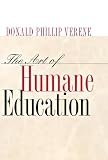
The Art of Humane Education | $32.95 | Buy on Amazon |
| 2 |

|
The Power and Promise of Humane Education | $23.84 | Buy on Amazon |
| 3 |

|
The Humane Interface: New Directions for Designing Interactive Systems | $26.26 | Buy on Amazon |
| 4 |

|
Humane Composition Pedagogy | $49.99 | Buy on Amazon |
| 5 |

|
Teacher Record Book | $4.89 | Buy on Amazon |
Other organizations describe the field with a different emphasis. The Animal Welfare Institute (AWI) frames it around compassion, empathy, living beings, and respect for habitats. Both descriptions share a concern for living things, but they do not define the field identically, so it is more accurate to attribute each definition to the organization that wrote it.
The scope has also widened over time. An older American Humane guide to humane education notes that the field came to include animal issues alongside environmental and human-rights issues. That document is useful for historical context; for a current definition, IHE’s description is the more recent statement.
Crashes, No Sound, or Screen Glitches?
Random freezes, missing sound and display glitches usually trace back to one bad driver. Find and replace yours safely.Free scan · under a minuteWindows Errors? Fix Them Before They Spread
Repair common Windows errors and clear accumulated junk for a smoother, more stable PC - no reinstall needed.Free scan · no reinstall#1 Best Overall
- Used Book in Good Condition
How it differs from animal-only lessons
The practical difference lies in the questions a lesson asks. An animal-focused unit usually asks how to treat animals well and why animals matter. An integrated humane education unit also asks how a problem affects people, animals, and ecosystems at the same time, and what social or economic systems produce that problem.
| Approach | Stated emphasis | Source of the description |
|---|---|---|
| Animal-centred education | Compassion, empathy, living beings, and respect for habitats | Animal Welfare Institute |
| Integrated humane education | Human rights, animal protection, and environmental sustainability, linked through systems inquiry and ethical action | Institute for Humane Education |
Neither approach is wrong. A teacher who wants a focused unit on animal habitats may find the first model fits. A teacher who wants students to trace a food, housing, or water problem across people, animals, and land will usually need the second.
The Solutionary Framework: from inquiry to action
IHE’s named method for this kind of learning is the Solutionary Framework. It is presented as a roadmap for structuring a project, not as proof that a given project will produce a particular measured result. In practice, a class or group works through four stages:
Rank #2
- Used Book in Good Condition
- Assess a problem. Choose a local or global problem and describe what is happening.
- Consider its effects. Ask how the problem affects humans, animals, and the environment.
- Examine systemic causes. Identify the policies, markets, habits, or institutions that keep the problem in place.
- Design an ethical, actionable response. Propose solutions that account for the stakeholders affected, and check whether they could cause harm elsewhere.
IHE pairs this sequence with four core practices: perspective-taking, careful evaluation of information, systems inquiry, and ethical solution design. Perspective-taking matters because the people, animals, and places affected by a problem often have different stakes in the outcome.
Where humane education is used
IHE names several settings in which the approach is applied:
- K–12 classrooms and higher education courses
- Nonprofit programs and community organizations
- Advocacy campaigns
- Policymaking and civic discussion
- Homeschooling, including families who teach children at home and already share daily life with companion animals
Humane World for Animals describes its own work as centred on classroom and community programs, which overlaps with the school and community settings above.
Starting resources
Several organizations publish material for educators. Each describes its own catalog, so the table below reports what each says it offers rather than comparing quality or cost.
| Organization | What it describes offering |
|---|---|
| Institute for Humane Education | Free lesson plans, teaching tools, exemplar units, and the Solutionary Framework |
| Humane World for Animals | Curricula, manuals, classroom and community resources, and teacher training material |
| Animal Welfare Institute | Publications and children’s activities, including resources on alternatives to dissection |
| Association of Professional Humane Educators | Professional networking, resource access, and development opportunities described on its membership page |
| National Humane Education Society | Introductory information and a handbook for offering humane education programs |
Before using any of these materials, check three things:
- Age fit. Confirm the reading level and activities suit the learners in front of you.
- Local context. Examples drawn from one country or community may need adjusting for another.
- Lesson goal. Match the resource to a specific objective, whether that is a habitat unit, a systems project, or a community action plan.
About the Institute for Humane Education
IHE’s own history states that Zoe Weil and Rae Sikora created the organization in 1996, initially as the Center for Compassionate Living. According to that history, IHE launched a certificate program in 1997 and affiliated with Cambridge College for a humane education master’s degree (M.Ed.) in 2000. Its current pages describe graduate programs offered in partnership with Antioch University.
Rank #4
Professional development has also grown. IHE reports that it launched a 30-hour Solutionary Micro-credential Program in 2021. Its timeline further states that IHE-trained educators brought the Solutionary Framework to students in 13 countries in 2023. Both figures are organization-reported; the first describes the length of the course, and the second describes the reported reach of trained educators.
IHE also reports that The World Becomes What We Teach by Zoe Weil became an Amazon #1 bestseller in 2022. That is a claim about the book’s standing at the time, not a current ranking. Readers who want a book-length introduction can treat it as optional further reading.
Independent reader supportYour contribution helps us test, update, and keep practical guides available for everyone.What IHE says about educators’ purpose
The IHE page on its impact stories includes a statement from Steve Cochrane, identified there as Executive Director:
Best Value
- Keep track of everything from attendance to test scores
- Spiral bound
- Measures 8-1/2" x 11"
“Our goal should not simply be to teach students how to solve problems, but to help them solve problems responsibly, compassionately, and with consideration for the wellbeing of people, animals, and the planet.”
The same sentence appears on the IHE impact stories page, which is where it is attributed. The page does not give an original publication date for the statement, so no date is assigned here.
What the evidence does and does not show
The figures above come from the organizations that run these programs. They are useful for understanding scope and reach, but they are not independent evaluations. The publicly available material does not include a controlled study that measures humane education’s effect on empathy, behavior, academic performance, or animal welfare. Claims that the approach produces those outcomes should be treated as untested until supported by study-specific evidence.
For a teacher or program leader, the practical implication is to define success locally. Decide what a unit should change, such as the quality of student proposals or the number of community actions completed, and collect that information directly.
Questions to ask when comparing programs
- Scope: Does the program focus on animals alone, or does it connect human, animal, and environmental issues?
- Learner age and setting: Is it designed for a particular age group, classroom, nonprofit, or household?
- Cost and access: Are materials free, paid, or part of formal training?
- Action: Does the instruction include inquiry and student-led action, or only information?
- Adaptation: Can the material be adjusted to local culture, language, and curriculum requirements?
Answers to these questions differ across organizations. Avoid assuming that programs with similar names offer equivalent content.
Quick Recap
Product prices and availability are accurate as of the date/time indicated and are subject to change. Any price and availability information displayed on Amazon at the time of purchase will apply.




