Veterinary technicians do much of the hands-on work in wound care. They help stabilize the patient, prepare the wound, apply and check bandages, record progress, and teach owners how to protect the wound at home. The veterinarian sets the treatment plan, including whether a wound is closed, which antimicrobial is used, and whether debridement is needed. As Heidi Reuss-Lamky, LVT, VTS (Anesthesia/Analgesia), (Surgery), writes in the American Animal Hospital Association (AAHA) article on this topic, “Veterinary technicians are an integral part of patient wound care.” (AAHA, June 1, 2022)
The sources behind this guide describe clinical principles and common practice. They do not define the legal limits of what a technician may do. Scope of practice is set by state, provincial, or national veterinary practice acts and by hospital policy. Before performing any task below on your own, confirm that it is within your jurisdiction and your clinic’s protocol.
The workflow at a glance
Most wound cases follow the same sequence. Each step depends on the one before it, and each has a place where the technician’s observations feed the veterinarian’s decisions:
- Stabilize the patient and address life-threatening injuries first.
- Examine the patient to establish the full extent of the injury.
- Classify and describe the wound.
- Prepare the wound: hair removal, lavage, and protection from further contamination.
- Apply the bandage the veterinarian specifies, with the right layers and padding.
- Monitor the bandage and wound, and record dimensions and progress.
- Instruct the client verbally and in writing, and confirm the recheck plan.
Stabilization and assessment come first
Local wound care waits until the patient is stable. The AAHA article says each animal should be stabilized and thoroughly examined to determine the extent of damage. Pain management, sedation, or general anesthesia may be needed to examine the wound safely and humanely, and the choice of analgesia and sedation belongs to the veterinary team under the veterinarian’s direction.
Recommended Free Tools
#1 Best Overall

- HEALING AID & SKIN REPAIR: Use a few times daily to flush dog cuts, abrasions, sores, and skin irritations
- PET FIRST AID ESSENTIAL: Works great on all animals at all life stages to help provide relief to skin problems
- SAFE & EFFECTIVE: Made with a non-toxic hypochlorous technology that is pH-balanced and safe if licked
- VETERINARIAN RECOMMENDED: Support wound healing with this anxiety-free, cost-effective alternative to antibiotic or steroid ointments.
- TRUSTED BRAND: Vetericyn is a leader in at-home animal health products manufactured to help pet owners take the best care of their animals
The AAHA article lists the range of presentations a technician may see, including burns, bite wounds, pressure sores, severe dermatitis, gunshot wounds, lacerations, and degloving injuries. Wear gloves when handling any wound. Describe what you find in plain terms (location, size, depth where it can be determined, edges, color of tissue, and the presence of debris, exudate, or odor) so the veterinarian has a clear starting record. (Sources: AAHA article; Merck Veterinary Manual, initial wound management in small animals.)
Classifying the wound
AAHA uses four wound categories to frame planning. Treat them as a framework from the cited article, not a replacement for the veterinarian’s assessment.
| Category | AAHA description |
|---|---|
| Class I, clean | Clean surgical incisions that do not enter contaminated tracts. |
| Class II, clean-contaminated | Surgery involving the alimentary, urogenital, or respiratory tracts in a controlled operative environment. |
| Class III, contaminated | Recent open wounds, such as gunshot wounds, or contamination occurring under controlled circumstances. |
| Class IV, dirty | Chronic or traumatic wounds with necrotic tissue or infection. |
Timing is about the wound, not the clock
Many older references describe a “golden period” after injury within which a wound can be closed. The AAHA article reports that this concept has been redefined. It also cautions against primary closure of heavily contaminated wounds. Merck similarly states that closure decisions depend on available skin, wound location, and the degree of contamination or infection.
Rank #2

- All-Purpose Wound Care Kit for Home, Travel & Work | Complete first aid set ideal for treating minor injuries at home, in the car, or on the job. Includes: 10 - Gauze pads (4 in x 4 in), 10 - Cleansing wipes (4.75 in x 7.75 in), 12 - Non-stick pads (3 in x 4 in), 4 - Transparent dressings (2.36 in x 2.75 in), 3 - Rolls of gauze (4 in x 2.5 yd), and 1 - Roll of paper tape (1 in x 10 yd).
- Premium 7–10 Day Wound Care Kit | Includes high-quality sterile gauze pads, wipes, dressing pads, and medical tape for effective first aid. Compact and ideal for home, car, office, or travel use. Designed to clean wounds, manage bleeding, and reduce irritation—made with safety and reliability in mind.
- TREATMENTS | Treatment for small to medium sized cuts and scraps with wound sites ranging from 1 Inch to 3 Inches
- PORTABLE WOUND CARE SUPPLY | Designed for convenient at-home or on-the-go use to help care for family, friends, and loved ones in emergency situations.
- Manufactured by the leader in consumer first aid in the USA
In practice, a wound that is still contaminated or infected may be managed open for a period, then closed once the bed is ready. Merck describes this delayed closure after initial open management as a standard approach when contamination or infection must be controlled first. Do not treat a fixed number of hours as a cutoff. The sources here do not establish one.
What’s actually slowing this PC down?
Pick the symptom - the matching free tool is one click away.
Lavage and wound preparation
Lavage clears debris and reduces bacterial load. The sections below set out what the AAHA article recommends, and they should be read as the source’s specifics rather than universal prescriptions.
Choosing the lavage solution
- Isotonic saline is described as the least toxic option for healing tissue. The AAHA article notes that clean water can suffice in a pinch.
- Dilute 0.5% chlorhexidine diacetate is described as having residual activity.
- Povidone-iodine has limits in purulent material, according to the AAHA article.
- Hydrogen peroxide and surgical scrub agents are described as toxic to healthy tissue and should be avoided on the wound bed.
Pressure and equipment
The AAHA article gives 8 pounds per square inch (psi) as the recommended lavage pressure and describes a 35 mL syringe connected to a 19-gauge needle as a way to achieve it. This figure is AAHA’s recommendation from its 2022 article. The sources do not present it as a newly verified universal standard, and the equipment should be used under your clinic’s protocol.
Rank #3

- 6-PIECE CLINICAL-GRADE KIT | Everything you need for a standard half-limb equine bandage, organized and ready to use. No scrambling for supplies in a stressful moment
- NON-ADHERENT DRESSING PADS (2, 3" x 4") | Sticky tabs keep pads securely in place without shifting, ideal for direct wound contact
- COTTON COMBINE (14" x 42") & BROWN CLING GAUZE | High-absorbency padding layer cushions the wound and manages drainage, secured in place with breathable cling gauze
- PREMIUM VET WRAP & EAB TAPE | Cohesive vet wrap provides compression and stability without sticking to hair, while EAB tape locks the bandage in place for a secure, long-lasting finish
- VET-GUIDED TECHNIQUE INCLUDED | Scan the QR code to watch step-by-step bandaging instructions demonstrated by our equine surgeon
Hair removal, lubricant, and drains
The AAHA article recommends adequate hair removal around the wound. It describes sterile lubricant as a way to limit hair contamination of the wound while clipping. Penrose drains are described as passive drains. Jackson-Pratt drains are described as active suction drains, used for selected wounds with dead space. Drain placement and removal are veterinary decisions, and the technician’s role is usually to monitor the drain, the surrounding skin, and the output as directed.
Debridement and closure are veterinary decisions
Lavage, staged debridement, and the assessment of closure options are part of the veterinarian’s treatment plan, as Merck describes. Your value lies in giving accurate observations that inform that plan. Several factors the sources identify are worth recording so they can be discussed:
The Tool Desk
Outbyte PC Repair FREERepair Windows errors before they cause bigger problemsFix Now →Outbyte Driver Updater FREEScan for outdated or missing drivers - takes under a minuteDriver Scan →- Contamination or infection: whether the wound is heavily contaminated, which the AAHA article says should not be closed primarily.
- Available skin: the amount of skin available to close the defect.
- Location: wounds near a joint may contract and impair range of motion, according to Merck.
- Patient morbidity and the expected treatment period: including cost over that period.
- Technical expertise and cosmetic goals: Merck advises referral when closure needs exceed the clinician’s expertise.
Bandaging
The three bandage layers
Merck lists the goals of bandaging as limiting hemorrhage, immobilizing an area, preventing further trauma or contamination, preventing wound desiccation, absorbing exudate, controlling infection, and aiding mechanical debridement. A typical bandage uses three layers:
Rank #4

- COMPREHENSIVE HELP: The Wound Spray is ideal for cat & dog hot spot treatment. Helps with scratches, cuts & skin irritations. It is perfect for dog wound care, as it provides a quick effect.
- HOT SPOT SPRAY TREATMENT FOR DOGS: Our cat & dog Wound Spray is suitable for all sizes & breeds, making it easy to support their well-being. Use our supplement with a cone for dogs to stop licking.
- COLLOIDAL SILVER FOR DOGS & CATS: It is the best hot spot treatment for dogs that has only two ingredients, Colloidal Silver and Deionized Water. It provides gentle skin care and quickly absorbs.
- DOSAGE & WARNING: Our advanced spray form makes our supplement easy to use and administer. Simply spray 2-4 times twice daily, use a cone for cats and dog bandages for wounds to prevent licking.
- SAFE COMPOUND: We created our supplement using only safe ingredients, without any additives, artificial colorants, or GMOs, to provide gentle wound care for dogs and cats.
| Layer | Role | What the sources say |
|---|---|---|
| Primary (contact) | Touches the wound | May be adherent or nonadherent. It can protect the bed, maintain moisture, absorb or transmit fluid, or support debridement. |
| Secondary (intermediate) | Padding and absorption | Provides padding and absorbs exudate. |
| Tertiary (outer) | Securing and protection | Secures and protects the underlying layers. |
Matching the dressing to the wound
Dressing choice should reflect tissue condition, the amount and type of exudate, the healing stage, the wound site, and the patient’s tolerance. Dressing types differ in how they adhere, whether they add or absorb moisture, and whether they support debridement. The table below lists the specific cautions the sources give.
| Wound feature | What the sources say | What the technician can do |
|---|---|---|
| Dry or necrotic wound | Hydrogel adds fluid and is suited to dry or necrotic wounds (Merck). | Note the tissue condition and report it so the veterinarian can select the dressing. |
| Highly exudative wound | Hydrogel is inappropriate here and can macerate surrounding healthy tissue (Merck). | Flag heavy exudate early and confirm the dressing plan with the veterinarian before changing it. |
| Strike-through on the bandage | For highly exudative wounds, AAHA advises changing the bandage when strike-through occurs. | Check the bandage on schedule and change it when strike-through appears, following the veterinarian’s change frequency. |
Applying the bandage
Apply bandages evenly and with sufficient padding. Poor technique can harm tissue or compromise the patient, so a bandage that is too tight, too loose, or unevenly padded is a problem to fix rather than leave in place. For body areas that are difficult to bandage, the AAHA article describes a tie-over bandage as an option. Fitting a bandage to a difficult anatomical area should be done as the veterinarian directs.
Independent reader supportYour contribution helps us test, update, and keep practical guides available for everyone.Monitoring and documentation
What to record
The AAHA article recommends meticulous wound progress records. Include:
Best Value
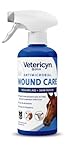
- HEALING AID & SKIN REPAIR: Use a few times daily to flush the horse's cuts, abrasions, sores, and irritations.
- HORSE FIRST AID KIT ESSENTIAL: Vetericyn Plus equine wound care spray is a must-have when looking for horse supplies.
- SAFE & EFFECTIVE: Made with a non-toxic hypochlorous technology that is pH-balanced and non-irritating.
- VETERINARIAN RECOMMENDED: Support wound healing with this anxiety-free, cost-effective alternative to antibiotic or steroid ointments.
- TRUSTED BRAND: Vetericyn is a leader in at-home animal health products manufactured to help equestrians take the best care of their horses.
- Patient identification and date of each check.
- Wound dimensions and progress notes.
- Topical treatments applied and the bandage materials used, where useful.
- Dated photographs with a labeled disposable ruler, which create a timeline of wound dimensions.
- Bandage condition, including strike-through, slippage, and soiling.
- Any licking, chewing, or attempts to remove the bandage.
Photographs that are useful
Photograph the wound at each check from the same angle when possible, with the labeled ruler in the frame. Consistent photographs are only as useful as their labels, so write the date and patient on the record that goes with each image.
Client instruction and home care
Give instructions verbally and in writing. Explain how to keep the patient from licking or disturbing the bandage, and make sure the owner understands when a recheck is needed under the veterinarian’s plan. The AAHA article calls a properly fitted Elizabethan collar essential. For some chest or abdominal wounds, it mentions a physical barrier such as a shirt. Check the collar fit before the owner leaves, and ask the owner to demonstrate how they will check the bandage at home.
Limits of the evidence
The guidance here comes from clinical references rather than comparative trials. No independent comparative trial, outcome rate, or current prevalence statistic is established in these sources, so this guide does not offer healing or infection rates. The 8 psi pressure and the 35 mL syringe setup are AAHA recommendations from its June 1, 2022 article. Merck’s guidance on small-animal wound management applies to small animals and should not be carried over to equine, livestock, or exotic species without species-specific sources.
For broader emergency and critical-care background, the chapter “Integumentary and Musculoskeletal Emergencies” in the Wiley text Veterinary Technician’s Manual for Small Animal Emergency and Critical Care (first published September 28, 2018) is available at Wiley. Clinical references are revised over time, so check current editions and your clinic’s protocols before relying on any specific figure.
Quick Recap
Product prices and availability are accurate as of the date/time indicated and are subject to change. Any price and availability information displayed on Amazon at the time of purchase will apply.




