Veterinary physical rehabilitation is individualized care that aims to protect an animal’s mobility, comfort, and day-to-day function during recovery from injury or surgery, or while living with a long-term condition. What a pet actually receives depends on the diagnosis, the neurologic status, and the plan set by the treating veterinarian or a qualified rehabilitation professional. The most specific published guidance on this topic addresses dogs recovering from thoracolumbar intervertebral disc extrusion (IVDE), a condition in which disc material is forced into the spinal canal of the mid-to-lower back. Where this article gives a specific recommendation, it comes from that dog-and-IVDE context and should not be applied automatically to other pets or conditions.
What physical therapy for pets includes
Pet physical therapy, usually called veterinary physical rehabilitation, uses supervised, progressive activities to help an animal move better, regain strength, and manage pain. Depending on the case, a plan may include passive movement of joints, assisted standing and walking, massage, cold or heat applications, and exercise tailored to the animal’s abilities. Some practices also use equipment such as underwater treadmills or therapy balls; this article does not evaluate those tools.
Providers differ by location and training. Care may be delivered by a veterinarian with rehabilitation training, a veterinary rehabilitation professional, or a certified canine rehabilitation practitioner working under veterinary direction. Ask who will assess your pet, who will write the plan, and who will review progress.
Does my dog need physical therapy after back surgery?
Not every dog that has spinal surgery needs a formal program, and no general rule answers that question. For dogs with thoracolumbar IVDE, the American College of Veterinary Internal Medicine (ACVIM) has published a consensus statement that describes a basic rehabilitation protocol. The statement presents it as an option that can be part of recovery, and the decision to use it should follow a neurologic examination and the surgeon’s or veterinarian’s assessment of your dog.
#1 Best Overall
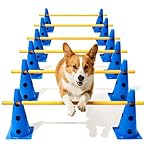
- Build Your Dog's Agility Course: Includes 12 cones & 6 durable rods. Mix and match to create endless training layouts!
- Adjustable Heights for Every Dog: Our agility hurdle cone set stand at 12 inches tall. Easily set jumps at 3 different heights (2", 5.5", 9") using the rods – perfect for puppies to pros!
- Premium Durability & Portability: This dog agility training set is made of lightweight plastic. Cones nest together for compact storage, and the whole set sets up or packs away in seconds – perfect for indoors or backyard fun!
- Versatile Training :This dog agility course backyard set create jumps, weave poles, or zig-zag tunnels! Transform your space into a stimulating agility course that keeps your dog engaged and excited to learn. And the lowest height allows the dog to undergo good rehabilitation training.
- Boost Agility & Bonding Time: Watch your dog gain confidence, speed, and coordination! This dog agility equipment strengthens your connection while providing essential physical & mental exercise.
How much weight the guidance can bear
ACVIM consensus statements are used where evidence is limited or practice varies. They reflect expert opinion and are meant to supplement, not replace, clinical judgment. The ACVIM panel describes the evidence behind its basic rehabilitation recommendation as low level. It endorses a stepwise approach that increases intensity over time and tailors exercises to each dog’s neurologic status. The 2022 consensus summary is the basis for the IVDE-specific details in this article; it is not a fixed treatment schedule for every dog.
The basic rehabilitation protocol for thoracolumbar IVDE
According to the ACVIM summary, the basic protocol for dogs with thoracolumbar IVDE includes five components. The summary states that these can be carried out without specialized equipment or training, though a veterinarian or trained professional should still set how and when each one is used.
Cryotherapy
Cryotherapy means applying cold to the affected area, typically to help manage pain and swelling after surgery. Timing, duration, and whether it is appropriate at all depend on the dog’s stage of recovery and surgical site, so confirm the approach with your veterinarian before starting.
Rank #2

- Build Your Dog's Agility Course: Includes 12 cones & 6 durable rods. Mix and match to create endless training layouts!
- Adjustable Heights for Every Dog: Our agility hurdle cone set stand at 12 inches tall. Easily set jumps at 3 different heights (2", 5.5", 9") using the rods – perfect for puppies to pros!
- Premium Durability & Portability: This dog agility training set is made of lightweight plastic. Cones nest together for compact storage, and the whole set sets up or packs away in seconds – perfect for indoors or backyard fun!
- Versatile Training :This dog agility course backyard set create jumps, weave poles, or zig-zag tunnels! Transform your space into a stimulating agility course that keeps your dog engaged and excited to learn. And the lowest height allows the dog to undergo good rehabilitation training.
- Boost Agility & Bonding Time: Watch your dog gain confidence, speed, and coordination! This dog agility equipment strengthens your connection while providing essential physical & mental exercise.
Passive range-of-motion (PROM)
In PROM, a handler or therapist gently moves the dog’s limbs through their normal range of motion without the dog actively working the joints. It is intended to help keep joints flexible and limit stiffness during periods when the dog cannot move freely. The number of repetitions and the range used should be taught and checked by a professional.
Quick wins for a faster PC:
Repair Windows errors before they cause bigger problemsFix Now →Scan for outdated or missing drivers - takes under a minuteDriver Scan →Massage
Massage is included as a supportive component of the protocol. It is usually paired with other elements rather than used alone, and its effect on the spinal injury itself is not what the consensus statement claims.
Assisted standing
Assisted standing involves supporting the dog so it can stand, typically with a sling or the handler’s hands under the body. It gives the dog a chance to bear weight and practice balance in a controlled way. The level of support and how long each attempt lasts should follow the dog’s neurologic status.
Rank #3
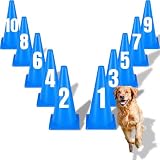
- Abundant Quantity: the dog agility equipment set includes 10 blue training cones and 2 sheets of number stickers (each number approximately 4 inches/10 cm high); This ample quantity is sufficient to set up complete agility training routes or word games, meeting various training needs from basic cones to complex commands;It's an ideal choice for professional dog trainers and pet owners
- Suitable Size: the dog training cones are 32 cm high with a 16.5 cm base diameter, a moderate height that combines stability and portability; They provide clear visual cues for your dog while being less likely to be knocked over by large dogs; The dog agility equipment wide base ensures stability on grass, mud, or indoor surfaces, while the dog agility course backyard set lightweight design makes them easy to store and carry to parks, backyards, or training grounds
- Superior Material: our dog agility training cones are made of PE material, molded in one piece; The material is tough, wear-resistant, and impact-resistant, able to withstand the impact of running and collisions from dogs and outdoor sun and rain; The smooth, burr-free surface will not harm your pet's paw pads and skin, and is easy to clean; Easy to wash with water, ensuring hygiene and safety during training
- Customizable Number Stickers: the included high-recognition number stickers allow you to freely number the cones according to the training difficulty; This can be used for brain teasers such as "picking up objects by number" and "memorizing track order, " greatly enriching the fun of training and helping dogs develop a basic understanding of numbers, stimulating their cognitive abilities
- Versatile Applications: whether you're conducting basic daily training in your backyard, organizing agility competitions at a pet park, or using it as a training tool in a professional kennel, this pet training cone set is nice; The striking blue color provides high contrast against a green lawn, easily attracting dogs' attention and making it a powerful tool for enhancing human-dog interaction
Walking
Walking is the final component, and it is the one most often misunderstood. The summary describes it as stepwise: short, controlled walks that increase gradually as the dog improves, rather than returning to normal exercise on a set date. Stepwise progression is the central principle of the protocol.
Rest and rehabilitation are not opposites
A common assumption is that a dog recovering from disc surgery should simply rest, and that rehabilitation exercises must wait until restrictions end. The ACVIM summary contradicts that assumption in part: it states that activity restriction does not mean avoiding rehabilitation exercises. Restriction and rehabilitation are designed to run together, with the rehabilitation activities matched to what the restriction allows.
The same summary says that at least four weeks of post-operative confinement and activity restriction is currently recommended as standard care in this context. It also acknowledges that direct evidence on the benefits, risks, and duration of that restriction is limited. The table below separates what the guidance establishes from what it leaves open.
Rank #4

- 【Professional-grade canine rehabilitation and all-around training tool】This high-strength PVC balance disc, designed specifically for dogs, not only supports post-operative rehabilitation, muscle building, and joint mobility improvement, but also boasts a unique dual-textured, non-slip surface and adjustable inflation system, allowing it to be used for everything from beginner balance exercises to high-intensity agility training, helping your dog improve core strength, coordination, and neurological acuity.
- 【Intelligent inflation system for precise training intensity control】The included efficient hand pump allows for easy adjustment of the airbag firmness to meet the needs of different body types, ages, and training stages. From soft rehabilitation to high-intensity balance challenges, this disc offers multiple uses, ensuring continuous improvement for your dog.
- 【Dual-sided sensory stimulation activates the entire body】The top surface features a variety of raised textures to stimulate paw nerves and proprioception; the reverse side features a smooth, shock-resistant structure, making it suitable for advanced balance and inversion training, comprehensively enhancing your dog's sensory awareness and motor control.
- 【Portable, explosion-proof design allows for training indoors and outdoors anytime】Made of explosion-proof construction and eco-friendly PVC, it weighs only 2.2 pounds and folds up for easy transport to the park, backyard, or on the go, eliminating training limitations and keeping your dog active.
- 【Suitable for all breeds and stages, from puppies to seniors】Safe for developmental guidance in puppies, agility training in adult dogs, and muscle maintenance and cognitive stimulation in seniors. A training guide is included to help parents implement effective rehabilitation and interactive play.
| Recovery question | What the ACVIM IVDE summary says | What it does not settle |
|---|---|---|
| Confinement and activity restriction | At least four weeks is currently recommended as standard post-operative care. | Direct evidence on benefits, risks, and duration is limited. |
| Rehabilitation during restriction | Restriction does not require avoiding rehabilitation exercises. | The exact exercises for a given dog are set by the veterinarian. |
| Increasing activity | Intensity should increase stepwise, with exercises tailored to neurologic status. | No fixed day-by-day schedule is given in the summary. |
| Mobility aids | No evidence on mobility aids for this population is reported. | Whether any aid improves outcomes is not established. |
Doing rehabilitation exercises at home
The ACVIM summary states that the basic protocol can be performed without specialized equipment or training. That is a statement about the protocol’s accessibility, not a home exercise plan. Home activity should begin only after your veterinarian or rehabilitation professional has shown you the exact movements, the amount of support to give, and the signs that mean you should stop.
Keep a simple log of what you did, how your dog responded, and any changes in pain, appetite, or behavior, and bring it to follow-up visits. Contact your veterinarian promptly if your dog suddenly loses the ability to stand or walk, shows new weakness, has changes in bladder or bowel control, or seems to be in more pain than before.
Independent reader supportYour contribution helps us test, update, and keep practical guides available for everyone.When does a dog need a wheelchair?
Wheelchairs are not a default accessory for recovery. The ACVIM summary reports no evidence on mobility aids for this population, and its consensus view is that a wheelchair should generally be reserved for dogs whose non-ambulatory status is likely to be permanent. As a typical example, the summary cites persistently absent pain perception more than four weeks after surgery. It also recommends that a veterinarian or certified canine rehabilitation practitioner supervise fitting and use. Trials have not established that wheelchairs improve outcomes, and not every disabled pet needs one.
Free tools Windows power users keep installed
One-click scans. No signup required.
Best Value

- Targeted Rear Leg Rehabilitation— The uniquely contoured "peanut" shape provides stable yet gentle support under the hindquarters, promoting weight-bearing and muscle engagement crucial for recovery in paralyzed or neurologically impaired pets
- Therapeutic Passive Motion— As your pet interacts with the ball, the soft, flexible silicone core encourages natural, low-impact leg movements that help maintain joint flexibility and combat stiffness
- Graded Resistance for Muscle Strengthening— The high-grade silicone construction offers subtle, adaptive resistance to your pet's movements, effectively rebuilding core and hind limb strength without causing strain or discomfort
- Universal Triple-Size Fit System— Available in three graduated support heights, this tool can be precisely matched to your pet's unique leg length and body frame, ensuring optimal positioning and safety
- A Compassionate Recovery Companion— This device transforms daily care into an opportunity for active rehabilitation, helping your pet regain mobility, confidence, and a better quality of life through guided, supported exercise
A dog wheelchair or canine mobility cart is a decision for a dog whose veterinarian has identified a likely persistent need, not for a dog that is simply slow to recover.
| Situation | Position in the ACVIM IVDE summary |
|---|---|
| Non-ambulatory status likely to be temporary | Wheelchairs are generally not the intended approach; the recovery plan centers on the protocol and restriction. |
| Non-ambulatory status likely to be permanent | A wheelchair may be considered, with the example of persistently absent pain perception more than four weeks after surgery. |
| Fit and use of any mobility aid | Should be supervised by a veterinarian or certified canine rehabilitation practitioner. |
Monitoring pain and daily function
The American Veterinary Medical Association (AVMA) supports an individualized approach to pain, combining pharmacological and non-pharmacological options based on current evidence and each animal’s clinical factors. Pain medication should be started, changed, or stopped only under veterinary direction.
AVMA educational material on companion-animal pain describes several ways to assess pain: behavior changes, pain scales, objective measures, and owner observations. Owners are often the first to notice a change, such as reluctance to move, altered posture, restlessness at night, or withdrawal from routine. Supportive environmental changes can also help preserve function and quality of life. Examples include non-slip flooring, ramps or steps in place of stairs, and bedding or feeding stations placed at a comfortable height. Ask your veterinarian which changes fit your dog’s condition.
Remote check-ins and telehealth
The AVMA’s telehealth guidance states that electronically delivered veterinary care should meet the same professional and standard-of-care expectations as in-person care, and that veterinary medical care requires a veterinarian-client-patient relationship. Video or phone progress checks can support a plan that a veterinarian has already established, but they do not replace an in-person examination when one is needed. Rules on remote veterinary care vary by location, so ask your practice how remote follow-up works in your area.
What’s actually slowing this PC down?
Pick the symptom - the matching free tool is one click away.
Questions to ask your veterinarian
- Does my dog’s condition fall within the IVDE guidance, or is a different rehabilitation approach needed?
- What is the planned confinement and restriction period, and what does my dog’s neurologic exam show?
- Which rehabilitation activities can start now, and who will show me how to perform them?
- What signs mean I should stop an activity and call the practice?
- Is a mobility aid appropriate now, or only if my dog’s non-ambulatory status is expected to persist?
- Who will fit and supervise any mobility aid, and how often will progress be reviewed?
Veterinary physical rehabilitation can help many animals, but its specifics depend on the diagnosis, the animal, and the professionals involved. Start with your veterinarian, and expect a written plan that names the activities, the limits, and the people responsible for each step.
Quick Recap
Product prices and availability are accurate as of the date/time indicated and are subject to change. Any price and availability information displayed on Amazon at the time of purchase will apply.




