Budesonide is a corticosteroid that a veterinarian may prescribe to a cat, most often for chronic inflammatory bowel disease, and in a separate form for airway disease. Neither use has a universal dose that can be copied from a label, a human prescription or another cat’s medication. The amount, schedule and form should come from the prescribing veterinarian, and the medication should not be stopped or reduced without that veterinarian’s direction.
What budesonide is and why it is prescribed to cats
Budesonide belongs to the glucocorticoid class of steroid medicines. It reduces inflammation, which is why veterinarians consider it for conditions where the immune system keeps irritating part of the body. In cats, the most common reason is chronic inflammatory bowel disease (IBD), sometimes called chronic enteropathy. Cornell University’s College of Veterinary Medicine describes feline IBD as long-term irritation and inflammation of the gastrointestinal tract, and says that diagnosis usually involves blood work, fecal testing, imaging and a search for other diseases that can look similar before treatment is chosen.
Budesonide is not a licensed feline medicine for this purpose. VCA Animal Hospitals, in its veterinary medication entry for budesonide, states that its use in cats and dogs to treat IBD is “off label” or “extra label.” VCA adds that in these situations, owners should follow the veterinarian’s directions and cautions very carefully, because those directions may differ significantly from the product label. Off-label does not mean improvised. It means the veterinarian is making a clinical judgment about this specific animal.
Two different uses that should not be mixed together
The word “budesonide” covers more than one product and more than one disease. Oral budesonide for intestinal inflammation and inhaled budesonide for airway disease are different routes, were studied in different groups of cats, and carry different questions about dose and side effects. Treat them as separate topics.
#1 Best Overall

- Easy Treating: Feline Greenies Chicken Treats are easy to use cat pill pockets, just put the pill or capsule of your cat's medicine inside the moldable pocket, pinch closed until the pill is hidden, and share with your adult cat for a hassle-free treatment experience
- Cats are smart - but you're smarter: Treats for cats with delicious chicken flavor, this pill wrap for cats helps mask the taste of the medicine
- Feline Greenies Pill Pockets Delectable Cat Treats are the #1 vet recommended choice for giving pills
- Greenies Pill Pockets For Cats are made with all natural, real ingredients plus minerals & trace nutrients, with no artificial flavors, artificial preservatives, or fillers, so you can feel good about treating your pet daily with their routine medication
- Convenient Feline Greenies Pill Pockets: These cat snacks are a great-tasting treat for adult cats
| Feature | Oral use for feline IBD | Inhaled use for airway disease |
|---|---|---|
| Typical condition | Chronic inflammatory bowel disease or chronic enteropathy | Naturally occurring asthma or chronic bronchitis |
| Regulatory status in cats | Off label, per VCA | Not stated as a labeled feline use in the sources reviewed; studied in an observational study |
| Forms mentioned | Capsule or tablet (VCA) | Inhalant (VCA lists nasal spray or inhalant as forms of the drug) |
| Strongest feline evidence | Limited historical evidence; a 2025 retrospective conference abstract (Murray et al.) | A 2013 observational study (Galler et al., Journal of Small Animal Practice) |
| Main systemic concern noted | Corticosteroid class effects such as thirst, urination, appetite change, and hyperglycemia | Adrenal-axis (HPA-axis) suppression detected in some tested cats |
What the evidence does and does not establish
Oral budesonide for feline IBD
For many years, evidence for oral budesonide in cats with IBD was thin. A 2013 veterinary review by Al-Ghazlat and colleagues, which discussed feline lymphosarcoma and IBD, stated that, to its authors’ knowledge at the time, studies evaluating budesonide’s efficacy in cats with IBD were lacking. That review offered empirical dose suggestions, but those suggestions were not presented as a universal or individualized prescription, and they should not be read that way now.
A 2025 conference abstract by Murray and colleagues, presented through iCatCare and ANZCVS, added a retrospective look at feline chronic enteropathy. It is a single-center, retrospective report, so it shows association rather than proof. Its key figures are:
- 72 cats in total, of which 48 received budesonide and 24 received prednisolone (Murray et al., 2025 abstract).
- Owner-reported clinical improvement in 87.5% of cats in each group (Murray et al., 2025 abstract).
- Documented hyperglycemia at any time in 39.6% of budesonide-treated cats and 41.7% of prednisolone-treated cats (Murray et al., 2025 abstract).
The authors state that prospective studies are warranted. Until those exist, the abstract does not show that budesonide and prednisolone are interchangeable, that budesonide is safer, or that any individual cat will respond.
Rank #2
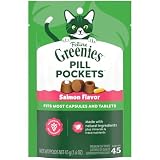
- Easy Treating: Feline Greenies Salmon Treats are easy to use cat pill pockets, just put the pill or capsule of your cat's medicine inside the moldable pocket, pinch closed until the pill is hidden, and share with your adult cat for a hassle-free treatment experience
- Cats are smart - but you're smarter: Treats for cats with delicious salmon flavor, this pill wrap for cats helps mask the taste of the medicine
- Feline Greenies Pill Pockets Delectable Cat Treats are the #1 vet recommended choice for giving pills
- Greenies Pill Pockets For Cats are made with all natural, real ingredients plus minerals & trace nutrients, with no artificial flavors, artificial preservatives, or fillers, so you can feel good about treating your pet daily with their routine medication
- Convenient Feline Greenies Pill Pockets: These cat snacks are a great-tasting treat for adult cats
Inhaled budesonide for asthma and chronic bronchitis
Galler and colleagues’ 2013 observational study followed cats with naturally occurring asthma or chronic bronchitis that had been prescribed 400 micrograms of inhaled budesonide twice daily. Of 43 owners contacted, 23 cats were still on treatment, and 19 continuing cats were re-evaluated. Owners of the continuing cats reported clinical improvement. HPA-axis suppression was found in 3 of the 15 cats that were tested. No clinical corticosteroid side effects were observed in the cats studied.
Crashes, No Sound, or Screen Glitches?
Random freezes, missing sound and display glitches usually trace back to one bad driver. Find and replace yours safely.Free scan · under a minuteWindows Errors? Fix Them Before They Spread
Repair common Windows errors and clear accumulated junk for a smoother, more stable PC - no reinstall needed.Free scan · no reinstallThe 400-microgram figure describes what was studied. It is not a recommendation for any cat, and it says nothing about oral dosing.
Dosage: why there is no standard cat dose
There is no single dose of budesonide that applies to cats. The correct amount depends on the diagnosis, the cat’s body weight and condition, the formulation, how the cat responds, and what other medicines the cat is taking. Published empirical suggestions in veterinary literature are a starting point for a clinician’s reasoning, not a self-dosing guide.
Rank #3

- Delicious Pill Wrap for Pets: Vetoquinol Pill Wrap features a flavorful paste designed for easily wrapping pills of any size or shape to turn medication time into stress-free daily pet care
- Easy-to-Swallow Paste: This shapeable pill paste conveniently wraps around any pill shape or size, creating a pocket-paste wrap treat option that stays moist and easy-to-swallow for daily use
- Great for Dogs & Cats: Vetoquinol Pill Wrap serves as tasty wrap treats for cats and dogs, providing an easy-to-use pill paste that fits seamlessly into daily pet care and pet training routines
- Shapeable Pill Paste: For best results, pinch off what you need from this oral paste container to cover pills completely, making it ideal for quick medication routines
- Everyday Health for Pets: Made with a commitment to transparency, rigorous review, and dependable standards, every product we create supports happier and healthier moments for your pet
The human budesonide delayed-release capsule label, which DailyMed lists in a revision dated April 2026, is written for human Crohn’s disease involving the ileum and/or ascending colon. Its dosing, duration and warnings are for people. It is useful for one purpose in this context: it shows that systemic corticosteroid effects, including hypercorticism and adrenal-axis suppression, are possible, and that CYP3A4 inhibitors can increase budesonide exposure. Those points are a reason to share a complete medication list with the veterinarian. They are not a feline dosing instruction.
Questions to ask the veterinarian before the first dose
- Is budesonide being prescribed for IBD, for airway disease, or for another reason, and what is the planned duration?
- Which exact product is being dispensed (capsule, tablet, or inhalant), and who compounded or manufactured it?
- How many milligrams or micrograms per dose, how often, and how should the dose change if the cat’s weight or response changes?
- Can the capsule or tablet be opened, split or mixed into food? VCA advises: “Do not open or crush the capsule or allow your pet to chew the capsule.” Confirm this for the specific product, since handling instructions can differ between formulations.
- What blood tests or check-ups are planned, and when?
- Are any current medicines or supplements a concern, including drugs that affect liver enzymes?
- Is there a plan for stopping, and what should be done if the cat misses doses?
Do not use leftover human capsules, a dose from another cat’s prescription, or a dose from a website, even if the symptoms look similar.
Side effects and safety monitoring
A medication described as acting mainly in the gut or lungs can still affect the whole body. VCA classifies budesonide as a systemic glucocorticoid, and it notes that effects can last longer in pets with liver or kidney disease. Because the cat’s organs may already be under stress, the veterinarian will weigh that risk before starting treatment.
Rank #4

- Easy Treating: Feline Greenies Salmon Treats are easy to use cat pill pockets, just put the pill or capsule of your cat's medicine inside the moldable pocket, pinch closed until the pill is hidden, and share with your adult cat for a hassle-free treatment experience
- Cats are smart - but you're smarter: Treats for cats with delicious salmon flavor, this pill wrap for cats helps mask the taste of the medicine
- Feline Greenies Pill Pockets Delectable Cat Treats are the #1 vet recommended choice for giving pills
- Greenies Pill Pockets For Cats are made with all natural, real ingredients plus minerals & trace nutrients, with no artificial flavors, artificial preservatives, or fillers, so you can feel good about treating your pet daily with their routine medication
- Convenient Feline Greenies Pill Pockets: These cat snacks are a great-tasting treat for adult cats
Corticosteroid effects to watch for
Cornell’s feline IBD overview says that cats receiving corticosteroids should be monitored closely, because diabetes and immune suppression are potential adverse effects. VCA’s feline IBD information lists the common early signs as increased drinking, increased urination and increased appetite. Longer-term concerns noted in that guidance include liver effects, diabetes risk and skin thinning. These are concerns for corticosteroids as a class. They do not mean every cat will experience them, and they are not proven to be unique to budesonide.
Adrenal suppression
The inhaled-use study shows that a steroid given for a localized problem can still suppress the adrenal axis. In that cohort, no clinical steroid side effects were seen, yet HPA-axis suppression was found in 3 of 15 tested cats. That study was of inhaled medication in a specific respiratory population, so it cannot be used to estimate the risk of oral therapy. It does show that “local” does not mean “no systemic effect.”
Metabolic effects
The 2025 abstract found documented hyperglycemia in a substantial share of cats in both groups, which argues against assuming that budesonide avoids metabolic effects. Because the study was retrospective and did not compare safety directly across all cats, it does not decide which drug is safer in a given patient.
The Tool Desk
Outbyte Driver Updater FREEScan for outdated or missing drivers - takes under a minuteDriver Scan →Outbyte PC Repair FREERepair Windows errors before they cause bigger problemsFix Now →Best Value

- Pill time can be your cat’s favorite activity when using masking paste to turn medicine into treats
- Moldable paste allows you to easily create a pocket to wrap and hide pills of any shape or size
- Bacon-flavored pill masker hides both taste and smell of capsules, wafers, tablets and liquid drops
- Pill masker won't crumble or dry out and is mess-free; can be used for medication, treats or training
- No more chasing your cat with medicine; your cat will come running to you for an irresistible treat
Do not stop or change the dose on your own
Stopping corticosteroids suddenly can be harmful, and VCA specifically advises against stopping budesonide abruptly unless the veterinarian instructs it. If the cat seems to be improving, the prescription still needs a plan from the veterinarian. Changes in dose, timing or form should be discussed first, even when the reason seems minor, such as a missed dose or a cat that refuses a capsule.
When to call the veterinary team
- A clear increase in drinking, urinating or appetite, especially if it develops over days.
- Vomiting, diarrhea, or a return of the original intestinal signs, such as weight loss.
- Weakness, lethargy, or a change in behavior.
- Labored breathing or coughing that is worse than before, for a cat on inhaled therapy.
- Suspected overdose, a cat that has chewed or eaten a capsule or inhaler, or any severe symptom. Call a veterinarian or an emergency veterinary clinic promptly. The sources reviewed for this article do not give a budesonide-specific emergency protocol, so the clinic’s advice should guide the next step.
How budesonide compares with prednisolone
Prednisolone is one of the most commonly used corticosteroids for feline IBD, and the 2025 abstract compared it directly with budesonide. The observed rates of owner-reported improvement were the same, and the rates of documented hyperglycemia were close. That result does not make either drug a clear first choice. The best option depends on the diagnosis, the cat’s other conditions, how easily the medicine can be given, and the veterinarian’s treatment goal. Cornell also notes that feline IBD care can include dietary changes and other medications, so steroid therapy is one part of a broader plan rather than the whole answer.
Quick Recap
Product prices and availability are accurate as of the date/time indicated and are subject to change. Any price and availability information displayed on Amazon at the time of purchase will apply.




