Box turtle breeding depends on the species and location. For eastern box turtles (Terrapene carolina), mating generally occurs from spring through fall, females commonly nest in May and June, and a typical clutch contains four or five eggs. Those figures are not a universal schedule for every box turtle: North American Terrapene and Asian Cuora differ, and incubation conditions and local laws matter.
How do box turtles mate?
Eastern box turtles generally mate from spring through fall. Smithsonian’s National Zoo and Conservation Biology Institute says they reach sexual maturity at around five years old; that is not a universal breeding-readiness threshold. The National Park Service notes that wild woodland box turtles may begin breeding later. Males may mate with more than one female, or mate with the same female more than once.
A fertile clutch does not establish that a female mated recently, or identify the male. Smithsonian reports that eastern box turtle females can store sperm for up to four years and may lay fertile eggs during that period without mating again. See the Smithsonian eastern box turtle account and the National Park Service woodland box turtle overview.
When do box turtles lay eggs, and how many?
For eastern box turtles, Smithsonian identifies May and June as the nesting period. Females dig a nest in sandy soil, lay eggs, and cover it. They usually lay four or five eggs, though the reported range is one to eleven. The National Park Service likewise describes woodland box turtles digging with their hind legs and laying several eggs, often four or five and as many as eleven.
Free tools Windows power users keep installed
One-click scans. No signup required.
#1 Best Overall

- Precise Temperature Control: It adopts advanced sensors and the temperature can be adjusted between 50-104°F, ensuring precise temperature control within ±37.4°F, which can provide a constant temperature incubation environment for small animal hatching.
- Humanized Design: The LED display shows the internal temperature in real-time, which is convenient for you to monitor at any time. In addition, the double-layered glass insulation layer not only gives you a clear view of the incubation process and effectively maintains temperature but also provides effective protection from harmful UV.
- Intelligent Design: Reptile egg incubators can intelligently adapt to seasonal changes. In winter or summer, when the indoor temperature is lower than or higher than the set cabinet temperature, the temperature can be manually adjusted.
- Large Capacity: It has a spacious large capacity of 6.08gal and has 3 removable metal shelves to create a 4-tier space, which can hatch multiple reptile eggs at the same time.
- High Safety: Multiple heat dissipation holes and a built-in cooling fan to ensure timely heat dissipation, not only extend the long service life of the machine but also improve the safety of use.
These are species-specific reports, not guarantees for every turtle or location. Nesting season and clutch size vary; do not apply the eastern box turtle calendar to Asian box turtles or assume every female will lay the same number.
How long do box turtle eggs take to hatch?
There is no single incubation duration for all box turtles. The California Turtle & Tortoise Club’s general guide for North American box turtles gives an approximate range of 50–90 days. By contrast, Smithsonian says Bourret’s box turtle eggs may take up to four months. These figures concern different taxa and contexts, so neither is a reliable promise for a particular clutch.
Rank #2
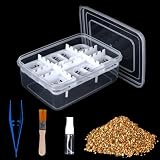
- 【Our reptile egg incubator has all-in-One Full Accessories Kit 】Our reptile breeding box comes with complete hatching supplies including natural vermiculite,tweezers, fixing clip and mini spray bottle(Please note the spray bottle is embedded in vermiculite because of the space constraint and our reptile egg hatchery box includes most accessories and customers do not need to buy extra accessories, meet all your reptile egg hatching needs at one time.(Please know that the vermiculite need to be mixed with water before using)
- 【Reptile incubator box for hatching eggs with 16 Independent Grid Design】The reptile hatching box is equipped with 16 separate individual compartments, which can isolate turtle eggs, lizard eggs, gecko eggs and snake eggs separately, effectively avoid egg extrusion and cross-infection, easy to manage and observe hatching progress one by one.
- 【 Premium Durable Plastic Material 】 Our reptile agama eggs breeder box is made of high-quality food-grade thickened plastic, drop-proof, crack-resistant and reusable, transparent design allows you to clearly view the internal humidity and egg status without opening the lid frequently.
- 【Humidity Control Easy Operation 】Our Crested gecko egg incubator hatcher is matched with dedicated spray bottle to easily adjust and maintain stable humidity, cooperate with vermiculite to create a constant moisture hatching environment, greatly improve the hatching rate of reptile eggs.
- 【Wide Compatibility & Multi-purpose】 Suitable for hatching tortoise, turtle, lizard, gecko, snake and other reptile eggs, lightweight and stackable design, easy to store and carry, ideal for pet breeders and hobbyists.
Wild nest conditions differ from artificial incubation, and development time depends on the species and conditions. Avoid moving or incubating eggs based on a timeline for another box turtle species. For a species-specific starting point, consult a qualified reptile veterinarian or experienced conservation breeder alongside the California Turtle & Tortoise Club’s Box Turtle Care guide.
What temperature should box turtle eggs be incubated at?
Incubation temperature can influence sex ratios in eastern box turtles, but these are tendencies, not guarantees. Smithsonian reports that eggs incubated at 22–27°C (70–80°F) are more likely to produce males, while eggs incubated above 28°C (82°F) are more likely to produce females. The National Park Service gives a similar pattern: males are more likely at 72–81°F and females above 82°F.
What’s actually slowing this PC down?
Pick the symptom - the matching free tool is one click away.
Rank #3

- SIZE: The reptile breeding box is 6.57"L x 4.84"W x 2.36"H, egg slot is 1.6"L x 0.8"W, 2 pack included
- MATERIAL: Made of high quality plastic, perdurable, reusable and washable. The whole box is transparent with a plastic egg tray inside
- DESIGN: 16-grids eggs tray design, you can also put the thermometer (not included) in it
- FEATURE: The box is highly transparent, making it easy to observe the hatching of the eggs. The egg tray in the incubator is suspended above, and the eggs do not touch the bottom matrix when placed on the egg tray, thereby increasing air circulation and improving the hatching rate
- APPLICATION: Designed to incubate the eggs of reptiles and amphibians, such as geckos, snakes, lizards, birds, turtles, etc
Do not choose an incubation temperature solely to produce a preferred sex. The figures describe eastern or woodland box turtle tendencies, not a universal protocol for all Terrapene or Cuora. A broad hobbyist recommendation is not a substitute for species-specific advice, stable monitoring, and appropriate care.
Artificial incubation: general keeper guidance
The California Turtle & Tortoise Club says artificial incubation is possible. Its general North American Terrapene guidance gives about 80°F (27°C) and about 80% humidity as broad starting figures, and names moistened vermiculite, sphagnum moss, and damp paper towels as substrate options. These are specialist club recommendations, not veterinary instructions or a species-specific recipe for every clutch. Use a suitable incubator and reliable temperature monitoring only with expert guidance appropriate to the species.
Rank #4

- Precise Temperature Control:Achieve precise temperature control with our digital temperature control feature. The incubator allows you to adjust the temperature from 5°C to 60°C (36-140°F), creating an ideal incubation environment for various applications.
- Led Display:The bright LED digital display shows the current temperature inside the chamber, ensuring easy monitoring and accurate temperature readings.
- Spacious Yet Portable:With a generous 25L chamber volume, our incubator provides ample space for your needs. Additionally, the built-in handle makes it convenient and effortless to move the incubator, allowing for flexibility and portability.
- Convenient And Durable:The power switch is conveniently located on the incubator itself, giving you easy access for turning it on or off during incubation. The visible PVC door allows you to observe the incubation conditions without disturbing the process, ensuring convenience and efficiency.
- Versatile Usage:Our incubator is not limited to reptiles and amphibians. It is a versatile solution suitable for various applications. It can be used for transporting animals that require a constant temperature. Additionally, it is suitable for incubating poultry eggs such as chickens, ducks, geese, and pigeons.
- Handle eggs carefully and do not shake, rotate, or turn them. The Club’s egg incubation guide also emphasizes not turning eggs and maintaining appropriate, stable temperature and humidity.
- Do not treat a single temperature or humidity setting as right for every box turtle. Confirm species and local expert guidance before setting up artificial incubation.
- Do not assume the presence of eggs means artificial incubation is necessary; avoid disturbing a wild nest.
What should you expect when box turtle eggs hatch?
Pipping—the first break in the shell—may occur several days before a hatchling fully emerges, according to the California Turtle & Tortoise Club. Its general keeper guidance is to minimize intervention while the hatchling emerges and avoid rupturing an attached yolk sac. Allow time for the yolk sac to be absorbed before moving the hatchling. The guide also identifies dehydration as a concern and describes a moist setup option.
These are general husbandry points, not medical treatment. Contact a reptile veterinarian for a difficult hatch, illness, or concerns about a retained or injured yolk sac rather than attempting a procedure yourself.
Best Value

- Reptile incubator made of food grade materials do not release harmful substances.
- It is a perfect hatching box with high transparent outlook, you can observe the different periods change of the reptiles eggs.
- A variety of substrates can be used depending on your preferences.easy to clean.
- The egg tray is great for incubating eggs from smaller reptiles, gecko, lizards, lions mane,etc.
- Size:7 *5.1*2 in (L*W*H), egg slot 1.57*0.8 in (L*W), you can put 14 egg.
Legal and conservation considerations before breeding
Check your local wildlife rules before acquiring, breeding, transporting, or keeping a box turtle. Regulations vary by jurisdiction: Indiana, for example, requires a permit to care for captive specimens, according to the Indiana Department of Natural Resources. That requirement should not be assumed to apply elsewhere; consult the wildlife agency where you live.
Do not collect adults, eggs, or hatchlings from the wild. The National Park Service lists habitat loss and fragmentation, vehicle strikes, climate change, and illegal collection among threats to woodland box turtles. Prefer captive-bred animals only where lawful, and never release a captive turtle without direction from the relevant wildlife agency.
Breeding should not be treated as a casual project. Smithsonian’s account of Bourret’s box turtles describes the zoo’s first successful hatchlings in 2017 after earlier unsuccessful egg development and a managed cooling period. That is a species-specific zoo example, not a home incubation protocol. Read the Smithsonian account of Bourret’s and other Asian box turtles for its context.
Quick Recap
Product prices and availability are accurate as of the date/time indicated and are subject to change. Any price and availability information displayed on Amazon at the time of purchase will apply.
Do these 3 things before closing this tab:
1Scan for outdated or missing drivers - takes under a minute2Repair Windows errors before they cause bigger problems3Fix the driver behind crashes, sound loss and screen glitches



