Anubias barteri var. nana (Anubias nana) is the best all-purpose semi-aquatic plant for most aquariums. It tolerates a wide pH range, low light and either submerged or emersed growth. Keep its rhizome and roots wet, attach the rhizome to wood or rock, and leave the rhizome uncovered. Choose Java fern when you want taller foliage; use scarlet temple, Bucephalandra, Bolbitis or suitable Cryptocoryne for more specialized humid transition zones.
What “semi-aquatic” means in an aquarium
A semi-aquatic aquarium plant can grow with some or all leaves above the water while its roots, rhizome or growing medium remains wet. This is different from simply floating a fully aquatic plant. Successful emersed growth depends on a humid transition zone, reliable water access and a gradual change between submerged and above-water conditions.
In a standard aquarium, these plants work around the waterline, on hardscape that breaks the surface, or in a paludarium and Wabi-Kusa-style layout. A lid, splash zone or gentle waterfall can help prevent leaves from drying.
Best semi-aquatic aquarium plants compared
| Plant | Best use | Light and growth | How to plant or attach | Main caution |
|---|---|---|---|---|
| Anubias barteri var. nana | Low-light foreground to midground; rhizome displayed above or below water | Partial shade; slow-growing and hardy | Attach the rhizome to rock or driftwood | Never bury the rhizome; it may rot |
| Java fern (Microsorum pteropus) | Taller midground or background foliage | Low to medium-high light; slow growth | Secure to driftwood or porous rock | Very high light can burn or melt leaves |
| Scarlet temple (Alternanthera reineckii) | Red accent in a humid paludarium or emersed section | Needs stronger light and dependable moisture than Anubias | Grow in moist medium or a humid container with water access | Less forgiving if humidity or moisture fluctuates |
| Bucephalandra or Bolbitis | Fine-textured epiphytes for splash zones and Wabi-Kusa layouts | Keep roots and attachment material continuously moist | Attach to a moist mat, wood or other hardscape | Leaves can dehydrate quickly in dry air |
| Cryptocoryne and other rooted aquatic plants | Substrate-planted transition areas | Varies by species and cultivar | Root in fine gravel, sand or a suitable aquatic substrate | Not every cultivar tolerates prolonged emersed display |
Compare candidates by light tolerance, growth rate, mature size, humidity needs, attachment versus substrate rooting, fish palatability and whether the plant is sold pre-attached. No universal trial establishes one ranking for every aquarium, so the choices above are care-based recommendations.
What’s actually slowing this PC down?
Pick the symptom - the matching free tool is one click away.
#1 Best Overall

- WHAT YOU GET - 3 Plants Of Our Choosingx Varies. Every plant is greenhouse-grown in our Texas facility and inspected before shipping.
- EASY CARE - Beginner difficulty level, thrives in low | med | high light, temperature range Tropical, no CO2 injection required. Perfect for beginners and experienced aquarists alike.
- VERSATILE PLACEMENT - Ideal for mid ground | centerpiece positioning in your aquarium. Works beautifully in planted tanks, community tanks, shrimp tanks, and breeding setups.
- SHIPPED WITH CARE: Each plant is carefully packaged using insulated materials and heat/cold packs (when needed) to ensure safe transit. Our proven packing method protects plants during shipping so they arrive in the best possible condition, ready to thrive in your aquarium
- GREENHOUSE GROWN IN TEXAS - Canton Aquatics is a family-run nursery in Terrell, TX. Every plant is grown on-site in our greenhouse -, .
1. Anubias nana: the safest beginner choice
Singapore’s National Parks Board describes Anubias barteri var. nana as a slow-growing, hardy aquarium plant that can be grown submerged or emersed. Its listed preferred water temperature is 22–26°C and its pH tolerance is 5.5–8.0. The record recommends partial shade and states that additional fertilisation is not required.
How to use it
- Tie or glue the rhizome to driftwood or rock until it anchors.
- Keep the rhizome completely above the substrate; roots may enter the substrate, but the horizontal rhizome must remain exposed.
- For emersed growth, keep the roots or attachment mat wet and maintain high humidity around the leaves.
- Place it in the foreground or midground of a 20–50 gallon aquarium, as listed by Aqueon.
Its slow growth rewards patience rather than frequent trimming. It is the strongest default where low light, simple maintenance and a forgiving plant matter most.
Rank #2

- Natural Filtration: Helps control nitrates and ammonia levels in your water environment
- Shade and Shelter: Protects fish and reduces water evaporation
- Fast Growth: Quickly covers surface areas for enhanced water coverage
- Low Maintenance: No planting required; simply float and allow to grow naturally
- Package Contents: Healthy greenhouse grown Water Hyacinth, carefully packaged for safe arrival, not collected from the wild
2. Java fern: taller foliage with low-maintenance care
Java fern (Microsorum pteropus) is suited to the midground or background, especially when Anubias nana would look too short. Aqueon recommends securing it to driftwood or porous rock. Aquarium Co-Op reports that low through medium-high light can work, while very high light may burn or melt the plant. Tropica lists Narrow, Trident and Windeløv forms as easy, undemanding choices.
Why fishkeepers choose it
Its thick leaves are generally left alone by fish. Aquarium Co-Op notes that most fish do not like Java fern’s taste, so even many plant-eating fish do not consume it. Growth remains slow and steady, whether submerged or grown in a humid emersed setup.
Rank #3

- IMPORTANT: Please note that during times of extreme weather, live plants will can suffer due to extreme temps. During winter, do not order live plants when temperatures are expected to go below 30F at the lowest point during the day.
- LIVE AQUARIUM PLANT - 6 Jungle Val aquatic plants perfect beginner plants very easy to grow
- LIVE ARRIVAL - We stand behind live arrival on all of our livestock provided you don't order when temperatures are expected to go below 30F at the lowest point during the day. If a plant ever arrives dead send us a clear photo of the plant in the unopened bag and and we will replace once verified.
- We do our very best to respond fast and ship happy, healthy plants. If you have any questions or concerns please message us we are always happy to help!
- Jungle val plants are easy to grow and are quite robust. Please keep in mind they tend to melt back a fair amount initially when transplanted so expect that. It's best to trim the tops and then plant as normal when you receive them.
Placement rule
Use Java fern behind Anubias or on a raised branch of hardscape. Keep the rhizome exposed and avoid burying it in gravel or sand.
3. Scarlet temple: a red accent for humid setups
Scarlet temple (Alternanthera reineckii) can provide red color above the waterline, but it is a more demanding choice than Anubias or Java fern. Aquarium Co-Op describes it thriving out of water in a humid container when water remains accessible.
Rank #4
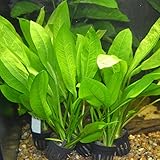
- Echinodorus bleheri from South America is undemanding and beautiful, and becomes 20-50 cm tall.
- A nutritious bottom promotes growth, but the plant needs pruning to prevent it depriving plants underneath of light.
- Echinodorus bleheri does well even in poorly illuminated aquariums, as it grows towards the light. It is a hardy and easy solitary plant for both beginners and the more experienced with quite large aquariums. It has been sold under the name "Paniculatus".
Conditions it needs
- A consistently humid enclosure, covered container or paludarium section.
- Moist growing medium or roots that can reach water.
- More accessible light than a shade-tolerant Anubias, without allowing the plant to dry out.
Choose it when color is a priority and you can control humidity; do not treat it as a carefree open-air houseplant.
4. Bucephalandra and Bolbitis for textured transition zones
Bucephalandra and Bolbitis are useful epiphytes for splash zones, moist mats and Wabi-Kusa layouts. Their roots or attachment material should stay damp, while leaves are held in humid air. They suit aquascapes where a small waterfall, filter return or frequent misting keeps the hardscape wet.
Quick wins for a faster PC:
Repair Windows errors before they cause bigger problemsFix Now →Scan for outdated or missing drivers - takes under a minuteDriver Scan →Best Value

- 🍀Ideal Aquarium Decor🍀 - This aquarium plant holder is perfect for growing fully aquatic as well as semi-aquatic plants in your aquarium, it not only decorates your aquarium but also prevents fish from eating the plant roots.
- 🍀Unique Designs🍀 - There are many slits and holes around and at the bottom of the holder to ensure that water can flow through the roots of aquatic plants, thus creating good water circulation. If your aquatic plants are newborn or small, you can put some pebbles or fine gravel at the bottom of the holder to keep them stable, which works better for aquatic plants that like to bury their roots.
- 🍀For All Your Needs🍀 - This aquarium plant holder is uniquely designed and easy to use. It can be used in two ways, it can be hung stably on the glass edge of various aquariums (aquarium edge thickness is less than 1.57 inch / 4 cm) or it can be attached to the aquarium glass by mounting suction cups. It is perfect for pothos, bamboo, lotus, daffodils, water poppies and more semi- or fully aquatic plants.
- 🍀Safety and High Quality🍀 - This aquarium plant holder is made of High quality PP plastic, strong and durable, corrosion resistant, high temperature resistant, non-toxic and odorless, can provide a safe and healthy living environment for fish and plants, suitable for rimmed aquariums and rimless aquariums.
- 🍀Product Size🍀 - Aquarium plant holder size: 3.54 x 3.54 x 3.94 inches. Complete with 6 hooks: there are 3 sizes (0.4/0.8/1.57 inches) 2 of each size. Also comes with 2 suction cups: 1.18 x 0.43 inches. Product weight: 1 ounce.
Attachment method
Secure the plant to a moist mat, porous rock or wood rather than burying an epiphytic rhizome. Check daily that the attachment area has not dried, especially during the first weeks.
Independent reader supportYour contribution helps us test, update, and keep practical guides available for everyone.5. Cryptocoryne and other rooted aquatic plants
Cryptocoryne and similar rooted aquatic plants can form a natural substrate-planted transition between underwater and above-water sections. Plant them in fine gravel, sand or another suitable substrate so roots remain stable.
Emersed performance varies substantially among species and cultivars. If a particular Cryptocoryne is not documented for prolonged emersed growth, keep the crown and surrounding medium consistently moist and watch for declining leaves rather than assuming every form will adapt equally.
How to establish emersed growth
- Build a wet transition. Keep leaves above the waterline while roots, rhizomes or a Wabi-Kusa mat remain wet. A lid or enclosed paludarium helps hold humidity.
- Attach epiphytes correctly. Use moist moss or a Wabi-Kusa mat for Anubias and Microsorum, following Aqua Design Amano’s emersed-setup guidance.
- Prevent dehydration. ADA states that daily water misting is essential for maintaining emersed leaves. Mist often enough that the leaves and attachment medium do not dry between checks.
- Allow rooting time. ADA reports that rooting can take about 1–2 weeks, depending on species. Keep the plant stable during this period.
- Acclimate gradually. Farm-grown emersed plants and submerged-grown plants may change leaf form when moved between environments. Increase air exposure and light slowly rather than making an abrupt transition.
- Monitor the waterline. Keep the roots or rhizome wet but do not let stagnant water collect around a buried rhizome. Improve circulation if the transition area smells sour or develops rot.
Lighting and placement in a regular aquarium
Anubias nana is the better low-light default. Java fern accepts low to medium-high light, but excessive intensity can burn or melt it. Petco’s 2016 aquatic plant care sheet emphasizes that good aquarium lighting is essential to plant survival; “low light” does not mean no light.
For 20–50 gallon tanks
- Foreground to midground: Anubias nana.
- Midground to background: Java fern.
- Surface-breaking hardscape: Bucephalandra or Bolbitis in a continuously damp splash zone.
- Humid paludarium section: Scarlet temple or a tested Cryptocoryne cultivar.
Keep slow-growing plants out of the strongest beam if algae becomes persistent, and avoid placing emersed leaves where an uncovered tank’s room air can dry them.
Quick Recap
Common mistakes and quick fixes
- Burying an Anubias or Java fern rhizome: Remove substrate from the rhizome and reattach it to hardscape.
- Letting emersed roots dry: Add a lid, deeper water contact, moist moss or more frequent misting.
- Using very high light on Java fern: Reduce intensity or add shade from taller plants and hardscape.
- Moving plants abruptly between submerged and emersed conditions: Increase humidity and exposure in stages, accepting that old leaves may change or be replaced.
- Choosing by appearance alone: Check mature height, light, humidity, rooting method and fish compatibility before buying.
Which plant should you choose?
- Choose Anubias nana for the most forgiving low-light, low-maintenance option.
- Choose Java fern for taller leaves and good resistance to fish grazing.
- Choose scarlet temple when you can maintain high humidity and want a red accent.
- Choose Bucephalandra or Bolbitis for small, textured epiphytes in splash zones.
- Choose Cryptocoryne when you need rooted plants in a moist substrate transition and can verify the cultivar’s emersed suitability.
Product prices and availability are accurate as of the date/time indicated and are subject to change. Any price and availability information displayed on Amazon at the time of purchase will apply.




