
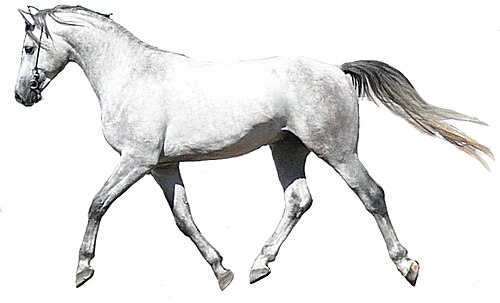
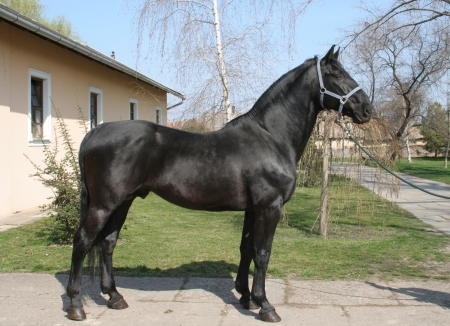
 Photo: Véronique Mestre Gibaud · CC BY-SA 3.0
horse breed · 671 on Animalso
Shagya Arabian Horse Breed
- Animal
- Horse
- Origin
- Hungary
The Shagya Arabian is a horse breed from Hungary. It was developed during the 19th century at five studs in the Austro-Hungarian Empire. Its recorded bloodlines trace to the stud books of Rădăuți, Babolna, and Topolcianky. The breed is now bred in Hungary and many other countries.
What the Shagya Arabian is
The Shagya Arabian is a horse breed that originated in Hungary. It developed during the 19th century in the Austro-Hungarian Empire at the Bábolna, Mezőhegyes, Radautz, Piber, and Topolcianky studs.
Where it began
Its foundation is tied to the stud network of the Austro-Hungarian Empire. Today, the breed is most often seen in the Czech Republic, Austria, Romania, former Yugoslavian countries, Poland, Germany, and Hungary. See horse breeds from Hungary.
Documented lineage
A purebred Shagya Arabian can trace every line of its bloodline to the stud books of Rădăuți, Babolna, and Topolcianky. The breed has also been exported and is bred around the world.
Points to understand
The breed’s classification is debated. Some people regard it as a subtype of Arabian horse, while others classify it as an Anglo-Arabian or a partbred Arabian because it includes a small amount of non-Arabian breeding.
Pricing
No purchase price or other cost is provided for this breed.
Who should look elsewhere
This profile does not establish a specific owner type, riding role, or use for the Shagya Arabian. Readers seeking breeds with recorded size, lifespan, or purpose should compare other entries in horse breeds.
Verdict
The Shagya Arabian has a clearly documented Hungarian origin and a stud-book lineage connected to three historic institutions. Its identity remains open to more than one classification because of limited non-Arabian breeding.
What stands out
- Developed at five named studs in the 19th-century Austro-Hungarian Empire.
- Bloodlines trace to the Rădăuți, Babolna, and Topolcianky stud books.
- Bred in Hungary and exported to countries around the world.
Worth knowing
- Its classification is debated among Arabian and Anglo-Arabian groupings.
- The breed includes a small amount of non-Arabian breeding.
- No height, weight, lifespan, or breeding purpose is recorded here.
Suits
- Readers tracing the origins of Hungarian horse breeds
- People comparing documented Arabian-related lineages
Think twice if
- You need recorded height, weight, lifespan, or working purpose before choosing a breed.
- You want a breed whose classification is not debated.
In short
The Shagya Arabian is a historically traceable breed with roots in Hungary’s imperial stud system. Its bloodlines connect to Rădăuți, Babolna, and Topolcianky, and its breeding now extends well beyond Europe. The main point to keep in mind is classification: references may place it within Arabian horses, Anglo-Arabians, or partbred Arabians. The available record does not establish its size, lifespan, or working role.
Questions
Where did the Shagya Arabian originate?
It originated in Hungary and was developed in the Austro-Hungarian Empire during the 19th century.
Which studs developed the Shagya Arabian?
Development took place at the Bábolna, Mezőhegyes, Radautz, Piber, and Topolcianky studs.
Where is the Shagya Arabian found today?
It is most often seen in the Czech Republic, Austria, Romania, former Yugoslavian countries, Poland, Germany, and Hungary, and it is bred elsewhere too.
What do its purebred bloodlines trace to?
All lines of a purebred Shagya Arabian trace to the stud books of Rădăuți, Babolna, and Topolcianky.
Is the Shagya Arabian an Arabian horse?
Some classify it as a subtype of Arabian horse. Others call it an Anglo-Arabian or partbred Arabian because of a small amount of non-Arabian breeding.
What are its height, weight, and lifespan?
Those measurements and lifespan figures are not provided in this profile.
More horse breeds from Hungary
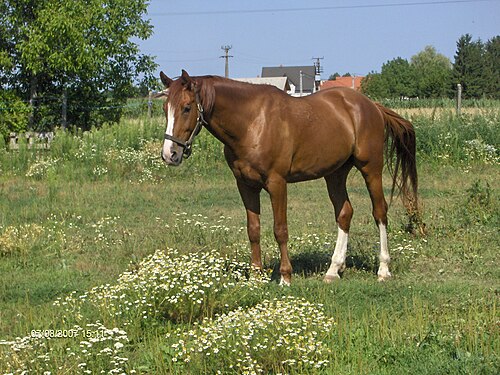 Gidran Hungary Photo: Siheder · CC BY-SA 3.0
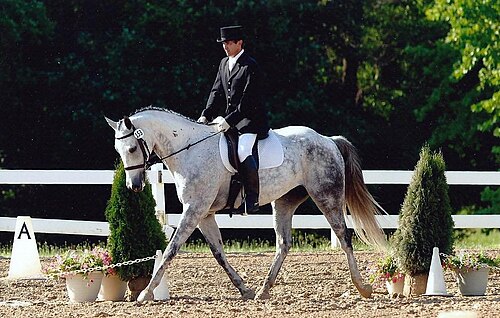
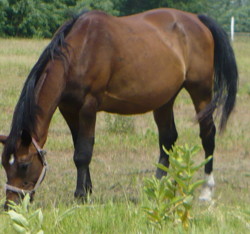 Kisber Felver Hungary Photo: én · CC BY-SA 4.0
 Nonius horse Hungary Weight 550 kg Photo: Tommy lieven · Public domain
Photo credits5 photographs on this page
- Shagya Arabian — Véronique Mestre Gibaud · CC BY-SA 3.0 · file page
- Gidran — Siheder · CC BY-SA 3.0 · file page
- Hungarian Sport Horse — Joe Haupt · CC BY-SA 2.0 · file page
- Kisber Felver — én · CC BY-SA 4.0 · file page
- Nonius horse — Tommy lieven · Public domain · file page
Photographs come from Wikimedia Commons under the licence each one names. How Animalso credits photographs.