Quick wins for a faster PC:
Repair Windows errors before they cause bigger problemsFix Now →Fix the driver behind crashes, sound loss and screen glitchesFind Drivers →Usually, no. A fishing license issued by one state is not a nationwide permit. You normally need the destination state’s license unless that state has a narrowly written reciprocity agreement for the exact border water where you will fish. Those agreements can limit the species, season, gear, access method, license type, age eligibility, and even which side of the boundary controls.
Before leaving, identify the precise water and fishing location, then verify the current rules with both state agencies. A “border river” or “shared lake” is not specific enough to establish permission.
Does my fishing license work across state lines?
There is no general all-state fishing license identified by the official guidance reviewed. An out-of-state license is not universally valid: Florida, for example, expressly says that out-of-state fishing licenses are not valid there. Treat every reciprocal privilege as a defined exception, not as a portable license.
Even when another state recognizes your license, that recognition may apply only to a named stretch of river, a particular lake section, a channel, or other described boundary water. It may not extend to tributaries, backwaters, nearby shorelines, or the rest of either state.
#1 Best Overall

- Enough to Use: you will receive 6 pieces of fishing license holders, and 6 pieces of safety pins, abundant in quantity, enough for you to choose and replace, can meet your different needs; You can also share them with your friends
- Long Time Use: the license holder is made of PVC material, sturdy and reliable, the decorative safety pins are made of stainless steel material, with smooth surfaces, solid and strong, not easy to bend or deform, can be applied for a long time
- Effective Protection: the hunting license holder is designed with waterproof zipper, can be put into your hunting and fishing licenses, providing them with nice protection, convenient and practical
- Bright Color Design: the waterproof fishing license holder mainly adopts fluorescent orange design, bright and stylish, so that you can find it easily, and don't worry about losing it easily, giving you a nice using experience
- Wide Range of Applications: the waterproof hunting license holder can be applied with the pins, making it easy to fasten, you can fasten it on your bag, jacket, sweater, skirt and more, making it easy to get your license out
When can one license cover fishing in another state?
Named reciprocal waters
States sometimes agree to recognize each other’s licenses on shared rivers, reservoirs, lakes, bays, or marine boundary waters. The legal text normally identifies the water and sets conditions. Louisiana and Texas, for instance, describe a reciprocal arrangement for certain named common border waters rather than for all waters in either state.
Eligibility and access conditions
Read the agreement for resident or nonresident status, license class, age exemptions, fishing method, and whether it covers bank fishing, boat fishing, or both. An exception that applies to an adjacent-state resident may not apply to a visitor from a third state.
Rank #2
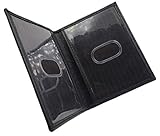
- Slim Bifold ID Holder made with Cowhide Leather
- Compact Design - Approximately 4.10 IN x 3.10 IN (Closed)
- Stylish & Functional - 2 Clear ID Windows with Easy Remove Center Cut Out
Location-specific control
Your position can change the answer. Rules may differ between the main channel and a tributary or backwater, and some arrangements address where a fish is landed. Texas states that all fish landed in Texas must meet Texas bag and length limits, even in a border-water context.
Examples that show why a blanket answer is unsafe
| Place or arrangement | What the official guidance says | Practical implication |
|---|---|---|
| Florida | Nonresidents aged 16 or older generally need Florida licenses and permits for freshwater or saltwater fishing; out-of-state fishing licenses are not valid in Florida. Catch-and-release anglers need a license when they attempt to take fish. | Do not assume a home-state license substitutes for a Florida license, even for release fishing. |
| Texas–Louisiana border waters | Reciprocity covers certain named common border waters, with conditions and exceptions. Texas separately requires fish landed in Texas to comply with Texas bag and length limits. | The arrangement does not authorize fishing throughout Texas or Louisiana. Confirm the named water, location, and landing rules. |
| Missouri shared waters | Missouri lists particular adjoining-state waters and distinguishes flowing water from backwaters and tributaries. Anglers are responsible for knowing which state they are in and the rules for those waters. | A map, channel, or shoreline detail can determine which license and regulations apply. |
| Minnesota boundary waters | Adjacent-state residents need a valid resident license from that state or another legal authorization for boundary waters. Nonadjacent residents may use a valid Minnesota or adjacent-state nonresident license, subject to the stated rules. More liberal regulations can be used only in the relevant state’s territorial waters. | Having a qualifying license does not let you carry the more generous limits across the boundary. |
| Delaware and federal ocean waters | Delaware’s FAQ says it has no reciprocity agreement with another state and says no Delaware license is needed when fishing exclusively in federal ocean waters beyond Delaware’s three-mile limit, unless a line is dropped inside that limit. | This is Delaware’s specific answer, not a nationwide coastal rule. Crossing into state waters can change the license requirement. |
| New York marine boundary waters | New York law provides reciprocal treatment only for specifically described portions of shared waters when its conditions are met, including named waters involving Connecticut, New Jersey, and Rhode Island. | Read the statutory boundary description rather than relying on a general “neighboring states” assumption. |
Do fishing regulations travel with the license?
No. A reciprocal license privilege does not automatically transfer seasons, species restrictions, size limits, bag limits, gear rules, or location rules. The controlling regulations can depend on the state’s territorial waters and where the fish is landed.
Rank #3

- Built For The Catch: Meet Jack’s Bass Double ID Bifold Wallet — built for the man who appreciates craftsmanship, functionality and a little time on the water. Handcrafted from full-grain, hand-burnished leather, this men’s bifold wallet features a striking embossed bass graphic and rugged detail that sets it apart. The double ID flip-out design offers quick access for those who carry multiple forms of identification. Classic, durable, and ready for the long haul — built to last, built for the catch.
- BIFOLD FEATURES: The Bass Double ID Bifold Wallet delivers organized storage with 10 card slots—8 interior slides, 2 hidden storage pockets, and a bill compartment. The flip-out dual ID window is perfect for guys who carry a driver’s license, work, military, or fishing ID, with thumbhole cut-outs for easy removal. Inside, the tan canvas lining features Jack’s signature “fish on” message — a reel catch for the guy who lives to fish. DIMENSIONS: 4.25″ L × 3.5″ H
- QUALITY LEATHER: Handcrafted from premium full-grain hides sourced from Leather Working Group (LWG)–certified tanneries, every House of Jack Co. wallet reflects a commitment to responsible leather production without sacrificing quality. Over time, the leather develops a rich, natural patina—a signature of authenticity and craftsmanship. Subtle variations in color and grain make each wallet truly one of a kind. Simply put, the more you carry it, the better it gets!
- ELEVATE your gift-giving experience with a House of Jack Co. wallet—thoughtfully packaged in our signature gift box for an unforgettable presentation. Each wallet arrives in a branded drawstring pouch, ready to gift and ready to impress. Gift-giving made easy!
- FOUNDED in 2014, House of Jack Co. was inspired by the original Jack—an all-American dreamer, doer, and thinker. What began as one man’s vision to create a “guy’s guy” wallet brand has grown into a small family business built on craftsmanship, integrity, and hard work—values deeply rooted in his small-town upbringing. Dare to be different with your next House of Jack Co. wallet.
- Confirm the open season for each target species.
- Check minimum and maximum lengths and daily or possession limits.
- Verify permitted hooks, lines, nets, bait, and other gear.
- Determine whether the rule changes between a main channel, tributary, backwater, or shoreline.
- Follow any landing-state requirements, such as Texas limits for fish landed in Texas.
Is the federal saltwater registry a multistate license?
No. NOAA explains that a qualifying saltwater license or registration can automatically enroll an angler in the National Saltwater Angler Registry, subject to listed territory exceptions. Registry enrollment is an administrative record, not permission to fish wherever you choose.
NOAA directs anglers fishing in state waters to the relevant state agency for license information. NOAA describes state waters generally as extending zero to three nautical miles offshore, but boundaries and licensing treatment can vary by context. Federal species or offshore permits may also apply, so verify the species and exact location with the responsible authority.
Rank #4

- FISHING LICENSE HOLDER W/ZIP CLOSURE
How to verify a planned multi-state fishing trip
- Identify the issuing and destination states. Note whether your license is resident or nonresident, its category, and any age-based status.
- Name the exact water. Record the lake, river reach, bay, channel, or reservoir—not merely the state border.
- Pinpoint your position. Determine the side of the boundary, whether you will fish from shore or a boat, and whether the area is a tributary or backwater.
- Read both agencies’ official rules. Look for reciprocity, border-water, or shared-water provisions and every eligibility condition.
- Match the regulations to the location. Check seasons, species, size and bag limits, gear, and fish-landing requirements for the waters you will use.
- Check saltwater and federal requirements. Establish whether you are in state or federal waters and whether a separate registration or federal species permit is required.
- Carry proof. Save the license and the official rule page, and recheck requirements shortly before departure because agreements and boundaries can change.
Should you buy a nonresident license or rely on reciprocity?
Use a comparison based on the actual trip rather than convenience alone.
| Question | Why it matters |
|---|---|
| Exact water and boundary location | Reciprocity may cover only a defined segment or side. |
| Resident status and license type | An agreement may exclude nonresidents, certain license classes, or particular methods. |
| Age and exemptions | Minimum ages and exceptions differ by state and arrangement. |
| Boat, bank, or both | The privilege may be limited to one access method. |
| Seasons, species, and limits | Recognition of a license does not harmonize biological regulations. |
| Cost and duration | Compare the current official fee and validity period with the risk of an incorrect assumption. |
| Saltwater registration or federal permit | A state license or reciprocity provision may not satisfy separate federal requirements. |
If the agency language is ambiguous, buying the destination state’s license and following its rules is generally safer than interpreting a broad privilege from a map or an informal explanation. When in doubt, contact the agency responsible for the exact water before fishing.
What’s actually slowing this PC down?
Pick the symptom - the matching free tool is one click away.
Best Value

- 3 Pack - Fluorescent Orange Hunting & Fishing License Holder is perfect for all hunters, hunt clubs, gun shops, ranges, wildlife management areas, taxidermists, sporting goods stores, anglers, boaters, hikers & sports enthusiasts.
- Made with a clear waterproof & dustproof zip to keep out moisture. All you have to do is press the front and back together and the zip snaps closed. The zip will keep your license, hunting tag, money, notes & pictures dry. Do not submerge for long periods of time.
- Includes THREE - 8" zip ties so you can attached it to a belt, backpack, tackle box, deer hoove, deer antler or anything else.
- Comes with 1 pre-punched hole on top to allow a rope, lanyard or clip to attach to anything you have.
- Interior Dimensions - 2 7/8" x 4 3/4" - Can fit most states hunting tags and fishing licenses. If it does not fit your states license you can easily fold it to fit in the clear front window.
What happens if you fish under the wrong license?
Reciprocity is a legal exception with conditions. Fishing outside its named water, using an ineligible license, crossing into a noncovered tributary, or violating the controlling limits can leave you unlicensed or in violation of fishing regulations. Keep the official rule text with your license so you can demonstrate the basis for your interpretation, but rely on the agency’s current wording—not an old screenshot or a general statement about neighboring states.
Quick Recap
Product prices and availability are accurate as of the date/time indicated and are subject to change. Any price and availability information displayed on Amazon at the time of purchase will apply.




