Neither farmed nor wild fish is automatically better. Both can provide useful nutrients; the better choice depends on the species, where it came from, how it was produced, and what matters most to you—such as mercury exposure or environmental impact.
Are farmed or wild fish more nutritious?
The FDA says both aquacultured and wild-caught seafood can be part of a healthy, well-balanced diet. Both can provide low-fat protein, omega-3 fatty acids, vitamins, and minerals. That does not mean every farmed fish and its wild counterpart have identical nutrient profiles: a fair comparison needs to match the species, cut, and source.
So, a general claim that wild fish always has more omega-3s—or that farmed fish is always less nutritious—goes beyond what this comparison establishes. Compare specific products if nutrition is the deciding factor.
Is one safer to eat?
For seafood sold in the United States, FDA says domestic and imported aquacultured seafood is subject to the same food-safety standards and regulatory requirements as wild-caught seafood. The agency also regulates animal drugs used in farmed seafood: only FDA-approved drugs may be administered, and withdrawal periods and testing help ensure residues comply with established tolerances. These are descriptions of the U.S. regulatory framework, not a guarantee about every individual fish or enforcement in every country.
#1 Best Overall
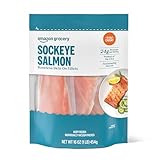
- WHAT'S INSIDE: 1-pound resealable bag of frozen sockeye salmon boneless, skin-on fillet portions
- WHY YOU’LL LOVE IT: This flavorful, deep red-hued salmon is perfect for grilling, baking, broiling, or pan-frying.
- SUSTAINABLY SOURCED: Wild caught and locally sourced in the pristine waters of Bristol Bay, Alaska
- HIGH QUALITY, LOW PRICES: Amazon Fresh brand family of products are all about high-quality food that fits every budget, every day.
- ONLY FROM AMAZON: Look for the Amazon Fresh label to find great deals on a wide selection of grocery essentials.
Mercury advice is based on the type of fish, not a blanket distinction between farmed and wild. Nearly all fish contain at least trace amounts of methylmercury, but levels vary by species; larger, longer-lived fish that eat other fish tend to accumulate more. People who are or may become pregnant, breastfeeding people, and caregivers choosing fish for children ages 1–11 should follow the current FDA/EPA fish advice chart and choose a variety from its lower-mercury “Best Choices” category.
For fish caught recreationally, check state or local advisories for the specific water body. Contaminants can vary by location, so advice for one lake or river may not apply to another.
Rank #2

- 1-pound resealable bag of pink salmon skinless fillet portions, individually vacuum sealed
- Wild Caught
- Sustainably Sourced: Certified by the Marine Stewardship Council
- Phosphate Free
- Pink Salmon has a delicate flavor and is lower in fat than most other types of salmon on average.
Which is more sustainable?
“Farmed” and “wild” describe how fish are produced; neither word alone tells you the environmental impact. Farms differ by species, location, and production system, while wild fisheries differ in their management and conditions. A useful sustainability judgment needs a current assessment of the particular farm or fishery—not a broad ranking of all aquaculture against all wild fishing.
Seafood Watch’s 2024 public-comment version of its aquaculture standard describes assessment at the farm and production-system level. It supports comparing specific systems, but it is not a consumer rating for any named fish or farm. Look for an up-to-date, source-specific assessment before treating a particular product as the more sustainable choice.
What’s actually slowing this PC down?
Pick the symptom - the matching free tool is one click away.
Rank #3

- Pre-packed, Farm-raised Atlantic Salmon, Certified by Best Aquaculture Practices (BAP).
- Ready-to-cook; to grill, bake, broil, air fry, or pan-fry.
- Conveniently cut into two 6oz portions.
- Fresh Premium Salmon Quality for gourmet meals at home.
- Beautiful color and marble with a mild flavor.
How to compare fish at a U.S. store
For covered fish and shellfish commodities sold at retail in the United States, USDA Agricultural Marketing Service guidance requires country-of-origin and method-of-production labeling. The production declaration may say “farm-raised” or “farmed,” or “wild caught” or “wild.” Restaurant menus and markets outside the United States are not necessarily covered by this retail labeling guidance.
- Check the species and form. Note the fish and cut so any nutrition or mercury comparison is like for like.
- Read the origin and production method. Use the country-of-origin and farmed-or-wild details where the covered retail label provides them.
- Apply the relevant safety advice. For mercury, consult the FDA/EPA chart by fish type; for self-caught fish, check the local advisory for the water body.
- Look for a specific sustainability assessment. Match it to the fishery or farm and production system rather than relying on “wild” or “farmed” alone.
What the global aquaculture figure does—and does not—mean
The FDA’s aquaculture guidance attributes to the FAO’s State of the World Fisheries a 2020 estimate that aquaculture supplied more than 50 percent of seafood produced for human consumption globally. The FDA says that share is expected to rise. This is a global production statistic attributed to a 2020 source, not a newly measured 2026 figure, and it does not show that farmed fish is better or worse for an individual consumer.
Quick Recap
Best Value

- Gluten free; GMO-free; OK Kosher; quality
Rank #4

- Pre-packed, Farm-raised Atlantic Salmon, Certified by Best Aquaculture Practices (BAP).
- Conveniently packaged on a pre-soaked cedar plank, ready to cook grill and bake.
- Perfect for grilling and BBQ season.
- Fresh Premium Salmon Quality for gourmet meals at home.
- Beautiful color and marble with a mild flavor.
Product prices and availability are accurate as of the date/time indicated and are subject to change. Any price and availability information displayed on Amazon at the time of purchase will apply.




