Yes. Typical fish gills include thread-like filaments attached to supporting arches, and each filament bears many thin lamellae. Those lamellae are the main surfaces where dissolved oxygen moves from water into blood and carbon dioxide moves the other way. Fish get water across the gills by pumping it or, in some species, by swimming.
What are fish gills made of?
A typical bony fish gill has several parts, each with a different job:
- Gill arches support the gills and provide attachment points for the filaments. In many bony fishes, arches also carry gill rakers.
- Gill filaments are the feathery or thread-like structures extending from the arches. They contain blood vessels and carry the finer exchange surfaces.
- Gill lamellae are thin plates or folds arranged along the filaments. Water and blood meet across these thin surfaces, where gas exchange takes place.
- Gill rakers are comb-like structures that screen food from water before it reaches the gills. They are not the same as lamellae and do not serve as the main respiratory surface.
- The operculum, or gill cover, protects the gills of many bony fishes and helps move water across them.
A peer-reviewed 1999 review by David H. Evans and coauthors describes typical teleost gills as arches bearing multiple filaments, with filaments subdivided into thousands of lamellae. That is the review’s description of teleost structure, not a fixed count for every fish. It also reports that pavement cells make up more than 90% of gill surface epithelium in its teleost-focused account; that figure should not be treated as a universal measurement for all fish. Read the review in Physiological Reviews.
How do fish breathe?
- Water moves over the gills. A fish takes water into its mouth or moves forward through water so it flows across the gill surfaces.
- Oxygen enters the blood. Dissolved oxygen crosses the thin lamellar surface from water into blood.
- Blood carries oxygen through the body. The circulatory system transports the absorbed oxygen to tissues.
- Carbon dioxide leaves the blood. It diffuses across the gill surface into the water, which then exits the fish.
At the lamellae, water and blood flow in opposite directions, a pattern called counter-current exchange. This arrangement helps sustain the difference in oxygen concentration across the exchange surface as water and blood pass one another. Evans and coauthors describe this structure and flow in their teleost-focused review. For an accessible overview of gill anatomy and ventilation, see the University of Hawaiʻi at Mānoa’s Exploring Our Fluid Earth.
Do these 3 things before closing this tab:
1Fix the driver behind crashes, sound loss and screen glitches2Clear out junk files and repair common Windows errors3Scan for outdated or missing drivers - takes under a minute#1 Best Overall

- Complete Anatomical Model - Includes a life-size model of a whole bass, with one side displaying the external coloration and the other side revealing detailed internal anatomical structures.
- Removable Internal Organs - Features removable swim bladder, intestines, and head, facilitating hands-on teaching and anatomical observation.
- Essential Teaching Tool - Features clear numbered labels and five-part structural markings for quick identification. Ideal for biology experiments in schools, laboratories, and home education settings.
- Includes Instructional Guide - Comes with a detailed product information card that explains the anatomical structures and provides key teaching points to support effective classroom instruction and self-directed learning.
- Suitable for Multiple Settings - Perfectly meets the needs of educators, students, medical professionals, home learners, and artists. Ideal for classroom instruction, science exhibitions, biology displays, and personal study.
How does water get across the gills?
Pumping with the mouth and gill cover
Many bony fish use movements of the mouth and operculum to draw water in and pump it across the gills. This is often called buccal pumping. The operculum also shields the gills while water passes through.
Swimming-driven ventilation
Some fish rely on forward movement to push water over their gills, a method known as ram ventilation. The University of Hawaiʻi resource contrasts tuna, which need continuous swimming to ventilate, with wrasses, which can pump water over the gills. That contrast is not a rule for every species: fish differ in how they ventilate, and not all must swim continuously to breathe.
Rank #2

- COMPLETE ANATOMICAL MODEL || Includes full-body carp model at natural size, with exterior coloring on one side and detailed internal anatomy on the other.
- REMOVABLE ORGANS || Features detachable air bladder, intestines, and testicles to support hands-on instructional use and examination.
- EDUCATIONAL || Illustrates both external morphology and internal systems including the skeleton, gills, and digestive structures.
- SUITABLE FOR CLASSROOM USE || Ideal for biology, zoology, comparative anatomy, and aquatic science studies at various educational levels.
- MOUNTED DISPLAY AND KEY CARD || Mounted on a base for stability and includes an English key card for easy identification of anatomical structures.
Do all fish breathe only with gills?
No. Gills are central to breathing in typical fish, but some species also take up oxygen from air or through other tissues. Washington State University’s Ask Dr. Universe article notes that African lungfish take air at the surface and mudskippers can obtain oxygen through skin or mouth tissue. These are examples of adaptations, not evidence that gills work the same way in every fish. Read WSU’s explanation of how fish breathe.
Independent reader supportYour contribution helps us test, update, and keep practical guides available for everyone.How do fish gills differ across groups?
Many bony fish have gills protected by an operculum. Sharks and rays, by contrast, have open gill openings rather than an operculum. Within these broad groups, ventilation also varies: some fish pump water across the gills, some use forward swimming, and some supplement gill breathing with air or oxygen uptake through other tissues.
Rank #3

- ✔ This model demonstrates the important internal organs of fish. From the gills to the digestive system, every aspect has been meticulously recreated for a comprehensive educational tool.
- ✔ Adult fish samples are anatomical reference, exquisite work, they can be divided into 3 parts, easy disassembly for In-depth study, facilitating a deeper understanding of their functions and relationships within the larger fish anatomy.
- ✔ This model demonstrates the important internal organs of the fish, such as the respiratory system, the circulatory system and the basic physiological structure of the fish.
- ✔ The full view of some iconic anatomy anatomical structures of the fish, which show in detail the major internal organ systems of fish, it is a rare commodity in teaching aquaculture.
- ✔ Very suitable for school teaching, learning, research and display can also be used as an important supplement for laboratory decorations.
The shared idea is a blood-rich exchange surface exposed to moving water; the exact structures and breathing strategy depend on the kind of fish.
Quick Recap
Rank #4
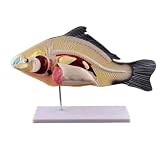
- Complete Anatomical Model - Includes a life-size model of a whole fishi, with one side displaying the external coloration and the other side revealing detailed internal anatomical structures
- Essential Teaching Tool - This model demonstrates the important internal organs of fish, such as the respiratory system, the circulatory system and the basic physiological structure of fish
- Removable Internal Organs - Adult fish specimens are an anatomical benchmark, an exquisite finish, can be divided into 3 parts.The aquatic anatomy is an important part of animal anatomy
- Premium Material - The model is made of high quality ecological PVC, purely hand painted, durable and long service life and comes with a sturdy base for display
- Wide Application - Very suitable for school education, learning, research display and can also be used as an important supplement for laboratory decorations, also is a rare product in the teaching of aquaculture
Product prices and availability are accurate as of the date/time indicated and are subject to change. Any price and availability information displayed on Amazon at the time of purchase will apply.




