What’s actually slowing this PC down?
Pick the symptom - the matching free tool is one click away.
Most aquarium flatworms do not harm adult fish. The important exception is a predatory planarian: confirmed planaria can injure or eat shrimp, fish fry and eggs. Because harmless rhabdocoelas and other organisms can look similar, identify the animal before choosing a treatment—especially in a tank containing shrimp or snails.
What “flatworm” means in an aquarium
“Flatworm” is a broad description, not a diagnosis. Aquariums can contain planaria, harmless rhabdocoelas, detritus worms, leeches, hydra and shrimp-associated organisms that differ in appearance, behavior and risk. A white worm on the glass is therefore not automatically a dangerous planarian.
How to tell planaria from harmless look-alikes
Planaria
Aquarium Science describes planaria as having “a distinct triangular head and two tiny black eyes.” Look for an arrow- or wedge-shaped front end with two dark eyespots. Planaria usually move by slow gliding over glass, plants or substrate on a mucus film rather than by rapidly wriggling through the water.
Rhabdocoelas
Rhabdocoelas are generally smaller, white or translucent flatworms with rounded heads and no pointed “ears.” The same guide describes them as completely harmless in aquariums. Their rounded head is a useful clue, but very small animals can be difficult to identify from a quick view, so treat the identification as provisional.
#1 Best Overall

- The flatworm exit is effective in removing flatworms
- The flatworm exit will start to work in thirty minutes
- Add the flatworm exit to the high flow area of the tank for maximum results
Movement-based checks for other organisms
- Detritus worm: typically thin and rapidly wriggling or curving through the water or substrate.
- Leech: often loops, stretches and contracts, or swims freely; leeches may arrive with live blackworms, bloodworms or tubifex.
- Hydra: remains attached at one end and waves tentacles in the water column.
These distinctions are summarized in aquarium pest guidance. Each organism requires a different control decision, so do not dose a tank solely because a worm is visible.
Which aquarium animals are at risk?
Adult fish
The available husbandry guidance does not identify ordinary adult aquarium fish as the main target of free-living planaria. Finding planaria is therefore not the same as finding a fish parasite or an immediate threat to healthy adult fish. Remove uneaten food and organic debris, and continue observing fish for injury or unusual behavior.
Rank #2
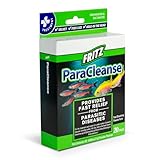
- Broad-Spectrum Parasite Treatment: Fritz ParaCleanse is expertly formulated to treat a wide range of parasitic diseases in aquarium fish, including velvet (Oodinium), hole-in-the-head disease (Hexamita & Spironucleus), fish lice, and gill & skin flukes (Dactylogyrus & Gyrodactylus), ensuring a healthy environment for your fish
- Safe for both freshwater and saltwater systems, this treatment does not, harm plants, invertebrates, or uninfected fish
- Dual Active Ingredients: Containing Metronidazole and Praziquantel, Fritz ParaCleanse is effective against a variety of common parasites in fish but also some internal bacterial infections
- User-Friendly Dosing: The pre-measured easy dosing packets simplifies the application process. Bulk jars are also available for larger systems
- Specific Treatment Indications: While highly effective against specific parasites, it is important to note that ParaCleanse does not treat Nematodes or Roundworms. For these, Fritz Expel-P is recommended
Shrimp
Predatory planaria are a serious concern in shrimp aquariums. Some species can secrete substances that stun and paralyze arthropods such as shrimp, allowing a planarian to consume prey larger than itself. Shrimplets and weakened or recently molted shrimp are especially vulnerable because they cannot escape or defend themselves effectively.
Fish fry and eggs
Some planaria eat fish larvae and eggs. A breeding tank with free-swimming fry, spawning mops or exposed eggs deserves more urgent investigation than a display tank containing only adult fish.
Rank #3

- Trusted Brand- Cloverleaf is a recognized and reputable brand in the aquarium industry, trusted by fush enthusiats for producing high quality, effective treatment solutions.
- l
- Safe For Aquarium Use- The formula is specifically crafted to be safe for use in both aquarium and pond environments. Safe to use on most tropical fish and salt water fish. Will not harm plants, or chemical filtration. Can be used in conjunction with other medications. No need to remove or unplug your UV sterilizer (just remove any activated carbon for full effect).
- Easy To Use- This fish wormer is simple to administer, with clear instructions for dosage based on the size of your tank, making treatment hassle free.
- Prevents Future Infections- Regular use of Cloverleaf Absolute Plus Wormer can help prevent reinfection, promoting long-term health for your fish.
Snails and other invertebrates
Planaria can eat small snails, but treatment may pose a greater risk than the worm itself. Fenbendazole can kill some snails and sensitive shrimp, and copper at ordinary ich-treatment strength will kill shrimp. Preserve valuable invertebrates by identifying the pest and checking the product label before medicating.
Are all organisms called “planaria” dangerous?
No. “Planaria” is often used loosely for several species, and the researched guidance notes that some white planaria are harmless. A triangular head, two eyespots and slow surface-gliding behavior make predatory planaria more likely, but they do not establish the species or its exact behavior. If the head is rounded and the animal is tiny and translucent, rhabdocoela is a better fit. When the evidence is unclear, use physical removal and observation before applying an invertebrate-toxic drug.
Rank #4

- Prevent nasty parasites from your Discus, Angel fish and other prized aquarium fish. It is harmless to most fresh water tropical fish.
- Flubendazole is the effective main active ingredient, and works differently to other Fluke treatments by gently starving the parasite; making this product perfectly safe for regular usage.
- Wormer Plus cleverly balances out its ingredients making very little (if any) difference to PH when using wormer plus.
- Safe to use on most tropical fish and salt water fish. Will not harm plants, or chemical filtration. Can be used in conjunction with other medications. No need to remove or unplug your UV sterilizer (just remove any activated carbon for full effect).
- Effective for use against Gill Flukes, Body Flukes, Parasites, Intestinal Helminths. Including Tapeworm, Nematodes (Roundworms), Planaria (Flatworms), Capillaria, Camallanus Nematodes, Metacercaria, Sanguinicola and Intestinal Protozoa. It is also an effective in eradicating pest snails from your tank.
Ways to reduce or eliminate confirmed planaria
1. Start with physical control
Use a commercial or homemade bait trap to draw planaria out overnight, then remove the trap and discard its contents. Trapping lowers numbers and is the lowest-impact option for a mixed community, but it cannot guarantee eradication because animals can remain in the substrate, plants or filter.
2. Choose medication around your livestock
| Method | Expected benefit | Main risks and limits | Mixed shrimp/snail tank? |
|---|---|---|---|
| Bait trap | Reduces visible planaria without adding medication | Does not reliably remove every worm or egg; repeated trapping may be needed | Generally the least disruptive first step |
| Praziquantel (for example, PraziPro, Fish Tapes, Tremazol or Fish Tapes Forte) | Described by the cited aquarium guides as effective against flatworms and the preferred medication when snails or shrimp are present | Follow the exact label dose, remove or disable incompatible filtration as directed, and monitor livestock; product formulations and approvals vary by region | Potentially compatible, but never assume safety beyond the label and your species |
| Fenbendazole | Reported as more lethal to planaria than praziquantel | May kill some snails and sensitive shrimp; residues can persist | Usually a poor choice when invertebrates must be preserved |
| Copper | Broad antiparasitic activity | Copper at reasonable ich-treatment strength kills shrimp and is unsuitable for invertebrate tanks | No, if shrimp or other invertebrates are present |
| No-Planaria | Betel-nut extract marketed to target planaria | Check the exact formulation, local labeling and livestock warnings before use | Depends on the product label and animals in the tank |
3. Plan for hatching eggs
Aquarium Science advises that repeated treatment may be necessary because planarian eggs can hatch over a prolonged period, giving a maximum interval of up to 48 days on that source’s guidance. Treat this as source-specific husbandry advice, not a universal laboratory constant. Follow the product label for retreatment timing, and do not redose early simply because you still see a worm unless the label or an aquatic veterinarian directs you to do so.
Free tools Windows power users keep installed
One-click scans. No signup required.
Best Value

- For treatment of praziquantel-susceptible disease conditions in pond, freshwater and marine aquariums and ornamental pond fishes.
- For disease conditions caused by flukes, tapeworm, flatworm and turbellarians
- Oxybispropanol and <5percentage praziquantel by weight
A safer treatment procedure for a community aquarium
- Confirm the target: photograph the head and movement under good lighting; check for the triangular head and two eyespots before calling it planaria.
- Protect livestock: count shrimp, snails, fry and eggs, and move particularly valuable or sensitive animals to an established quarantine container if the chosen label permits and your setup can support them.
- Trap first: run a bait trap for several nights and siphon visible worms and debris.
- Read the entire label: verify active ingredient, dose, water-volume calculation, required water changes, filtration instructions and warnings for mollusks and crustaceans.
- Monitor during treatment: watch for lethargy, failed molts, snail inactivity, oxygen stress or unexpected water-quality changes; stop and perform the label-directed water change if a product warning is triggered.
- Repeat only as directed: continue observation after treatment because eggs may hatch later, and remove dead organisms promptly.
Scutariella and other shrimp-associated flatworm-like organisms
Scutariella japonica is described in the fluke guidance as a small white, flatworm-like organism that attaches to shrimp or crayfish and feeds on detritus; that source generally characterizes it as harmless. It is not the same control problem as free-living predatory planaria. A worm attached to a shrimp should therefore be identified separately rather than automatically treated as planaria.
When to seek specialist help
- You cannot distinguish a pointed head from a rounded one even with a close photograph.
- Shrimp, snails or fry are dying and the cause is not confirmed.
- A medication label does not clearly state safety for your species or region.
- Symptoms continue after a correctly completed treatment and water-quality checks.
An aquatic veterinarian or experienced aquarium professional can examine a specimen and design a treatment that accounts for the entire community, not just the visible worm.
Quick Recap
Product prices and availability are accurate as of the date/time indicated and are subject to change. Any price and availability information displayed on Amazon at the time of purchase will apply.